
NEW: Please subscribe to my Substack/newsletter at the bottom of the page. Thanks!
Hebrew Ancient and
Near-East Cosmology
 |
| Click to view with captions Tom-L, CC BY 4.0, via “Wikimedia Commons” https://commons.wikimedia.org/wiki/File: Early_Hebrew_Conception_of_the_Universe.svg |
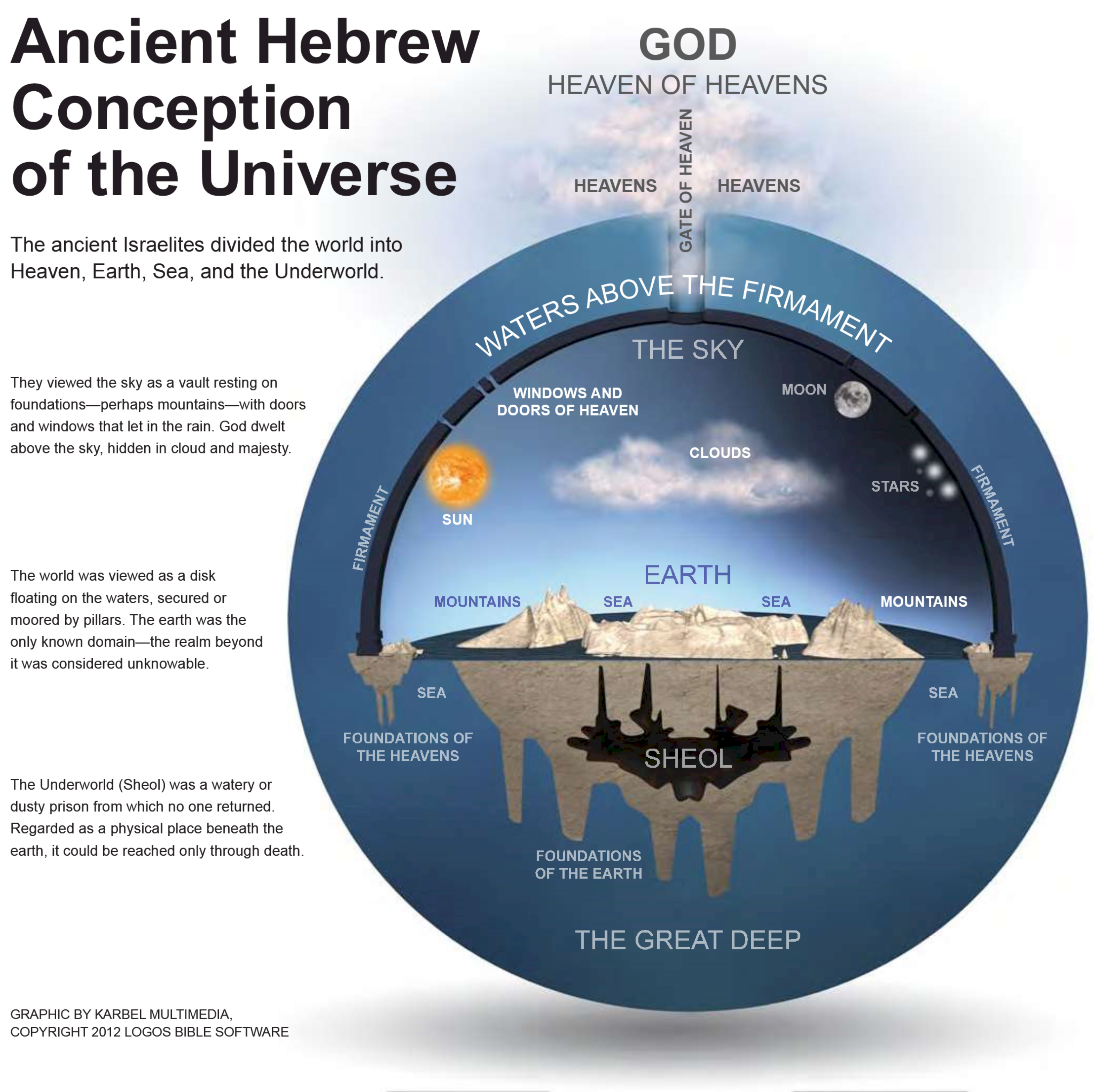
 This image depicts (in
general) the Hebrew and Ancient Near-East (ANE) concept of their
universe. They viewed their earth as essentially flat, supported
by the Pillars of the Earth. Above the earth was a solid, rotating
bowl-shaped, Firmament which rested upon high mountains at the
edges of the earth. The sun, moon, and stars were affixed to the
Firmament, the rotation of which caused the lights in the sky to
move.
This image depicts (in
general) the Hebrew and Ancient Near-East (ANE) concept of their
universe. They viewed their earth as essentially flat, supported
by the Pillars of the Earth. Above the earth was a solid, rotating
bowl-shaped, Firmament which rested upon high mountains at the
edges of the earth. The sun, moon, and stars were affixed to the
Firmament, the rotation of which caused the lights in the sky to
move.
Above the firmament were the Waters of the Upper Seas or Waters above the Firmament, and below the pillars of the earth were the waters of the Great Deep. Between the earth and the Great Deep were the Fountains of the Deep or Fountains of the Great Deep (Gen. 7:11), which allowed the waters of the Great Deep to flow up and water parts of the earth.
The gods (or “sons of God,” the b'nei Elohim) and various other “classes” (“species”?) of spirit beings resided in Chambers in the Heavens, ruled over by the one supreme God over all.[1] Deep in the earth was the cavernous Sheol (שְׁא֣וֹל), the dwelling of the dead. Sheol was divided into two chambers, which were separated by “a great chasm” (Luke 16:26). The righteous dead resided in the pleasant of the two chambers, known as Abraham’s Bosom; the unrighteous dead were in conscious torment in the other unnamed chamber of Sheol. (See Luke 16:19-31)
Below Sheol, or more likely beneath the Great Deep, lay the Abyss, Hebrew Abaddon (אֲבַדּֽוֹן) or Greek Tartarus (ταρταρός) or Gehenna (γέεννα),[3] the place of utter ruin, death, desolation, or destruction. There is a spiritual being who rules over Abaddon, who is called a king in the book of Revelation. The “angel”[2] of the Abyss is called Destruction or Destroyer (or sometimes called Abaddon) because his task is to oversee the devastation of the inhabitants of the earth, although it is curious that his minions are allowed only to torture and not to kill (Rev. 9:5). His identity is a matter of dispute. Some make him Satan himself, while others take him to be only one of Satan’s many evil subordinates. Many of the b'nei Elohim who rebelled against Yehovah are bound in “eternal restraints” (Jude 1:6; 2 Pet. 2:4) in the Abyss, while others are free to roam the earth in pursuit of Satan’s objectives.
“In the Book of Revelation (Rev. 9:1-11), when John sees his vision of the fifth trumpet blowing, a vast horde of demonic horsemen is seen arising from the newly opened abyss. They are sent forth to torment the unfortunate inhabitants of earth, but not to kill them. They have a ruler over them, called a king (βασιλέα [basilea]), the angel of the abyss, whose name is given in both Hebrew and Greek. In Hebrew it is Abaddon [אֲבַדּֽוֹן] and in Greek Apollyon [Ἀπολλύων], both words meaning Destroyer or Destruction.” (Baker's Evangelical Dictionary of Biblical Theology - Abaddon)
1. For a discussion of the residents of the Unseen Realm, see “What the Torah Says About Spirit Beings” and related articles. [BACK]
2. Probably a ben Elohim. It is important to remember that when the Scriptures were being translated from Hebrew into Greek, owing to limitations of vocabulary, all the “white hat” spirit beings were classified as angelous (angels) and all the “black hat” spirit beings were classified as daimoniois (demons). More here. [BACK]
3. Greek Gehenna is a transliteration of the Hebrew term, Gêhinnōm, “the valley of Hinnom”) – Gehenna, i.e. hell (also referred to as the “lake of fire” in Revelation). Gehenna (“hell”), the place of post-resurrection torment (judgment), refers strictly to the everlasting abode of the unredeemed where they experience divine judgment in their individual resurrection-bodies. Each of the unredeemed receives one at the Great White Throne Judgment (Rev. 20:11-15), i.e. a body that “matches” their capacity for torment relating to their (unique) judgment. [BACK]
|
 |
Subscribe to my Substack/newsletter |

ANXIOUSLY WATCHING FOR MASHIACH’S RETURN,
SPEEDILY AND IN OUR DAY. MARANA, TA!


