
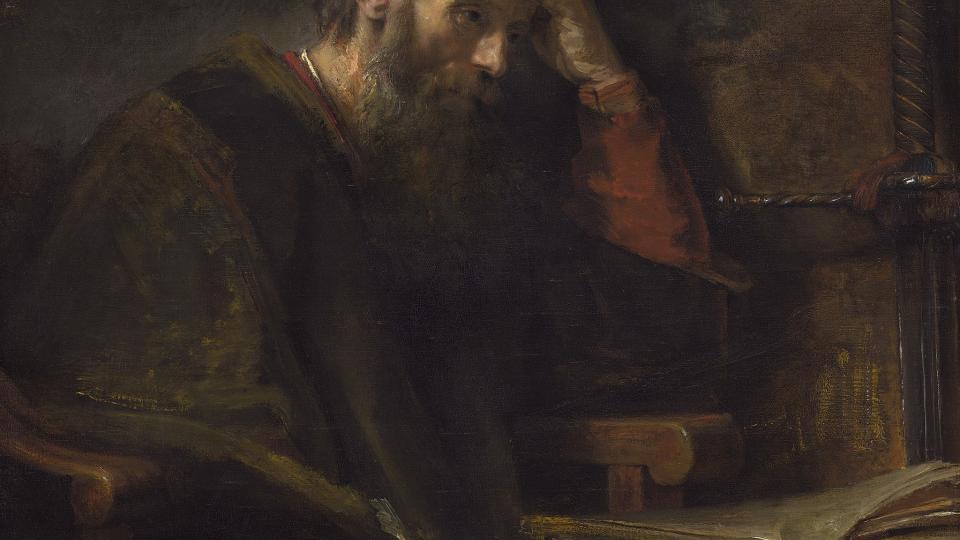
An introduction of Paul's epistle to the Galatians, identifying the author, the addrees, and the situation that occasioned its composition. This teaching is the first in a series of 26 sermons prepared and delivered to Beth Immanuel Messianic Synagogue in 2009 which First Fruits of Zion edited together into the book The Holy Epistle to the Galatians: Sermons on a Messianic Jewish Approach.
Fair Use Notice: Under the provisions of 17USC107 (the 1976 Copyright Act), allowance is made for “fair use” of copyrighted materials for purposes such as criticism, comment, news reporting, teaching, scholarship and research. This article is reproduced here without the permission of the author only for the purpose of education (teaching/scholarship). If you are the copyright owner and want this article removed, please contact me and I will immediately remove it. [Inclusion of this content does not necessarily indicate that I agree with the content or the author.]
Media Disclaimer: Presence of video or audio recordings on this website does not
necessarily indicate agreement with all (or any) of the speaker’s theological position.
Mirrored from
www.bethimmanuel.org/audio-series/galatians
Kind permission to share these messages is granted by the announcer at the beginning
of each message.
The teacher is Messianic Pastor Daniel Thomas Lancaster of
Beth Immanuel Messianic Synagogue,
828 3rd St. Hudson, WI.
He is also Director of Education at
First Fruits of Zion, editor of
Messiah Magazine,
and author of the
Torah Club commentaries and several books and study programs.
Order Daniel Lancaster’s books Holy Epistle to the Galatians (from
Amazon)
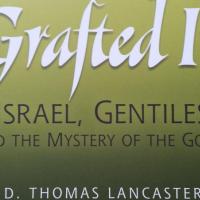
and/or Grafted In (from
Amazon)
Audio Series: Galatians






Has anyone ever warned you that you might be placing yourself under a curse by keeping the Torah? Paul says, "As many as are of the works of the law are under the curse" (Galatians 3:10). What's the "curse of the law" and how does it apply?

Paul says, "The Torah is not faith." This seems to imply that, if you want to be a person of faith, the one thing you chould not do is observe the Torah. Does this make sense? In Galatians 3:11-12, Paul quotes Leviticus 18:5 and Habakkuk 2:4 in a manner consistent with rabbinic interpretation to establish that it is not the hearers of the Torah who will be declared righteous but the doers of the Torah.

What does it mean that Messiah has become a curse? Paul says, "Messiah redeemed us from the curse of the Torah by becoming a curse for us" (Galatians 3:13). Paul reinvents a popular anti-Yeshua taunt derived from Deuteronomy 21:22-23 to argue that the Messiah's suffering and death releases those who rely upon him from the cruse of the Torah.

How long were the children of Israel in Egypt? Was it 430years? If so, how do we account for 430 years over only three generations? In Galatians 3, Paul employs a rabbinic tradition about the duration of Israel's sojourn in Egypt, interprets the "seed of Abraham" as a reference to Messiah, and compares the Torah to a competing inheritance document.

"We were held captive under the law ... imprisoned until the coming faith would be revealed ... but now that faith has come, we are no longer under a guardian" (Galatians 3:23-26). This difficult saying is understood to mean, "The Torah was only a guardian until faith in Messiah came, but now that the Messiah is here, we are no longer under the Torah's authority, therefore the Torah has been done away with." This teaching takes a look at Paul's analogy in which the Torah and Jewish status is compared to a paidagogos, a guardian-slave entrusted with the care and supervision of a child.

In Messiah, "there is neither Jew nor Greek," so that makes us all the same? Wrong! When Paul declares that there is no difference between Jew and Gentile in Messiah, he does not mean to imply that Jews and Gentiles forfeit their unique roles and identities. This important teaching compares "One New Man Theology" and "One Law Theology," revealing them to be two sides of the same coin of replacement theology.
One Law is the end of Jewish identity for Jewish believers. In its place comes a new pseudo-Jewish/Gentile identity in which differentiation between the two vanishes.

The Spirit of Messiah cries out from within the inner being of the believer, "Abba! Father!" Both Jewish and Gentile believers have received the adoption as sons, not just sons of Abraham, but as the sons of God. In this teaching from Galatians, Paul warns the God-fearers not to be enslaved again by the pagan elementary principles of the world thorugh observing days, months, season, and years.

Does Paul rebuke Gentiles for observing the biblical calendar? If not, how do we understand Galatians 4:9-10?
"How can you turn back again to the weak and worthless elementary principles of the world, whose slaves you want to be once more? You observe days and months and seasons and years!" (Galatians 4:9).

Was Paul in disguise? Paul says, "I have become all things to all people, that by all means I might save some." Did he adopt hypocritical pretenses in order to win people with the Gospel, acting like Jew around Jews and like a Gentile around Gentiles? This teaching on Galatians 4:12-20 considers Paul's evangelism strategies and the real meaning behind 1 Corinthians 9:19-23.

Does Hagar represent the Jews in slavery under the law while Sarah represents the Christians in freedom under grace? That's the conventional interpretation of Paul's parable in Galatians 4:22, but this teaching turns over that common interpretation by revealing the Jewish background to the story.
Page last updated on Monday, 23 February 2026 10:45 AM
|

ANXIOUSLY WATCHING FOR MASHIACH’S RETURN,
SPEEDILY AND IN OUR DAY. MARANA, TA!


