The summary of the entire Torah is as simple as this:
Love what HaShem loves; hate what HaShem hates.
All else is commentary.
דְּבָרִ֗ים • Devarim
(“Words”)
The Fifth Book of Moshe,
Commonly Called
Deuteronomy
פָּרָשָׁה דְּבּרִים
Parsha 44. Devarim |
|
|
This week’s commentary from First Fruits of Zion (Messianic) |
|
| This Week’s Reading Schedule | ||
|
Sunday Review and meditate on last week’s Parsha Monday Rishon [1st]: 1:1-11 Sheni [2nd]: 1:12-21 Tuesday Shlishi [3rd]: 1:22-38 R'vi'i [4th]: 1:39-2:1 Wednesday Chamishi [5th]: 2:2-30 Shishi [6th]: 2:31-3:14 |
Thursday Shvi'i [7th]: 3:15-19 Maftir [Concluding]: 3:20-22 Friday Haftarah: (Selections) Yesha‘yahu (Isaiah) 1:1–27 Ketuvei HaShalichim (Apostolic Writings) Basar: The Gospel Yochanan (John) 15:1–11 Kepherim: Letters (optional) Messianic Jews (Hebrews) 3:7–4:11 |
|
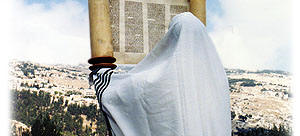
TorahThe Blessing of the TorahClick here to listen to this canted byCantor Kenneth B. Cohen of Temple Sholom, Greenwich, CT. |
|
| Aliya: (the one who “goes up” to read) | |
|
Bar-khu et Adonai
ham-vor-ack. (Praise ADONAI Who is worthy to be praised.) |

|
| Congregation: | |
|
Ba-rookh Adonai ham-vor-ack
ley-oh-lam vah-ed. (Praise ADONAI Who is worthy to be praised for all eternity.) |

|
| All: | |
|
Ba-rookh Adonai ham-vor-ack
ley-oh-lam vah-ed. (Praise ADONAI Who is worthy to be praised for all eternity.) |
|
|
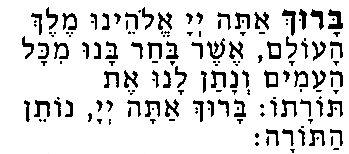
Ba-rookh ah-tah
Adonai, Eh-lo-hay-noo meh-lekh hah oh-lahm, ah-sher ba-char ba-noo me-kol ha-ahmeem, v’na-tahn lah-noo et torah-toe, ba-rookh ah-tah Adonai, no-tane hah-torah. Blessed are You, O Lord our God, King of the Universe, Who has chosen us from all peoples and given us His Torah. Blessed are You, O Lord, Giver of the Torah. |
 |

(i) 1 These are the words[1] which MosheMoses spoke to all Isra'el beyond the YardenJordan (River) in the wilderness, in the Arabah [MAP] near Suph [MAP], between Paran [MAP], Tophel [MAP], Laban [MAP], Hazeroth [MAP], and Dizahab [MAP]. 2 It is eleven days’ journey from Horeb [MAP] by the way of Mount Seir [MAP] to Kadesh Barnea. [MAP] 3 In the fortieth year,[3] in the eleventh month, on the first day of the month, Moshe spoke to the children of Isra'el according to all that ADONAI[GN] had given him in commandment to them, 4 after he had attacked Sihon the king of the Amorites[4a] who lived in Heshbon, and Og[4b] the king of Bashan who lived in Ashtaroth, at Edrei. 5 Beyond the Yarden, in the land of Mo’av, Moshe began to declare this torah,[GN] saying, 6 “When we were in Horeb, ADONAI Eloheinu[6] told us, ‘You have lived long enough at this mountain. 7 Turn, and take your journey, and go to the hill country of the Amorites and to all the places near there: in the Arabah, in the hill country, in the lowland, in the South, by the seashore, in the land of the Canaanites, and in Lebanon as far as the great river, the river Euphrates. 8 Look![GN] I have set the land before you. Go in and possess the land[8] which ADONAI swore to your fathers — Avraham, Yitz’chak, and Ya'akov — to give to them and to their descendants after them.’”
9 At that time I told you, “I am not able to bear you myself alone. 10 ADONAI Elohekemאֱלֹהֵיכֶ֖ם, your God has multiplied you, and look! today you are as numerous as the stars of the sky. 11 May ADONAI, the God of your fathers, make you a thousand times as many as you are and bless you, as He has promised you! (ii) 12 How can I myself alone bear your problems, your burdens, and your strife? 13 Take wise men of understanding who are respected among your tribes, and I will make them heads over you.”
14 You answered me, and said, “The thing which you have spoken is good to do.” 15 So I took the heads of your tribes, wise and respected men, and made them heads over you, captains of thousands, captains of hundreds, captains of fifties, captains of tens, and officers, according to your tribes. 16 I commanded your judges at that time, saying, “Hear cases between your brothers and judge righteously between a man and his brother, and the foreigner who is living with him. 17 You shall not show partiality in judgment; you shall hear the small and the great alike. You shall not be afraid of the face of man, for the judgment is God’s. The case that is too hard for you, you shall bring to me, and I will hear it.” 18 I commanded you at that time all the things which you should do. 19 We traveled from Horeb and went through all that great and terrible wilderness which you saw, by the way to the hill country of the Amorites, as ADONAI Eloheinu commanded us; and we came to Kadesh Barnea. 20 I told you, “You have come to the hill country of the Amorites, which ADONAI Eloheinu gives to us. 21 Look! ADONAI Elohekem has set the land before you. Go up, take possession, as ADONAI the God of your fathers has spoken to you. Don’t be afraid, neither be dismayed.”
(iii) 22 You came near to me, everyone of you, and said, “Let’s send men before us, that they may search the land for us, and bring back to us word of the way by which we must go up, and the cities to which we shall come.”
23 The thing pleased me well. I took twelve of your men, one man for every tribe. 24 They turned and went up into the hill country, and came to the valley of Eshcol, and spied it out. 25 They took some of the fruit of the land in their hands and brought it down to us, and brought us word again, and said, “It is a good land which ADONAI Eloheinu gives to us.”
26 But you wouldn’t go up. Instead you rebelled against the commandment of ADONAI Elohekem. 27 You complained in your tents, and said, “Because ADONAI hated us, He has brought us out of the land of Egypt, to deliver us into the hand of the Amorites to destroy us. 28 Where are we going up? Our brothers have made our heart melt, saying, ‘The people are greater and taller than we. The cities are great and fortified up to the sky. Moreover we have seen the sons of the Anakim there!’”
29 Then I said to you, “Don’t be terrified. Don’t be afraid of them. 30 ADONAI Elohekem, who goes before you, He will fight for you, just like He did for you in Egypt before your eyes, 31 and in the wilderness where you have seen how ADONAI Elohekem carried you, as a man carries his son, in all the way that you went, until you came to this place.”
32 Yet in this thing you didn’t believe ADONAI Elohekem, 33 Who went before you on the way, to seek out a place for you to pitch your tents in: in fire by night, to show you by what way you should go, and in the cloud by day. 34 ADONAI heard your words and was angry, and He swore, 35 “Surely not a single one of these men of this evil generation will see the good land which I swore to give to your fathers, 36 except KalevCaleb benthe son of Y’funehJephunneh. He will see it. I will give the land that he has trodden on to him and to his children, because he has followed ADONAI completely.”
37 And ADONAI was angry with me because of you, and He said, “You will not enter there either. 38 Y’hoshua[38] benthe son of Nun, your assistant, will enter there. So encourage him, because he will enable Isra'el to inherit it. (iv)39 Moreover, your little ones, whom you said would be captured or killed, and your children don’t yet good from evil, will go in there. I will give it to them as their possession. 40 But as for yourselves, turn around and head into the wilderness by the road to the Sea of SuphRed Sea.”
41 Then you answered and said to me, “We have sinned against ADONAI. We will go up and fight, according to all that ADONAI Eloheinu commanded us.” Every man of you put on his weapons of war, and presumed to go up into the hill country.
42 ADONAI said to me, “Tell them, ‘Don’t go up and don’t fight; for I am not among you, lest you be struck before your enemies.’”
43 So I told you that, but you didn’t listen. Instead, you rebelled against the orders of ADONAI, and were presumptuous, and went up into the hill country 44 where the Amorites who lived in that hill country came out against you and swarmed after you like bees, and they defeated you in Seir [MAP] and drove you back all the way to Hormah [MAP]. 45 You returned and wept before ADONAI, but ADONAI neither listened to what you said nor paid any attention to you. 46 So you stayed in Kadesh a long time, according to the days that you remained.
1. דְּבָרִ֗ים (d'varim), words [BACK]
2. We need to figure out why Mt. Sinai must be in modern Saudi Arabia and not near the southern tip of the Sinai peninsula, where many scholars have placed it. We have two ways of testing our theory. The first uses our Bible maps.
a. Horeb is the area around Mt. Sinai. This map gives two possible locations:
b. Mt. Seir (also known as Bozrah) [MAP] is south-east of the Dead Sea.
c. Kadesh-Barnea (also known as Zin) [MAP] is on the Sinai Peninsula close to the Mediterranean Sea.
d. “It is eleven days’ journey from Horeb by way of Mount Seir to Kadesh-Barnea” (Deut. 1:2). So, the trip is from Horeb (Mt. Sinai) to Mt. Seir and then to Kadesh-Barnea. If we went from the supposed Mt. Sinai location at the southern end of the Sinai Peninsula all the way north-east to Mt. Seir near the Dead Sea, and then back north-west all the way to Kadesh-Barnea close to the Mediterranean Sea, we would almost double our travel time. But if we travel from the Mt. Sinai location in Saudi Arabia to Kadesh-Barnea, then Mt. Seir is on our way.
We have a second way of testing our theory using only the Bible text.
a. Moses’ father-in-law, Jethro, was “the priest of Midian.” (Exod. 18:1)
b. “Now Moses was pasturing the flock of his father-in-law Jethro, the priest of Midian; and he led the flock to the west side of the wilderness and came to Horeb, the mountain of God” (where he encountered the “burning bush” (Exod. 3:1)
c. Midian is in modern Saudi Arabia.
d. Therefore, “Horeb [also known as Mt. Sinai], the mountain of God” is in Midian, which is in modern Saudi Arabia.
Now wasn’t that fun? This exercise is a simple illustration of why all the little details the Bible gives us are so important. (For example, in Deut. 1:3 Moses is careful to give us the exact date he began giving this extended lesson to the people of Israel.) It also demonstrates the value of taking our time to look at the maps and other tools that we have when we want to do serious Bible study.
3. That is, the 40th year since leaving Egypt. [BACK]
4a. The Amorites were a clan of Nephilim, or so-called “Giants,” the descendants of the benéi Elohim (sons of God) who “left their first estate” (Jude 1:6) and mated with human women (Gen. 6:1-4). A list of the clans of Nephilim is here, plus a discussion of their origin. [BACK]
4b. In Deut. 3:11 we are given the dimensions of Og’s bed: “his bed was a bed of iron; … Its length was nine cubits, and its width four cubits by the usual cubit.” The “usual cubit” is from the tip of a man’s elbow to the tip of his outstretched finger, or about 18 inches. Doing a bit of math, we find that “His bed was made of iron and was more than thirteen feet long and six feet wide” (Deut. 3:11 NLT). From this we can assume that Og stood about twelve feet tall. He was king of one of the “giant” clans. An important clue — which we will explore in detail — is found in chapter 2. [BACK]
6. The Hebrew word rendered Eloheinu is אֱלֹהֵ֖ינוּ (“our God”) from אֱלֹהִ֑ים, Elohim (“God”). [BACK]
8. At present there is a lot of argument going on about the extent of the land God actually has given to Israel as their permanent possession (Gen. 17:8). The text tells us: “On that day ADONAI made a covenant with Abram, saying, ‘To your descendants I have given this land, From the river of Egypt as far as the great river, the river Euphrates: …’” (Gen. 15:18) So there is no question that Israel’s land goes as far as the Euphrates River. The real question is what is meant by “the river of Egypt.” Is it the Nile River, or is it the Wadi el-Arish as some claim? You decide. [BACK]
38. יְהוֹשֻׁ֤עַ (yə·hō·wō·šu·a‘), Yehoshua or Yoshua = “ADONAI is salvation” or “ADONAI saves.” This is the name that Yosef (Mat 1:18-21 HNV) and Miryam (Luke 1:26-31 HNV) were instructed to name their Son, Yeshua. Yeshua is just a shortened form of Yehoshua. [BACK]
|