The summary of the entire Torah is as simple as this:
Love what HaShem loves; hate what HaShem hates.
All else is commentary.
דְּבָרִ֗ים • Devarim
(“Words”)
The Fifth Book of Moshe,
Commonly Called
Deuteronomy
Parsha 44. Devarim
“Words” (continued)

1 Then we turned, and went up the way to Bashan. Og the king of Bashan came out against us, he and all his people, to battle at Edrei. 2 ADONAI said to me, “Don’t fear him; for I have delivered him, with all his people and his land, into your hand. You shall do to him as you did to Sihon king of the Amorites,[GN] who lived at Heshbon.”
3 So ADONAI[GN] Eloheinuאֱלֹהֵ֖ינוּ, our God also delivered into our hand Og, the king of Bashan, and all his people. We struck him until no one was left to him remaining. 4 We took all his cities at that time. There was not a city which we didn’t take from them: sixty cities, all the region of Argob, the kingdom of Og in Bashan. 5 All these were cities fortified with high walls, gates, and bars, in addition to a great many villages without walls. 6 We utterly destroyed them, as we did to Sihon king of Heshbon, utterly destroying every inhabited city, with the women and the little ones. 7 But all the livestock, and the plunder of the cities, we took for plunder for ourselves. 8 We took the land at that time out of the hand of the two kings of the Amorites who were beyond the Yarden, from the valley of the Arnon to Mount Hermon. 9 (The Sidonians call Hermon Sirion, and the Amorites call it Senir.) 10 We took all the cities of the plain, and all Gilead, and all Bashan, to Salecah and Edrei, cities of the kingdom of Og in Bashan. 11 (For only King Og of Bashan remained of the remnant of the Rephaim.[GN] Hinneh! his bedstead was a bedstead of iron. Isn’t it in Rabbah of the children of Ammon? Nine cubits[GN] [13.5 ft.] was its length, and four cubits [6 ft.] its width, after the cubit [18 inches] of a man.) 12 This land we took in possession at that time: from Aroer, which is by the valley of the Arnon, and half the hill country of Gilead with its cities, I gave to the Reubenites and to the Gadites; 13 and the rest of Gilead, and all Bashan, the kingdom of Og, I gave to the half-tribe of Manasseh — all the region of Argob, even all Bashan. (The same is called the land of Rephaim. 14 Jair ben of Manasseh took all the region of Argob, to the border of the Geshurites and the Maacathites, and called them, even Bashan, after his own name, Havvoth Jair, to this day.)
(vii) 15 I gave Gilead to Machir. 16 To the Reubenites and to the Gadites I gave from Gilead even to the valley of the Arnon, the middle of the valley, and its border, even to the river Jabbok, which is the border of the children of Ammon; 17 the Arabah also, and the Yarden and its border, from Chinnereth even to the sea of the Arabah, the Salt Sea, under the slopes of Pisgah eastward.
18 I commanded you at that time, saying, “ADONAI Elohekem has given you this land to possess it. All of you men of valor shall pass over armed before your brothers, the children of Isra'el. 19 But your wives, and your little ones, and your livestock, (I know that you have much livestock), shall live in your cities which I have given you, (Maftir) 20 until ADONAI gives rest to your brothers, as to you, and they also possess the land which ADONAI Elohekemאֱלֹהֵיכֶ֖ם, your God gives them beyond the Yarden. Then you shall each return to his own possession, which I have given you.”
21 I commanded Y’hoshua at that time, saying, “Your eyes have seen all that ADONAI Elohekem has done to these two kings. So shall ADONAI do to all the kingdoms where you go over. 22 You shall not fear them; for ADONAI Elohekem himself fights for you.”
The Blessing After TorahClick this to hear the blessing canted by Cantor Kenneth B. Cohen of Temple Sholom, Greenwich, CT |
|
|
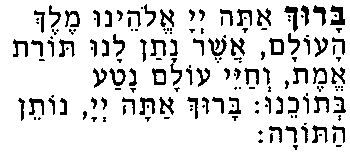
Ba-rookh ah-tah Adonai,
eh-lo-hay-noo meh-lech hah-ohlahm, ah-sher nah-tahn la-noo toe-raht eh-met, v’cha-yaye oh-lahm nah-tah b’toe-chay-noo. Ba-rookh ah-tah Adonai, no-tain ha-to-rah. Blessed are you, O Lord our God, King of the Universe, Who has given us a Torah of truth, and has planted eternal life in our midst. Blessed are You, O Lord, Giver of the Torah. |
|
Now that you've read Parsha Devarim, listen to
Rabbi Greg Hershberg teach from the text
Haftarah
The Blessing of the Haftarah
|
|
|
Ba-rookh, ah-tah Adonai, eh-lo-hay-noo, Ba-rookh ah-tah, Adonai, Blessed are you, O Lord our God, Blessed are You, O Lord, |

|
Haftarah Devarim is Yesha‘yahu (Isaiah) 1:1–27
1 The vision of Yesha‘yahu ben Amotz, which he saw concerning Y'hudah and Jerusalem, in the days of Uzziah, Jotham, Ahaz, and Hezekiah, kings of Y'hudah.
and listen, earth; for ADONAI has spoken:
“I have nourished and brought up children
and they have rebelled against me.
and the donkey his master’s crib;
but Isra'el doesn’t know.
My people don’t consider.”
a people loaded with iniquity,
offspring of evildoers,
children who deal corruptly!
They have forsaken ADONAI.
They have despised the Holy One of Isra'el.
They are estranged and backward.
5 Why should you be beaten more,
that you revolt more and more?
The whole head is sick,
and the whole heart faint.
6 From the sole of the foot even to the head there is no soundness in it,
but wounds, welts, and open sores.
They haven’t been closed, bandaged, or soothed with oil.
Your cities are burned with fire.
Strangers devour your land in your presence
and it is desolate,
as overthrown by strangers.
8 The daughter of Zion is left like a shelter in a vineyard,
like a hut in a field of melons,
like a besieged city.
9 Unless ADONAI-Tzva’ot had left to us a very small remnant,
we would have been as Sodom.
We would have been like Gomorrah.
10 Hear ADONAI’s word, you rulers of Sodom!
Listen to the law of our God, you people of Gomorrah!
11 “What are the multitude of your sacrifices to me?” says ADONAI.
“I have had enough of the burnt offerings of rams
and the fat of fed animals.
I don’t delight in the blood of bulls,
or of lambs,
or of male goats.
12 When you come to appear before me,
who has required this at your hand, to trample my courts?
13 Bring no more vain offerings.
Incense is an abomination to me.
New moons, Sabbaths, and convocations—
I can’t stand evil assemblies.
14 My soul hates your New Moons and your appointed feasts.
They are a burden to me.
I am weary of bearing them.
15 When you spread out your hands, I will hide my eyes from you.
Yes, when you make many prayers, I will not hear.
Your hands are full of blood.
16 Wash yourselves. Make yourself clean.
Put away the evil of your doings from before my eyes.
Cease to do evil.
Seek justice.
Relieve the oppressed.
Defend the fatherless.
Plead for the widow.”
18 “Come now, and let’s reason together,” says ADONAI:
“Though your sins are as scarlet, they shall be as white as snow.
Though they are red like crimson, they shall be as wool.
19 If you are willing and obedient,
you will eat the good of the land;
20 but if you refuse and rebel, you will be devoured with the sword;
for ADONAI’s mouth has spoken it.”
21 How the faithful city has become a prostitute!
She was full of justice.
Righteousness lodged in her,
but now there are murderers.
22 Your silver has become dross,
your wine mixed with water.
23 Your princes are rebellious and companions of thieves.
Everyone loves bribes and follows after rewards.
They don’t defend the fatherless,
neither does the cause of the widow come to them.
24 Therefore the Lord, ADONAI-Tzva’ot,,
the Mighty One of Isra'el, says:
“Ah, I will get relief from my adversaries,
and avenge myself on my enemies.
25 I will turn my hand on you,
thoroughly purge away your dross,
and will take away all your tin.
26 I will restore your judges as at the first,
and your counselors as at the beginning.
Afterward you shall be called ‘The city of righteousness,
a faithful town.’
27 Zion shall be redeemed with justice,
and her converts with righteousness.
Ketuvei HaShalichim (Apostolic Writings)
The Blessing of the Ketuvei HaShalichimClick this to hear the blessing canted by Jeremiah Greenberg of Messianic Liturgical Resources. Page numbers refer to his Messianic Shabbat Siddur. |
|
|
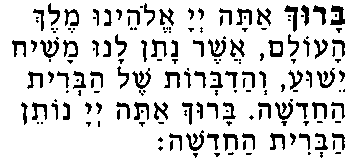
Bah-rookh ah-tah Adonai, Eh-lo-hay-noo meh-lekh hah-ohlahm, ah-shehr nah-tahn la-noo mah-she-ahch Yeshua, v’ha-deebrote shell Ha-breet Ha-kha-da-shah, ba-rookh ah-ta Adonai, notain Hah-breet Hah-kha-da-shah. Blessed are You, O Lord our God, |
 |
Basar
(Gospel)
Yochanan (John) 15:1–11
1“I am the true vine, and my Father is the farmer. 2Every branch in Me that doesn’t bear fruit, He cuts off, but every branch that bears fruit, He prunes,[2] to make it even more fruitful. 3You are already pruned clean because of the word I have spoken to you. 4Remain in Me, and I will remain in you. Just as the branch can’t bear fruit by itself unless it remains in the vine, neither can you near fruit unless you remain in Me. 5I am the vine, you are the branches. He who remains in Me and I in him bears much fruit, for apart from Me you can do nothing. 6If a man doesn’t remain in Me, he is thrown away as a branch and withers. Such branches are gathered up, thrown into the fire, and burned. 7If you remain in Me and My words remain in you, ask whatever you intend and it will be done for you.
8“My Father is glorified in this, that you bear much fruit and prove yourselves to be my talmidimdisciples. 9As the Father has loved Me, so I have loved you. Remain in My love. 10If you keep My mitzvotcommandments,[10a] you will remain in My love, just as I have kept my Father’s mitzvot[10b] and remain in His love. 11I have told you these things so that My joy may remain in you, and that your joy may be made complete.[11]
Kepherim (Letters, optional)
Messianic Jews (Hebrews) 3:7–4:11
3: 7 Therefore, just as the Ruach HaKodeshHoly Spirit says,
“Today if you will hear his voice,
8 don’t harden your hearts as in the rebellion,
in the day of the trial in the wilderness,
9 where your fathers tested Me and tried Me,
and saw My deeds for forty years.
10 Therefore I was displeased with that generation,
and said, ‘They always err in their heart,
but they didn’t know my ways.’
‘They will not enter into my rest.’”
12 Beware, brothers, lest perhaps there might be in any one of you an evil heart of unbelief, in falling away from the living God; 13 but exhort one another day by day, so long as it is called “today”, lest any one of you be hardened by the deceitfulness of sin. 14 For we have become partakers of Mashiach, if we hold the beginning of our confidence firm to the end, 15 while it is said,
“Today if you will hear his voice,
don’t harden your hearts, as in the rebellion.”
16 For who, when they heard, rebelled? Wasn’t it all those who came out of Egypt led by Moshe? 17 With whom was He displeased forty years? Wasn’t it with those who sinned, whose bodies fell in the wilderness? 18 To whom did He swear that they wouldn’t enter into his rest, but to those who were disobedient? 19 We see that they weren’t able to enter in because of unbelief.
4: 1 Let’s fear therefore, lest perhaps anyone of you should seem to have come short of a promise of entering into His rest. 2 For indeed we have had Good News preached to us, even as they also did, but the word they heard didn’t profit them, because it wasn’t mixed with faith by those who heard. 3 For we who have believed do enter into that rest, even as He has said,
“As I swore in My wrath,
they will not enter into My rest;”
although the works were finished from the foundation of the world. 4 For He has said this somewhere about the seventh day,
“God rested on the seventh day from all His works;”
“They will not enter into My rest.”
6 Seeing therefore it remains that some should enter into it, and they to whom the Good News was preached before failed to enter in because of disobedience, 7 He again defines a certain day, “today”, saying through David so long a time afterward (just as has been said),
“Today if you will hear His voice,
don’t harden your hearts.”
8 For if Joshua had given them rest, He would not have spoken afterward of another day. 9 There remains therefore a Sabbath rest for the people of God. 10 For he who has entered into His rest has himself also rested from his works, as God did from His. 11 Let’s therefore give diligence to enter into that rest, lest anyone fall after the same example of disobedience.
The Blessing After the Ketuvei HaShalichimClick this to hear the blessing canted by Jeremiah Greenberg of Messianic Liturgical Resources. Page numbers refer to his Messianic Shabbat Siddur. |
|
|
Ba-rookh ah-tah, Adonai Eh-lo-hay-noo, Blessed are You, O Lord our God, |
 |
The Blessing of the MessiahClick this to hear the blessing canted by Jeremiah Greenberg of Messianic Liturgical Resources. Page numbers refer to his Messianic Shabbat Siddur. |
|
|
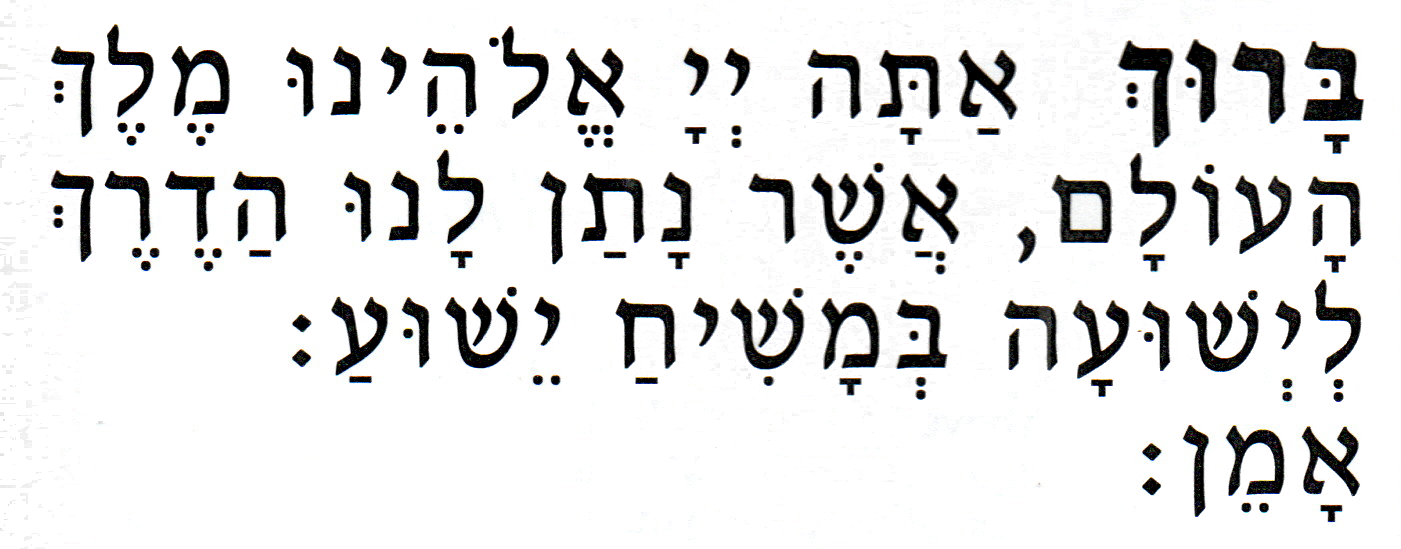
Ba-rookh ah-tah Adonai Eh-lo-hay-noo,
meh-lekh hah-oh-lahm, ah-sher na-tahn la-noo ha-deh-rech l'y'shoo-ah b'ma-she-ahch Yeshua. Ah-mein. Blessed are You, O Lord our God,
King of the Universe, |
 |

פָּרָשָׁה וָאֶתְחַנַּן
Parsha 45. Va’etchanan |
|
|
This week’s commentary from First Fruits of Zion (Messianic) |
|
| This Week’s Reading Schedule | ||
|
Sunday Review and meditate on last week’s Parsha Monday Rishon [1st]: 3:23-4:4 Sheni [2nd]: 4:5-40 Tuesday Shlishi [3rd]: (A) 4:41-49 Shlishi [3rd]: (S) 5:1-18(21) R'vi'i [4th]: (A) 5:1-18(21) R'vi'i [4th]: (S) 5:19(22)-6:3 Wednesday Chamishi [5th]: (A) 5:19(22)-6:3 Chamishi [5th]: (S) 6:4-9 Shishi [6th]: (A) 6:4-25 Shishi [6th]: (S) 6:10-25 |
Thursday Shvi'i [7th]: 7:1-8 Maftir [Concluding]: 7:9-11 Friday Haftarah: (Selections) Yesha‘yahu (Isaiah) 40:1–26 Ketuvei HaShalichim (Apostolic Writings) Basar: The Gospel Mattityahu (Matthew) 4:1–11; 22:33–40 Mark 12:28–34; Luke 4:1–13; 10:25–37 Kepherim: Letters (optional) Acts 13:13–43; Romans 3:27–31; 1 Timothy 2:4–6; Ya‘akov (James) 2:14–26 and all the readings for Parashah 17 |
|
TorahThe Blessing of the TorahClick here to listen to this canted byCantor Kenneth B. Cohen of Temple Sholom, Greenwich, CT. |
|
| Aliya: (the one who “goes up” to read) | |
|
Bar-khu et Adonai
ham-vor-ack. (Praise ADONAI Who is worthy to be praised.) |

|
| Congregation: | |
|
Ba-rookh Adonai ham-vor-ack
ley-oh-lam vah-ed. (Praise ADONAI Who is worthy to be praised for all eternity.) |

|
| All: | |
|
Ba-rookh Adonai ham-vor-ack
ley-oh-lam vah-ed. (Praise ADONAI Who is worthy to be praised for all eternity.) |
|
|
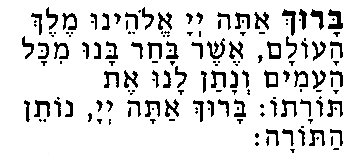
Ba-rookh ah-tah
Adonai, Eh-lo-hay-noo meh-lekh hah oh-lahm, ah-sher ba-char ba-noo me-kol ha-ahmeem, v’na-tahn lah-noo et torah-toe, ba-rookh ah-tah Adonai, no-tane hah-torah. Blessed are You, O Lord our God, King of the Universe, Who has chosen us from all peoples and given us His Torah. Blessed are You, O Lord, Giver of the Torah. |
 |
(1) 23 Then I begged ADONAI, 24 “Adonai ELOHIM, you have begun to show your servant your greatness, and your strong hand. For what god is there in heaven or in earth that can do works like yours, and mighty acts like yours? 25 Please let me go over and see the good land that is beyond the Yarden, that fine mountain, and Lebanon.”
26 But ADONAI was angry with me because of you, and didn’t listen to me. ADONAI said to me, “That is enough! Speak no more to me of this matter. 27 Go up to the top of Pisgah, and lift up your eyes westward, and northward, and southward, and eastward, and see with your eyes; for you shall not go over this Yarden. 28 But commission Y’hoshua, and encourage him, and strengthen him; for he shall go over before this people, and he shall cause them to inherit the land which you shall see.” 29 So we stayed in the valley near Beth Peor.
|