
NEW: Please subscribe to my Substack/newsletter at the bottom of the page. Thanks!
Parsha[GN] 17: Yitro (continued)
“Jethro,” Exod. 18:1-20:23(26)[a]
2. The Decalogue (Ten Commandments) (20:1-17)[b]
1 Elohim את
א 2 “I am ADONAI [GN] your Elohim, who brought you out of the land of Egypt, out of the house of slavery.
בּ 3 “You are to have no other gods before Me.[3] 4 You you are not to make for yourselves any carved image nor any kind of representation of anything that is in the heavens above or on the earth bneath, or is in the water below the shoreline.[4] 5 You are not to bow down to them or serve them, for I, ADONAI your Elohim, am a jealous God, punishing the children for the sins of the parents to the third and on the fourth generation of those who hate Me, 6 but showing loving kindness to thousandth generation of those who love Me[6] and obey My mitzvotcommands.
ג 7 “You are not use lightly the name of ADONAI your Elohim,[7] because ADONAI will not leave unpunished someone who uses His name lightly.
ד 8 “Remember the day, the Shabbat, to keep it set apart for Elohim. 9 You have six days in which to labor and do all your work, 10 but the seventh day is a Shabbat to ADONAI your Elohim. On it you are to do no kind of work; not you, nor your son, nor your daughter, your male servant, nor your female servant, nor your livestock, nor your stranger who is within your gates; 11 for in six days ADONAI made heaven and earth, the sea, and everything in them, but on seventh day he ceased working;[11] therefore ADONAI blessed the dy, the Shabbat, separated it to Himself.
ה 12 “Honor your father and your mother so that you may live long in the land which ADONAI your Elohim is giveing you.
ט 16 “Do not give false evidence against your neighbor.
י 17 (14) “Do not covet[17] your neighbor’s house; do not covet your neighbor’s wife, his male or female servant, his ox, his donkey, or anything that belongs to your neighbor.”
3. Moses Mediates Between God and Isra'el (20:18-21)
(A:vii) 18 (15) All the people witnessed the thunder, the lightning, the sound of the shofar, and the mountain smoking. When the people saw it, they trembled, and stayed at a distance. 19 (16) They said to Moshe, “Speak to us yourself, and we will listen; but don’t let Elohim speak with us, or we will die.”
20 (17) Moshe said to the people, “Don’t be afraid, for Elohim has come to test you, so that the fear of Him may be before you, to keep you from sinning.” 21 (18) The people stayed at a distance as Moshe approached the thick darkness where Elohim was.
4. The Book of the Covenant (20:22-23:33)
a. Idolatry Forbidden (20:22-26)
(A: Maftir) 22 (19) Then ADONAI said to Moshe, “This is what you are tell the Isra'elites: ‘You have seen for yourselves that I have spoken to you from heaven. 23 (20) You shall most certainly not make for yourselves gods of silver gold to rival Me.
(S: Maftir) 24 (21) You are to make an altar of earth for Me, and sacrifice on it your burnt offerings and your peace offerings, your sheep and goats and your cattle. In every place where I cause My name to be remembered I will come to you and I will bless you. 25 (22) And if you make an altar of stone for Me, you must not build it of cut stones; for if use a tool on it, you have polluted it. 26 (23) And you must not go up to My altar on steps, lest your nakedness be exposed on it.’
The Blessing After TorahClick this to hear the blessing canted by Cantor Kenneth B. Cohen of Temple Sholom, Greenwich, CT |
|
|
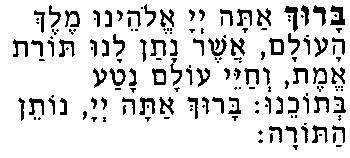
Ba-rookh ah-tah Adonai,
eh-lo-hay-noo meh-lech hah-ohlahm, ah-sher nah-tahn la-noo toe-raht eh-met, v’cha-yaye oh-lahm nah-tah b’toe-chay-noo. Ba-rookh ah-tah Adonai, no-tain ha-to-rah. Blessed are you, O Lord our God, King of the Universe, Who has given us a Torah of truth, and has planted eternal life in our midst. Blessed are You, O Lord, Giver of the Torah. |
|
Now that you’ve read
Yitro,
watch Rabbi Greg Hershberg’s teaching
Haftarah
The Blessing of the Haftarah
|
|
|
Ba-rookh, ah-tah Adonai, eh-lo-hay-noo, Ba-rookh ah-tah, Adonai, Blessed are you, O Lord our God, Blessed are You, O Lord, |

|
Haftarah Yitro is Shof'tim (Judges) 4:4–5:31 (A);
5:1-31 (S)
Listen to it read from the
Complete Jewish Bible
Haftarah Yitro is Yesha‘yahu (Isaiah) 6:1–7:6; 9:5–6 (A); 6:1–13 (S)
6 1 In the year that king Uzziah died, I saw ADONAI sitting on a throne, high and lifted up; and his train filled the temple. 2 Above him stood the seraphim.[GN] Each one had six wings. With two he covered his face. With two he covered his feet. With two he flew. 3 One called to another, and said,
- “Holy, holy, holy, is ADONAI Tzva’otof Hosts, or of Armies
- The whole earth is full of his glory!”
4 The foundations of the thresholds shook at the voice of him who called, and the house was filled with smoke. 5 Then I said, “Woe is me! For I am undone, because I am a man of unclean lips and I live among a people of unclean lips, for my eyes have seen the King, ADONAI Tzva’ot!”
6 Then one of the seraphim flew to me, having a live coal in his hand, which he had taken with the tongs from off the altar. 7 He touched my mouth with it, and said, “Hinneh,[GN] this has touched your lips; and your iniquity is taken away, and your sin forgiven.”
8 I heard ADONAI’s voice, saying, “Whom shall I send, and who will go for Us?”
Then I said, “Here I am. Send me!”
9 He said, “Go, and tell this people,
- ‘You hear indeed,
- but don’t understand.
- You see indeed,
- but don’t perceive.’
- 10 Make the heart of this people fat.
- Make their ears heavy, and shut their eyes;
- lest they see with their eyes,
- hear with their ears,
- understand with their heart,
- and turn again, and be healed.”
11 Then I said, “Lord, how long?”
He answered,
- “Until cities are waste without inhabitant,
- houses without man,
- the land becomes utterly waste,
- 12 and ADONAI has removed men far away,
- and the forsaken places are many within the land.
- 13 If there is a tenth left in it,
- that also will in turn be consumed,
- as a terebinth, and as an oak whose stump remains when they are cut down,
- so the holy seed is its stump.”
7 1 In the days of Achaz the benthe son of Yotam, ben ‘UziyahuUzziah, king of Y'hudahJudah, King Retzin of AramSyria and Pekach ben Remalyah, king of Isra'el, advanced on YerushalayimJerusalem to wage war against it, but could not conquer it. 2 David’s house was told that Aram and Efrayim had becomme allies. Achaz’s heart began to tremble, as did the hearts of his people, like the trees in the forest tremble with the wind.
3 Then ADONAI said to Yesha‘yahu, “Go out now to meet Achaz, you and your son Sh’ar Yashuv, at the end of the aquaduct rom the Upper Pool, on the road to the Launderer’s Field. 4 Tell him, ‘Be careful, and stay calm. Don’t be afraid; and don’t be demoralized by these two smoldering stumps of firewood, by the blazing anger of Retzin and Aram or by ben Remalyah; 5 or because Aram, Ephrayim, and ben Remaliah, have been plotted evil against you, thinking, 6 “Let’s invade Y'hudah, tear it apart, divide it among ourselves, and appoint the son of Tav'wl as king there.”
- 9 6 (5) For a child will born to us.
- A son will be given to us;
- and the government will be on his shoulders.
- He will be named Wonderful Counselor,
- Mighty God, Eternal Father, Prince of Peace.
- 7 (6) His government will be vast
- and its prosperity will never end.
- He will reign on David’s throne and over his kingdom,
- to establish it and to uphold it with justice and with righteousness
- from that time on and forever.
- The zeal of ADONAI-Tzva’otof Hosts, or of Armies
- will accomplish this.
Ketuvei HaShalichim (Apostolic Writings)
The Blessing of the Ketuvei HaShalichimClick this to hear the blessing canted by Jeremiah Greenberg of Messianic Liturgical Resources. Page numbers refer to his Messianic Shabbat Siddur. |
|
|
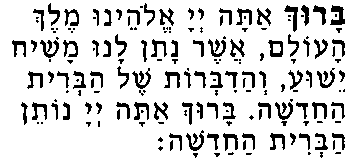
Bah-rookh ah-tah Adonai, Eh-lo-hay-noo meh-lekh hah-ohlahm, ah-shehr nah-tahn la-noo mah-she-ahch Yeshua, v’ha-deebrote shell Ha-breet Ha-kha-da-shah, ba-rookh ah-ta Adonai, notain Hah-breet Hah-kha-da-shah. Blessed are You, O Lord our God, |
 |
Basar
(Gospel)
The suggested reading from the Apostolic Writings is
Matthew 5:21–30; 15:1–11;
19:16–30; Mark 7:5–15;
10:17–31; Luke 18:18–30
Matthew 5
21“You have heard that our ancestors were told, ‘Do not murder’[21] and ‘Whoever murders will be in danger of judgment.’ 22But I tell you that anyone who is angry with his brother will be subject to judgment; and whoever calls his brother, ‘You good-for-nothing!’ will be brought before the Sanhedrin; and whoever says, ‘You fool!’ is in danger of the fire of Gie-Hinnom!
23“So if you are offering your gift at the Temple altar and remember that your brother has anything against you, 24leave your gift right there by the altar, and go and reconcile with your brother. Then come back and offer your gift. 25If someone sues you, come to terms with him quickly while you are on your way to court; otherwise the prosecutor may hand you over to the judge, and the judge may hand you over to the officer of the court, who may throw you into prison. 26I’m telling you the truth, there is no way that you will get out until you have paid the very last penny.
27“You have heard that our fathers were told ‘Do not commit adultery.’ 28but I tell you that everyone who gazes at a woman with the intent to lust after her has already committed adultery with her in his heart. 29If your right eye makes you sin, gouge it out and throw it away! It's better for you to lose one of your parts than for your whole body to be thrown into Gie-Hinnom. 30If your right hand makes you sin, cut it off and throw it away! It's better for you to lose one of your parts than for your whole body to be thrown into Gie-Hinnom.
1Then some PhariseesP'rushim and Scribes, Torah teachersSofrim from Yerushalayim came to Yeshua and asked Him, 2“Why do your disciplestalmidim disobey the TakanotTradition of the Elders? For they don’t wash their hands[2] before they eat.”
3Yeshua answered, “Really? Why do you disobey God’s commandment because of your TakanotTradition? 4For God commanded, ‘Honor your father and your mother,’ and, ‘He who speaks evil of father or mother, let him be put to death.’ 5But you say, ‘Anyone who tells his father or his mother, “Whatever help you might otherwise have gotten from me is a gift devoted to God,” 6he doesn’t need to honor his father or mother.’ You have nullified the word of God for the sake of your TakanotTradition. 7You hypocrites! IsaiahYesha'yahu was right about you when he prophesied,
8‘These people draw near to me with their mouth, and honor me with their lips; but their heart is far from me. 9And in vain do they worship me, teaching as doctrine rules made by men.’”
10He called the crowd to Him and said, “Listen and understand this! 11It isn’t what goes into his mouth that makes a man unclean; what makes a man unclean is what what comes out of his mouth.”
16Someone came to Him and asked, “Rabbi, what good thing do I need to do to have eternal life?”
17He said to him, Why are you asking me about what’s good? There is only One who is good. But if you want to enter into life, keep the commandments of Torahmitzvot.”
18Then he asked Him, “Which ones?”
Yeshua said, “‘Don’t murder.’ ‘Don’t commit adultery.’ ‘Don’t steal.’ ‘Don’t give false testimony.’ 19‘Honor your father and mother.’ And, ‘You shall love your neighbor as yourself.’”
20The young man said to Him, “I have kept all these things. What do I still lack?”
21Yeshua said to him, “If you want to be complete, go sell your possessions and give to the poor, and you will have treasure in heaven; and come, follow Me.” 22But when the young man heard this, he went away sad, for he was very wealthy. 23Then Yeshua said to his talmidim, “Truly I tell you, it’s hard for a rich man to enter the Kingdom of Heaven. 24Again I tell you, it is easier for a camel to go through the eye of a needle than for a rich man to enter the Kingdom of God.”
25When the talmidim heard this, they were amazed, and asked, “Then, who then can be saved?”
26Looking at them, Yeshua said, “With man it is impossible; but with God everything is possible.”
27Then Kefa said to Him, “Look, we have left everything and followed you. What then will there be for us?”
28Yeshua said to them, “Truly I tell you that in the regeneration, when the Son of Man sits on His glorious throne, you who have followed Me will also sit on twelve thrones, judging the twelve tribes of Yisra'el. 29Everyone who has left houses or brothers or sisters or father or mother or children or lands for My name’s sake will receive many times as much, and will inherit eternal life. 30But many who are first will be last; and many who are last will be first.
5The P'rushim and the Sofrim asked Yeshua, “Why don’t your disciples walk according to the Takanot of the elders instead of eating their food with unclean hands?”
6Yeshua answered, “Isaiah prophesied correctly about you hypocrites, as it is written,
8“For you disregard the commandments of God, and cling tightly to the Takanot of men.” 9He went on, “Full well do you reject the commandment of God, that you may keep your Takanot. 10For Moses said, ‘Honor your father and your mother;’ and, ‘He who speaks evil of father or mother, let him be put to death.’ 11But you say, ‘If a man tells his father or his mother, “Whatever benefit you might have received from me is Corban,”’” (that is to say, devoted to God) 12“then you no longer allow him to do anything for his father or his mother, 13nullifying the word of God by your Takanot which you have handed down. You do many things like this.”
14He called the crowd to Himself and said to them, “Hear me, all of you, and understand. 15Nothing that goes into a person from outside can defile him; but the things which come out of a person are the things that defile him.
17As He was starting out on His way, a man ran up to Him and knelt before Him. He asked Yeshua, “Good Rabbi, what must I do to inherit eternal life?”
18Yeshua answered him, “Why do you call me good? No one is good except one — God. 19You know the commandments: ‘Do not murder,’ ‘Do not commit adultery,’ ‘Do not steal,’ ‘Do not give false testimony,’ ‘Do not defraud,’ ‘Honor your father and mother.’”
20The man said to Him, “Rabbi, I have kept all these things from my youth.”
21Yeshua looked at him, loved him, and said to him, “You lack one thing. Go, sell whatever you have, and give to the poor, and you will have treasure in heaven; and come, take up your stauros,[GN] and follow Me.”
22But the man was saddened by these words, and he went away grieving, because he was very wealthy.
23Yeshua looked around and said to His talmidim, “How difficult it is for the wealthy to enter into the Kingdom of God!”
24The talmidim were amazed at His words. But Yeshua answered again, “Children, how hard it is to enter the Kingdom of God! 25It is easier for a camel to go through a needle’s eye than for a rich person to enter the Kingdom of God.”
26They were totally astonished, and asked Him, “Then who can be saved?”
27Yeshua looked at them and said, “With men it is impossible, but not with God, for all things are possible with God.”
28KefaPeter started to tell Him, “Hinneh,[GN] we have left everything and have followed you.”
29Yeshua said, “Most certainly[GN] I tell you, there is no one who has left house, or brothers, or sisters, or father, or mother, or wife, or children, or land, for My sake, and for the sake of the Good News, 30who will not receive a hundred times more now in the Olam Hazehpresent world: house, brothers, sisters, mothers, children, and land, with persecutions; and eternal life in the Olam Habaage to come. 31But many who are first will be last, and the last will be first.”
18One of the leaders asked Him, “Good Rabbi, what should I do to obtain eternal life?”
19Yeshua asked him, “Why are you calling Me good? No one is good except God alone. 20You know the mitzvotcommandments: ‘Don’t commit adultery,’ ‘Don’t murder,’ ‘Don’t steal,’ ‘Don’t give false testimony,’ ‘Honor your father and your mother.’”
21He said, “I have observed all these things from my youth up.”
22When Yeshua heard that, He told him, “You still lack one thing. Sell all that you have, and distribute it to the poor. You will have treasure in heaven. Come, follow me.”
23But when he heard that, he became very sad, for he was very rich.
24Yeshua looked at him and said, “It is so very hard for the very wealthy to enter into the Kingdom of God! 25It is easier for a kamelos25] to pass through a needle’s eye than for a rich man to enter into the Kingdom of God.”
26Those who heard this asked, “Then who can be saved?”
27Yeshua answered, “Things which are impossible with people are possible with God.”
37. Reward for sacrifice (vv 28-30)
28KefaPeter said, “Look, we have left everything we had and followed you.”
29Yeshua said to them, “I assure you that there is no one who has left a house, or a wife, or brothers, or parents, or children for the sake of the Kingdom of God, 30who will not receive many times more in the Olam Hazehthe present world and eternal life in the Olam Habaworld to come.”
Kepherim (Letters, optional) [SKIP THE OPTIONAL READINGS]
Acts 6:1–7;
Romans 2:17–29; 7:7–12;
13:8–10; Ephesians 6:1–3;
1Timothy 3:1–14
2Timothy 2:2; Titus 1:5–9;
Hebrews 12:18–29;
James 2:8–13; 1Peter 2:9–10
1Now in those days, as the number of talmidimdisciples was increasing, a complaint arose from the Greek-speaking Jews against the Hebrew-speakers, because their widows were being neglected in the daily food distribution. 2The Twelve summoned the assembly of the talmidim and said, “It is not appropriate for us to abandon the word of God to serve tables. 3Therefore, brothers, select from among yourselves seven men with good reputation who are full of Ruach HaKodesh and of wisdom, whom we may put in charge of this responsibility. 4But we will devote ourselves to prayer and the ministry of the word.”
5The whole assembly approved of the idea, so they chose Stephanos, a man full of faith and of Ruach HaKodesh, Philippos, Prochorus, Nicanor, Timon, Parmenas, and Nicolaus, a proselyte from Antioch. 6They brought these men to the Sh'liachimEmissaries, Apostles. After having prayed, they laid their hands on them. 7The word of God continued to spread. The number of talmidim in Yerushalayim grew rapidly, and large number of kohenimpriests became obedient to the faith.
17Indeed you bear the name of a Jew, rest on the law, glory in God, 18know his will, and approve the things that are excellent, being instructed out of the law, 19and are confident that you yourself are a guide of the blind, a light to those who are in darkness, 20a corrector of the foolish, a teacher of babies, having in the law the form of knowledge and of the truth. 21You therefore who teach another, don’t you teach yourself? You who proclaim that a man shouldn’t steal, do you steal? 22You who say a man shouldn’t commit adultery, do you commit adultery? You who abhor idols, do you rob temples? 23You who glory in the law, do you dishonor God by disobeying the law? 24For “the name of God is blasphemed among the Gentiles because of you,”[24] just as it is written. 25For circumcision indeed profits, if you are a doer of the law, but if you are a transgressor of the law, your circumcision has become uncircumcision. 26If therefore the uncircumcised keep the ordinances of the law, won’t his uncircumcision be accounted as circumcision? 27Won’t those who are physically uncircumcised, but fulfill the law, judge you, who with the letter and circumcision are a transgressor of the law? 28For he is not a Jew who is one outwardly, neither is that circumcision which is outward in the flesh; 29but he is a Jew who is one inwardly, and circumcision is that of the heart, in the spirit, not in the letter; whose praise is not from men, but from God.
7What shall we say then? Is the law sin? May it never be! However, I wouldn’t have known sin except through the law. For I wouldn’t have known coveting unless the law had said, “You shall not covet.” 8But sin, finding occasion through the commandment, produced in me all kinds of coveting. For apart from the law, sin is dead. 9I was alive apart from the law once, but when the commandment came, sin revived and I died. 10The commandment which was for life, this I found to be for death; 11for sin, finding occasion through the commandment, deceived me, and through it killed me. 12Therefore the law indeed is holy, and the commandment holy, righteous, and good.
8Owe no one anything, except to love one another; for he who loves his neighbor has fulfilled Torah. 9For the commandments, “You shall not commit adultery,” “You shall not murder,” “You shall not steal,” “You shall not covet,” and whatever other commandments there are, are all summed up in this saying, namely, “You shall love your neighbor as yourself.” 10Love doesn’t harm a neighbor. Love therefore is the fulfillment of Torah.
1 Children, obey your parents in the Lord, for this is right. 2 “Honor your father and mother,” which is the first commandment with a promise: 3 “that it may be well with you, and you may live long on the earth.”
1 This is a faithful saying: someone who seeks to be an overseer desires a good work. 2 The overseer therefore must be without reproach, the husband of one wife, temperate, sensible, modest, hospitable, good at teaching; 3 not a drinker, not violent, not greedy for money, but gentle, not quarrelsome, not covetous; 4 one who rules his own house well, having children in subjection with all reverence; 5 (for how could someone who doesn’t know how to rule his own house take care of God’s assembly?) 6 not a new convert, lest being puffed up he fall into the same condemnation as the devil. 7 Moreover he must have good testimony from those who are outside, to avoid falling into reproach and the snare of the devil.
8 ShammashimServants or Deacons, in the same way, must be reverent, not double-tongued, not addicted to much wine, not greedy for money, 9 holding the mystery of the faith in a pure conscience. 10 Let them also first be tested; then let them serve as shammashim if they are blameless. 11 Their wives in the same way must be reverent, not slanderers, temperate, and faithful in all things. 12 Let shammashim be husbands of one wife, ruling their children and their own houses well. 13 For those who have served well as shammashim gain for themselves a good standing and great boldness in the faith which is in Messiah Yeshua.
14 These things I write to you, hoping to come to you shortly, …”
The things which you have heard from me among many witnesses, commit the same things to faithful men who will be able to teach others also.
5 I left you in Crete for this reason, that you would set in order the things that were lacking and appoint elders in every city, as I directed you — 6 if anyone is blameless, the husband of one wife, having children who believe, who are not accused of loose or unruly behavior. 7 For the overseer must be blameless, as God’s steward, not self-pleasing, not easily angered, not given to wine, not violent, not greedy for dishonest gain; 8 but given to hospitality, a lover of good, sober minded, fair, holy, self-controlled, 9 holding to the faithful word which is according to the teaching, that he may be able to exhort in the sound doctrine, and to convict those who contradict him.
18For you have not come to a mountain that might be touched, and that burned with fire, and to blackness, darkness, tempest, 19the sound of a shofar, and the voice of words; which those who heard it begged that not one more word should be spoken to them, 20for they could not stand that which was commanded, "If even an animal touches the mountain, it shall be stoned;" 21and so fearful was the appearance, that Moshe said, "I am terrified and trembling."
22But you have come to Mount Tziyon, and to the city of the living God, the heavenly Yerushalayim, and to innumerable hosts of angels, 23to the general assembly and assembly of the firstborn who are enrolled in heaven, to God the Judge of all, to the spirits of just men made perfect, 24to Yeshua, the mediator of a new covenant, and to the blood of sprinkling that speaks better than that of Hevel.
25See that you don't refuse Him who speaks. For if they didn't escape when they refused Him who warned on the Earth, how much more will we not escape who turn away from Him who warns from heaven, 12:26Whose voice shook the earth, then, but now He has promised, saying, "Yet once more I will shake not only the earth, but also the heavens." 27This phrase, "Yet once more," signifies the removing of those things that are shaken, as of things that have been made, that those things which are not shaken may remain. 28Therefore, receiving a Kingdom that can't be shaken, let us have grace, through which we serve God acceptably, with reverence and awe, 29for our God is a consuming fire.
8However, if you fulfill the royal Law according to the Tanakh, “You shall love your neighbor as yourself,”[8] you do well. 9But if you show partiality, you commit sin, being convicted by the Torah as transgressors. 10For whoever keeps the whole Torah, and yet stumbles in one point, he has become guilty of all. 11For he who said, “Do not commit adultery,”11a also said, “Do not commit murder.”11b Now if you do not commit adultery but do murder, you have become a transgressor of Torah. 12So speak and so do as men who are to be judged by the law of freedom. 13For judgment is without mercy to him who has shown no mercy. Mercy triumphs over judgment.
9 But you are a chosen race, a royal priesthood, a holy nation, a people for God’s own possession, that you may proclaim the excellence of him who called you out of darkness into His marvelous light. 10 In the past, you were not a people, but now are God’s people, who had not obtained mercy, but now have obtained mercy.
The Blessing After the Ketuvei HaShalichimClick this to hear the blessing canted by Jeremiah Greenberg of Messianic Liturgical Resources. Page numbers refer to his Messianic Shabbat Siddur. |
|
|
Ba-rookh ah-tah, Adonai Eh-lo-hay-noo, Blessed are You, O Lord our God, |
 |
The Blessing of the MessiahClick this to hear the blessing canted by Jeremiah Greenberg of Messianic Liturgical Resources. Page numbers refer to his Messianic Shabbat Siddur. |
|
|
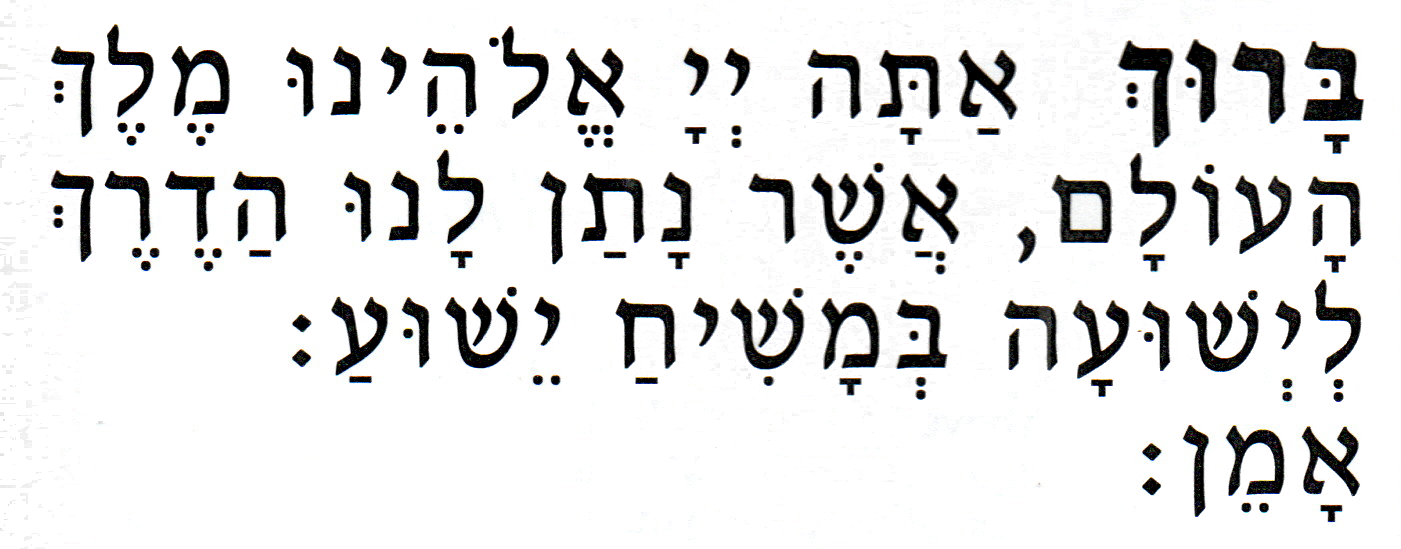
Ba-rookh ah-tah Adonai Eh-lo-hay-noo,
meh-lekh hah-oh-lahm, ah-sher na-tahn la-noo ha-deh-rech l'y'shoo-ah b'ma-she-ahch Yeshua. Ah-mein. Blessed are You, O Lord our God,
King of the Universe, |
 |
Chapter 21 • Parsha 18: Mishpatim (Rulings)
a. The Hebrew text has slightly different chapter and verse numbering than most English versions. [BACK]
b. The so-called “Ten Commandments” provide a “summary” of the “Law of Moses.” The remaining 603 mitzvot explain how these ten are to be carried out. (My personal opinion; feel free to disagree.) [BACK]
1. After “Elohim” the Hebrew has the two letters “Aleph Tav” (the first and last letters of the Hebrew alphabet), not as a word, but as a grammatical marker. However, it also clearly signifies “the First and the Last.” [BACK]
3. Anything that would interfere with our relationship with God becomes a god to us. [BACK]
4. In context, the prohibition is not against images, per se, but against images that are intended to be worshipped. [BACK]
6. The contrast between “hate Me” and “love Me” is a Semitic “thought-form” and does not mean that it is necessary to have an extreme dislike of God to fall into this category. Rather, it means that anyone who fails to obey God’s mitzvot clearly does not love Him. If they did love Him, they would certainly obey Him. “The key to understanding these words is found in a knowledge of Semitic thought-forms. The Semitmic mind [thinks using] the contrast of extremes, such as light and darkness, truth and falsehood, love and hate.” Read the entire article HERE. [BACK]
7. or, You are not to misuse the name of ADONAI your Elohim. The word translated “in vain” in most English versions is לַשָּׁ֑וְא (laš·šāw), emptiness, vanity, falsehood, nothingness, emptiness of speech, lying. Thus the prohibition is also against taking a false oath in His name. [BACK]
11. God did not “rest” on the seventh day of creation because He was tired. The Almighty never tires (Psalm 121:4, Isa 40:28). Rather, He ceased from working because the work of creation was accomplished. (See my note on Gen 2:2.) So (from a purely human perspective) He took some time to stop, relax, think about, and perhaps even admire the work of His hands. “God saw everything that He had made, and indeed it was very good” (Gen 1:31). And so on His Shabbat we are also to take the time to stop, relax, think about, and admire the work of His hands. [BACK]
17. There is an interesting article on the interpretation of the word “covet” HERE. [BACK]
Other commentaries on Exodus 20
Ellicott's Commentary for English Readers
Pulpit Commentary
Matthew Henry's Concise Commentary
Gill's Exposition of the Entire Bible
|
 |
Subscribe to my Substack/newsletter |

ANXIOUSLY WATCHING FOR MASHIACH’S RETURN,
SPEEDILY AND IN OUR DAY. MARANA, TA!


