
NEW: Please subscribe to my Substack/newsletter at the bottom of the page. Thanks!
Parsha 21:
Ki Tissa (continued)
“When you take” • Exod. 30:11-34:36
d. The Second Set of Tablets (34:1-9)
(v) 1 ADONAI[GN] told Moshe, “Chisel out two stone tablets like the original ones and I will write on them the words that were on the first tablets, which you broke. 2 Be ready by morning and come on Mount Sinai, and present yourself before Me on the mountaintop. 3 No one is to come up with you; in fact, no one is to be seen anywhere on the mountain. Do not even let the flocks or herds graze in front of that mountain.”
4 So Moshe
chiseled out two stone tablets like the original ones. Then he rose up early in
the morning, and taking the two stone tablets in his hand, he went up Mount Sinai, as ADONAI had
commanded him.
5 ADONAI
came down in a cloud, stood with him there, and proclaimed His Name, ADONAI.
6 Then ADONAI
passed in front of him and called out, “ADONAI! ADONAI
Elohim! Compassionate and gracious, slow to anger, and abundant in lovingkindness and
8 Moshe immediately bowed down to the ground and worshiped. 9 “Adonai,” He said, “if now I have found favor in Your sight, please, Adonai, go with us. Even though this is a stiff-necked people, forgive our iniquity and our sin, and take us for Your possession.”
e. God Renews the Covenant (34:10-35)
(vi) 10 [ADONAI] said, “Hinneh,[GN] I am making a covenant. Before all your people I will perform wonders which have never been performed in any nation in all the earth. And all the people among whom you live shall see the work of ADONAI, for it is an awesome thing that I am doing with you. 11 Observe what I command you today. Watch, I will drive out before you the EmoriAmorite, the Kena‘ani,Canaanite, the HittiHittite, the P’riziPerizzite, the Hivi Hivite, and the Y’vusiJebusite.[11] 12 Be careful, not to make any treaty with the inhabitants of the land where you are going, lest they become a snare among you; 13 But you are to tear down their altars, smash their sacred pillars, and cut down their Asherah poles.[13] 14 For you must worship no other god; for ADONAI, whose name is Jealous, is a jealous God.[14]
15 “Don’t make any treaties with the inhabitants of the land,[15a] for when they prostitute themselves with their gods and sacrifice to them, they will invite you and you will eat their sacrifices;[15b] 16 and when you take some of their daughters as brides for your sons, their daughters will prostitute themselves with their gods and cause your sons to prostitute themselves with their gods.[16]
17 “You are to make no molten gods for yourselves.
18 “You are to observe the Feast of Matzahunleavened bread. You are to eat matzah for seven days as I commanded you, at the appointed time[GN] in the month Aviv;[18] for in the month of Aviv you came out of Egypt.
19 “Everything that is firstborn from the womb is mine, including all your firsborn male livestock, whether cattle or sheep.[19] 20 You are to redeem the firstborn of a donkey with a lamb; but if you do not redeem it, then you shall break its neck.[20] You shall redeem all the firstborn of your sons. No one shall appear before me empty-handed.
21 “Six days you are to work, but on the seventh day you must stop working: even in plowing time and in harvest you must stop working.[21]
22 “You are to observe the festival of Shavu‘ot[22] with the first-gathered produce of the wheat harvest, and the festival of ingathering at the turn of the year. 23 Three times in the year all your males must appear before Adonai ADONAI, the God of Isra'el.[23] 24 For I will drive out nations[24a] before you and expand your territory; and no one will covet your land when you go up to appear before ADONAI your Elohim, three times in the year.[24b]
25 “You must not offer the blood of My sacrifice with leavened bread, and the sacrifice of the feast of the Pesach shall not be left to the morning.[25]
26 “You are to bring the best of the first fruits of your soil to the house of ADONAI your God.
“You must not boil a young goat in its mother’s milk.”[26]
(vii) 27 ADONAI also told Moshe, “Write down these words, for in accordance with these words I have made a covenant with you and with Isra'el.”
28 So Moshe was there with ADONAI forty days and forty nights without eating either food or drinking water. He wrote on the tablets the words of the covenant:[28a] the Ten Words.[28b]
29 When Moshe came down from Mount Sinai with the two tablets of the Testimony in his hands as he descended, he wasn’t aware that his face shone as a result of his speaking with ADONAI.[29] 30 When Aharon and all the Isra'elites saw Moshe, hinneh,[GN] his face shone and they were afraid to come near him. 31 But Moshe called out to them, so Aharon and all the rulers of the congregation returned to him; and Moshe spoke to them. 32 After that all the Isra'elites came near, and Moshe commanded them to do all that ADONAI had told him on Mount Sinai.
(Maftir) 33 When Moshe had finished speaking to them, he put a veil over his face. 34 But whenever Moshe went in before ADONAI to speak with Him, he would remove the veil until he came out. And when he came out, he would tell the Isra'elites whaterer he had been commanded, 35 and the Isra'elites would see Moshe’s face shone. So Moshe would put the veil over his face again until he went in to speak with ADONAI.
The Blessing After TorahClick this to hear the blessing canted by Cantor Kenneth B. Cohen of Temple Sholom, Greenwich, CT |
|
|
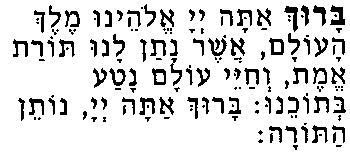
Ba-rookh ah-tah Adonai,
eh-lo-hay-noo meh-lech hah-ohlahm, ah-sher nah-tahn la-noo toe-raht eh-met, v’cha-yaye oh-lahm nah-tah b’toe-chay-noo. Ba-rookh ah-tah Adonai, no-tain ha-to-rah. Blessed are you, O Lord our God, King of the Universe, Who has given us a Torah of truth, and has planted eternal life in our midst. Blessed are You, O Lord, Giver of the Torah. |
|
Haftarah
The Blessing of the Haftarah
|
|
|
Ba-rookh, ah-tah Adonai, eh-lo-hay-noo, Ba-rookh ah-tah, Adonai, Blessed are you, O Lord our God, Blessed are You, O Lord, |

|
Haftarah Ki Tissa is M'lakhim Alef (1 Kings) 18:1-39 (A); 18:20-39 (S)
Listen to it read from the Complete Jewish Bible
1 Several days later, ADONAI’s word came to Eliyahu, in the third year, saying, “Go, show yourself to Ach’av; and I will send rain on the earth.”
2 Eliyahu went to show himself to Ach’av. The famine was severe in Shomron. 3 Ach’av called ‘Ovadyah, who was over the household. (Now ‘Ovadyah feared ADONAI greatly; 4 for when Izevel was murdering ADONAI’s prophets, ‘Ovadyah took one hundred prophets, and hid them fifty to a cave, and fed them with bread and water.) 5 Ach’av said to ‘Ovadyah, “Go through the land, to all the springs of water, and to all the brooks. Perhaps we may find grass and save the horses and mules alive, that we not lose all the animals.”
6 So they divided the land between them to pass throughout it.
Ach’av went one way by himself, and ‘Ovadyah went another way by himself.
7 As ‘Ovadyah was on the way,
8 He answered him, “It is I. Go, tell your lord, ‘Hinneh, Eliyahu is here!’”
9 He said, “How have I sinned, that you would deliver your servant into the hand of Ach’av, to kill me? 10 As ADONAI your God lives, there is no nation or kingdom where my lord has not sent to seek you. When they said, ‘He is not here,’ he took an oath of the kingdom and nation that they didn’t find you. 11 Now you say, ‘Go, tell your lord, “Hinneh, Eliyahu is here.” ’ 12 It will happen, as soon as I leave you, that ADONAI’s Spirit will carry you I don’t know where; and so when I come and tell Ach’av, and he can’t find you, he will kill me. But I, your servant, have feared ADONAI from my youth. 13 Wasn’t it told my lord what I did when Izevel murdered ADONAI’s prophets, how I hid one hundred men of ADONAI’s prophets with fifty to a cave, and fed them with bread and water? 14 Now you say, ‘Go, tell your lord, “Hinneh, Eliyahu is here.”’ He will kill me.”
15 Eliyahu said, “As ADONAI of Hosts lives, before Whom I stand, I will surely show myself to him today.” 16 So ‘Ovadyah went to meet Ach’av, and told him; and Ach’av went to meet Eliyahu.
17 When Ach’av saw Eliyahu, Ach’av said to him, “Is that you, you troubler of Isra'el?”
18 He answered, “I have not troubled Isra'el, but you and your father’s house, in that you have forsaken ADONAI’s commandments and you have followed the Ba'als.[GN] 19 Now therefore send, and gather to me all Isra'el to Mount Carmel, and four hundred fifty of the prophets of Ba'al, and four hundred of the prophets of the Asherah,[GN] who eat at Izevel’s table.”
20 So Ach’av sent to all the children of Isra'el, and gathered the prophets together to Mount Carmel. 21 Eliyahu came near to all the people, and said, “How long will you waver between the two sides? If ADONAI is God, follow him; but if Ba'al, then follow him.”
The people didn’t say a word.
22 Then Eliyahu said to the people, “I, even I only, am left as a prophet of ADONAI; but Ba'al’s prophets are four hundred fifty men. 23 Let them therefore give us two bulls; and let them choose one bull for themselves, and cut it in pieces, and lay it on the wood, and put no fire under; and I will dress the other bull, and lay it on the wood, and put no fire under it. 24 You call on the name of your god, and I will call on ADONAI’s name. The God who answers by fire, let him be God.”
All the people answered, “What you say is good.”
25 Eliyahu said to the prophets of Ba'al, “Choose one bull for yourselves, and dress it first, for you are many; and call on the name of your god, but put no fire under it.”
26 They took the bull which was given them, and they dressed it, and called on the name of Ba'al from morning even until noon, saying, “Ba'al, hear us!” But there was no voice, and nobody answered. They leaped about the altar which was made.
27 At noon, Eliyahu mocked them, and said, “Cry aloud, for he is a god. Either he’s lost in thought, or he’s in the privy, or he’s on a journey, or perhaps he’s asleep and must be awakened.”
28 They cried aloud, and cut themselves in their way with knives and lances until the blood gushed out on them. 29 When midday was past, they prophesied until the time of the evening offering; but there was no voice, no answer, and nobody paid attention.
30 Eliyahu said to all the people, “Come near to me!”; and all the people came near to him. He repaired ADONAI’s altar that had been thrown down. 31 Eliyahu took twelve stones, according to the number of the tribes of the sons of Ya'akov, to whom ADONAI’s word came, saying, “Isra'el shall be your name.” 32 With the stones he built an altar in ADONAI’s name. He made a trench around the altar large enough to contain two seahs[GN] of seed. 33 He put the wood in order, and cut the bull in pieces and laid it on the wood. He said, “Fill four jars with water, and pour it on the burnt offering and on the wood.” 34 He said, “Do it a second time;” and they did it the second time. He said, “Do it a third time;” and they did it the third time. 35 The water ran around the altar; and he also filled the trench with water.
36 At the time of the evening offering, Eliyahu the prophet came near and said, “ADONAI, the God of Abraham, of Isaac, and of Isra'el, let it be known today that You are God in Isra'el and that I am Your servant, and that I have done all these things at Your word. 37 Hear me, ADONAI, hear me, that this people may know that You, ADONAI, are God, and that You have turned their heart back again.”
38 Then ADONAI’s fire fell and consumed the burnt offering, the wood, the stones, and the dust; and it licked up the water that was in the trench. 39 When all the people saw it, they fell on their faces. They said, “ADONAI, He is God! ADONAI, He is God!”
Ketuvei HaShalichim (Apostolic Writings)
The Blessing of the Ketuvei HaShalichimClick this to hear the blessing canted by Jeremiah Greenberg of Messianic Liturgical Resources. Page numbers refer to his Messianic Shabbat Siddur. |
|
|
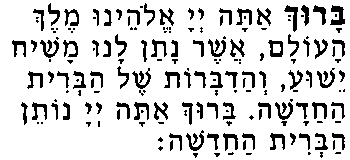
Bah-rookh ah-tah Adonai, Eh-lo-hay-noo meh-lekh hah-ohlahm, ah-shehr nah-tahn la-noo mah-she-ahch Yeshua, v’ha-deebrote shell Ha-breet Ha-kha-da-shah, ba-rookh ah-ta Adonai, notain Hah-breet Hah-kha-da-shah. Blessed are You, O Lord our God, |
 |
Basar
(Gospel)
The reading from the Gospels is Yochanan (John) 11:47-56
47So the kohenim gadolimchief priests and the P'rushim conviened a sanhedrin[47] and said, “What are we doing? This man performs many miracles. 48If we let Him go along like this, everyone will believe in Him, and the Romans will come and take away both our place and our nation.”[48]
49But one of them, KayafaCaiaphas, who was Cohen GadolHigh Priest that year,[49] said to them, “You know nothing at all! 50You don’t realize that it is better for you that one man die for the people than that the whole nation perish.” 51Now he didn’t say this on his own, but as Cohen Gadol that year he was prophesyiing that Yeshua would die for the nation,[51] 52and not only for the nation, but that He might also gather together all the children of God who are scattered abroad into one.[52] 53So from that day on they plotted to kill Him.
V. Yeshua goes to Ephraim (11:54)
54So Yeshua no longer went about openly among the Judeans, but left from there to a town called Ephraim[54] in the area near the wilderness, and He stayed there with His talmidim.
W. Yeshua discussed by Judeans and Priests (11:55-57)
55Now the Jewish[55] Feast of PesachPassover was at near. Many went up from the country to YerushalayimJerusalem before Pesach, to purify themselves. 56They kept looking for Yeshua and asking one another as they stood in the Temple, “What do you think — will He come to the Feast at all?”[56]
Kepherim (Letters, optional)
Lukos (Luke) 11:14–20
P’yilut (Acts) 7:35–8:1
Korintim Alef (1Cor.) 10:1–13
Korintim Bet (2Cor.) 3:1–18
Lukos (Luke) 11:14–20
14He was casting out a demon, and it was mute. It happened, when the demon had gone out, the mute man spoke; and the crowds marveled.
15But some of them said, “He casts out demons by Beelzebul, the prince of the demons.” 16Others, testing him, sought from him a sign from heaven.
17But knowing their thoughts He said to them, “Every kingdom divided against itself is brought to desolation. A house divided against itself falls. 18If Satan also is divided against himself, how will his kingdom stand? For you say that I cast out demons by Beelzebul. 19But if I cast out demons by Beelzebul, by whom do your children cast them out? Therefore will they be your judges. 20But if I by the finger of God cast out demons, then the Kingdom of God has come to you.
35“This Moshe, the same man they rejected and told ‘Who made you a ruler and a judge?’ — this is the same man that God sent as both a ruler and a redeemer through the angel who appeared to him in the bush. 36This man led them out, performing miracles and signs in Egypt, at the Red Sea[36], and for forty years in the wilderness. 37This is the same Moshe who said to the people of Yisra'el, ‘God will raise up for you a prophet like me from among your brothers.[37] 38This is the same man who was in the assembly in the wilderness with the angel that spoke to him on Mount Sinai, and with our fathers, who received living oracles to pass on to us.
39But our fathers refused to obey him. Instead, they rejected him and in their hearts they turned back to Egypt. 40They said to Aharon, ‘Make gods for us to lead us; this Moshe, who led us out of Egypt, we don’t know what has become of him.’[40] A41That was when they made a calf-shaped idol, sacrificed to it, and celebrated in the works of their own hands. 42So God turned away from them, and gave them up to serve the army of the sky,[42] — just as it is written in the book of the prophets,
- ‘Did you offer to me slain animals and sacrifices
- forty years in the wilderness, O house of Yisra'el?
- 43You took up the tabernacle of Moloch,
- the star of your god Rephan,
- the figures which you made to worship.
- I will send you into exile beyond BavelBabylon.’[43]
44“Our fathers had the Tabernacle of Testimony in the wilderness. It had been made exactly as He Who spoke to Moshe commanded him to make it, according to the pattern that he had seen. 45Later our fathers who had received it brought it with Y'hoshuaJoshua when they dispossessed the nations that God had driven out before them. It remained until the days of David. 46He found favor with God, and asked if he might be allowed to provide a dwelling place for the God of Ya'akov. 47But it was ShlomoSolomon built Him a House. 48However, the Most High doesn’t dwell in man-made sanctuaries, as the prophet says,
- 49‘Heaven is My throne,
- and the earth is My footstool.
- What kind of house will you build me?’ says ADONAI;
- ‘or what is the place of my rest?
- 50Didn’t I Myself make all these things?’[50]
51“You stiff-necked people with uncircumcised hearts and ears! You continually resist Ruach HaKodesh! You do just as your fathers did! 52Which one of the prophets didn’t your fathers persecute? They killed those who foretold the coming of the Righteous One; and now you have become His betrayers and murderers! 53You accept the Torah as having been delivered by angels, but you haven’t kept it!”
54When they heard these things, they were enraged, and they gnashed their teeth at him. 55But Stephanos, full of Ruach HaKodesh, stared up into heaven and saw God’s Sh'khinahvisible Glory, with Yeshua standing at the right hand of God. 56“Hinne!”[GN] he said, “I see the heavens opened, and the Son of Man standing at the right hand of God!”
57When they heard this they began shouting at the top of their voices, covered their ears so they could’t hear him, and rushed at him with one intent. 58They dragged him out of the city and began stoning him. The witnesses placed their garments at the feet of a young man named Sha'ul. 59As they were stoning him, Stephanos cried out with a loud voice, “Lord Yeshua, receive my spirit!” 60Falling to his knees, he and again shouted, “Lord, don’t hold this sin against them!” Then he died. 8:1And Sha'ul approved of his murder.
1 Now I would not have you ignorant, brothers, that our fathers were all under the cloud, and all passed through the sea; 2 and were all immersed into Moses in the cloud and in the sea; 3 and all ate the same spiritual food; 4 and all drank the same spiritual drink. For they drank of a spiritual rock that followed them, and the rock was Messiah. 5 However with most of them, God was not well pleased, for they were overthrown in the wilderness.
6 Now these things were our examples, to the intent we should not lust after evil things as they also lusted. 7 Don’t be idolaters, as some of them were. As it is written, “The people sat down to eat and drink, and rose up to play.”[7] 8 Let’s not commit sexual immorality, as some of them committed, and in one day twenty-three thousand fell. 9 Let’s not test Messiah, as some of them tested, and perished by the serpents. 10 Don’t grumble, as some of them also grumbled, and perished by the destroyer. 11 Now all these things happened to them by way of example, and they were written for our admonition, on whom the ends of the ages have come. 12 Therefore let him who thinks he stands be careful that he doesn’t fall.
13 No temptation has taken you except what is common to man. God is faithful, who will not allow you to be tempted above what you are able, but will with the temptation also make the way of escape, that you may be able to endure it.
1 Are we beginning again to commend ourselves? Or do we need, as do some, letters of commendation to you or from you? 2 You are our letter, written in our hearts, known and read by all men, 3 being revealed that you are a letter of Messiah, served by us, written not with ink, but with the Spirit of the living God; not in tablets of stone, but in tablets that are hearts of flesh.
4 Such confidence we have through Messiah toward God, 5 not that we are sufficient of ourselves to account anything as from ourselves; but our sufficiency is from God, 6 who also made us sufficient as servants of a new covenant, not of the letter but of the Spirit. For the letter kills, but the Spirit gives life.
7 But if the service of death, written engraved on stones, came with glory, so that the children of Isra'el could not look steadfastly on the face of Moses for the glory of his face, which was passing away, 8 won’t service of the Spirit be with much more glory? 9 For if the service of condemnation has glory, the service of righteousness exceeds much more in glory. 10 For most certainly that which has been made glorious has not been made glorious in this respect, by reason of the glory that surpasses. 11 For if that which passes away was with glory, much more that which remains is in glory.
12 Having therefore such a hope, we use great boldness of speech, 13 and not as Moses, who put a veil on his face so that the children of Isra'el wouldn’t look steadfastly on the end of that which was passing away. 14 But their minds were hardened, for until this very day at the reading of the old covenant the same veil remains, because in Messiah it passes away. 15 But to this day, when Moses is read, a veil lies on their heart. 16 But whenever someone turns to the Lord, the veil is taken away. 17 Now the Lord is the Spirit; and where the Spirit of the Lord is, there is liberty. 18 But we all, with unveiled face seeing the glory of the Lord as in a mirror, are transformed into the same image from glory to glory, even as from the Lord, the Spirit.
The Blessing After the Ketuvei HaShalichimClick this to hear the blessing canted by Jeremiah Greenberg of Messianic Liturgical Resources. Page numbers refer to his Messianic Shabbat Siddur. |
|
|
Ba-rookh ah-tah, Adonai Eh-lo-hay-noo, Blessed are You, O Lord our God, |
 |
The Blessing of the MessiahClick this to hear the blessing canted by Jeremiah Greenberg of Messianic Liturgical Resources. Page numbers refer to his Messianic Shabbat Siddur. |
|
|
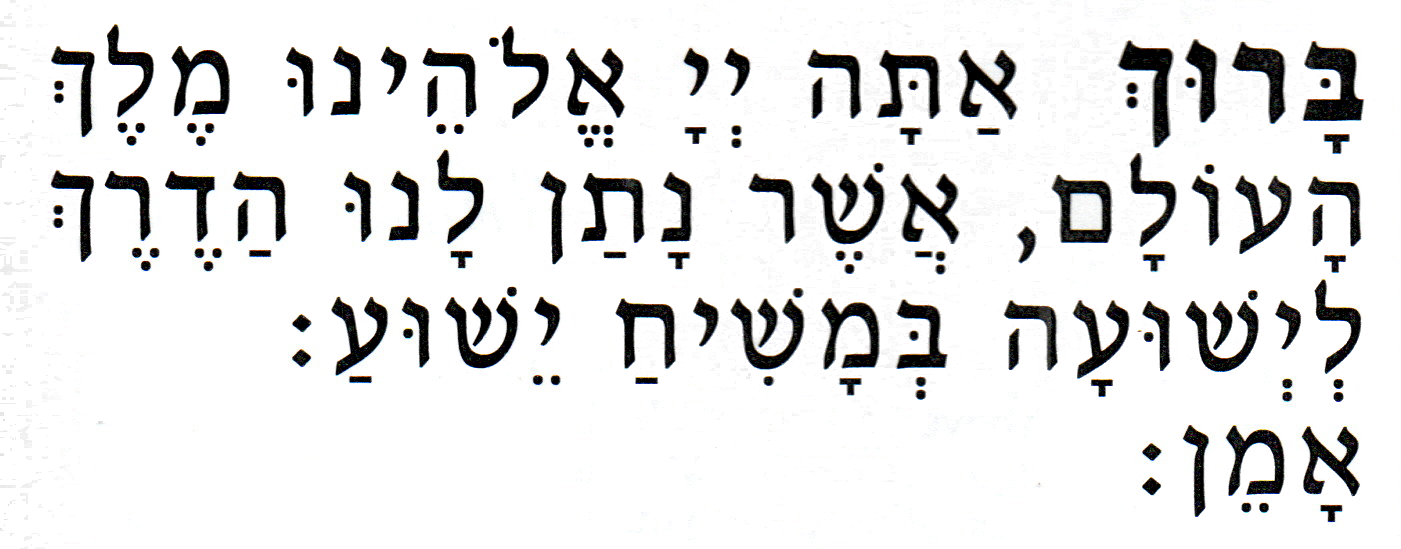
Ba-rookh ah-tah Adonai Eh-lo-hay-noo,
meh-lekh hah-oh-lahm, ah-sher na-tahn la-noo ha-deh-rech l'y'shoo-ah b'ma-she-ahch Yeshua. Ah-mein. Blessed are You, O Lord our God,
King of the Universe, |
 |
6. “… lovingkindness and truth”: Hebrew חֶ֥סֶד (ḥe·seḏ) וֶאֱמֶֽת (v’ĕ·meṯ). ADONAI describes Himself useing these two attrubutes extensively throughout the Tanakh. “Lovingkindness” is often translated as “loving devotion,” “faithful love,” “loyal love,” “steadfast love.” The clear intent is that we can always count on His love toward us, even when we stray. That does not mean that He does not discipline us or that we escape the consequences of our sin. It means that He disciplines us in love (Deut. 8:5; Psalm 94:10; Hebrew 12:6, 12:10), and loves us even though He allows us to suffer our own consequences. [BACK]
7a. Iniquity: Hebrew עָוֺ֛ן (‘ā·wōn), perversity, depravity, guilty condition. Disobedience: Hebrew פֶשַׁע (p̄e·ša‘), transgression, rebellion, breach of trust. Sin: Hebrew חַטָּאָה (khat-taw-aw'), sinful thing, sin; Yochanan defines sin as any violation of Torah (1 John 3:4). If Torah has been abolished as the Church claims, how can there be any sin? (Romans 4:15) Since “all have sinned” (Romans 3:23) the Torah must still be in effect. The Church’s teaching that “Torah has been nailed to Yeshua’s cross” is clearly false. [BACK]
7b. Some people use this verse to justify what they call a “generational curse.” God just does not work that way. See Deuteronomy 24:16: “Fathers are not to be executed for the children, nor are children to be executed for the fathers; every person will be executed for his own sin.” Among other Oriental nations the family of a criminal was commonly involved in his punishment. “The rule was addressed for the guidance of magistrates, and it established the equitable principle that none should be responsible for the crimes of others.” (Jamieson-Fausset-Brown Bible Commentary) If ADONAI sets this standard for earthly judges, will He not hold Himself to a similar standard? However, He does not protects children from the results or consequences of the father’s sin. For example, as a result of David’s sin, his son turned against him and the kingdom was led to ruin and civil war. [BACK]
8. Worship: Hebrew שָׁחָה (shaw-khaw'), to bow down, to prostrate one’s self. Some versions translated this as “prostrated himself.” [BACK]
11. Amorite = “a sayer” — one of the peoples of east Canaan and beyond the Jordan. Canaanite = see Cana “zealous” — descendant of Canaan, the son of Ham. Hittite = “descendant of Heth” — the nation descended from Heth, the 2nd son of Canaan; once inhabitants of central Anatolia (modern Turkey), later in north Lebanon. Perizzite = “belonging to a village” — a people who inhabited southern Canaan. Hivite = “villagers” — 6th generation of descendants of Canaan who were living in northern Canaan near Mount Hermon at the time of the conquest. Jebusite = “descendants of Jebus” — descendants of the 3rd son of Canaan who lived in or around the site of Jebus, the early name for Jerusalem. [BACK]
13. Asherah (Astarte), Canaanite goddess of fortune and happiness, the supposed consort of Ba'al. Just one of the many names for Ishtar / Semiramis / Venus / Artemis / Diana. See also Judges 2:13; Judges 10:6; 1 Samuel 7:3-4; 1 Samuel 12:10; Acts 19:28; Acts 19:34. [BACK]
14. ADONAI is about to bring the people of Isra'el into a marriage relationship with Himself. Of course He doesn’t want her committing adultry with anyone else. [BACK]
15a. It concerns me greatly that today Isra'el is entering into treaties with the surrounding Muslim nations. It is because of one such treaty with Jordan that Jews are currently barred from their holiest place, Temple Mount. [BACK]
15b. Yeshua taught us that “anything that enters the mouth goes into the stomach and passes out into the latrine” (Matthew 15:17). So simply eating the food sacrificed to their gods is not the problem. It is participating in the sacrifice ritual in any way that is the problem. When we allow our children to hunt for “Ishtar eggs” we are teaching to participate in ancient rituals that were part of the worship of the Babylonian goddess Ishtar. When we have “trunk or treat” parties we are participating in part of one of Satan’s high holy days.
“Halloween is traditionally a time when the obscure portal into the realms of darkness, death and the supernatural is thrown open. Demons and spirits have free reign for one night, cavorting, enticing us into their revels and revealing glimpses into the future ... Yes, the demons have indeed provided a crystalline vision of the future to me this most unhallowed night. I see the firelight flickering wildly in my son’s eyes as he dances happily in his pirate costume. I see the young monsters and witches and vampires loosed in our streets, never to be shackled again. I see reason and science and fantasy blasting away the dull lethargthy of defunct philosophies. I see Satanists all over the world meeting in small groups this night and Hallowe’ens 500 years hence, to raise a glass to the Infernal Hosts, the revolutionaries, myth-makers, infidels and reprobates, and to Anton LaVey — Long Live our High Priest! Hail Satan!”
https://www.churchofsatan.com/halloween-xxxiv/ accessed 16 September 2022.Anton LaVey, the founder of the church of Satan, himself once said that “by dressing up, either by wearing a costume or by coloring oneself in celebration of Halloween, signifies that you allow Satan to own you.” … Meanwhile, a former Satanist turned Christian pastor, John Ramirez, corroborated with LaVey’s statement. In an interview on October 20, 2018, for CBS News, Ramirez said that, “When you dress up even as an angel or a little mermaid for Halloween, you give the devil the legal rights to change your identity … There’s a much darker reality in Halloween beyond costumes and candy.” “Halloween the Devil’s Holiday, Says Anton LaVey” www.nilaeslit.com accessed 16 September 2022.
If our true goal in the “trunk or treat” tradition is, as some people claim, simply to provide our children with a night to have a harmless costume party, God has already provided such a biblical holiday. It is called Purim. [BACK]
16. This is not just figurative language, it is literal. Ritual prostitution (heterosexual, homosexual, and pedophilic) was a significant part of many of the Canaanite religions. [BACK]
18. Aviv: Hebrew אָבּיבּ, fresh, young ears. Thus the month of Avav begins at the first new moon that occurs after the very first year ears of barley appear on their stalks. Modern Rabbinical Judaism refers to the Feast of Unleavened Bead as Pesach, or Passover. [BACK]
19. Hebrew שֶׂה (seh) includes everything from a flock, both sheep and goats. [BACK]
20. Redeem: Hebrew פָדָה (paw-daw'), to ransom, redeem, rescue, deliver, buy back. Every firstborn belongs to ADONAI. It must be either redeemed or destroyed; you may not keep it for yourself because it belong to ADONAI. [BACK]
21. Stop working: Hebrew שָׁבּת (shaw-bath'), to cease, desist, rest. Literally, “on the seventh day you must shabbat.” [BACK]
22. The Feast of Matzah is celebrated at the first sign of the barley crop, but Shavuot [Weeks] is celebrated approximately 50 days later at the time of the first wheat harvest. Christian tradition observes this feast as Pentecost.
Shavuot means “weeks,” and it refers to the Biblical Holiday celebrated on Sivan 6 (and 7 in the Diaspora) on the anniversary of the giving of the Torah at Sinai. The word Shavuot (or Shavuos) means “weeks.” It celebrates the completion of the seven-week Omer counting period between the second day of Passover and Shavuot. … Shavuot is also the celebration of the wheat harvest and the ripening of the first fruits, which is the reason for the other two biblical names for this holiday: 1) "Yom Habikkurim" or the "Day of the First Fruits." 2) "Chag HaKatzir," the "Harvest Festival." [“What Is the Meaning of Shavuot?” at Chabad.org, accessed 16 September 2022.] [BACK]
23. The three mandatory “Pilgrim Festivals” are Passover, Shavuot, and Sukkot. [BACK]
24a. Nations: Hebrew גּוֹיִם֙ (gō·w·yim), nations, people groups; also used to refer to anyone other than Isra'el (Gentiles). [BACK]
24b. With all the males away for the Pilgrim Feasts, Isra'el would be easily conquered by any invading force. However, ADONAI promises that they will not want to do so. [BACK]
25. Through the Tanakh levening is used as a metaphor for sin. It is therefore to be completely excluded from any of the blood sacrifices. Any of the Paschal Lamb that was not eated was required to bt completely burnt (Exodus 12:10). [BACK]
26. See the note on Exod. 23:19. Please note that it is this particular Canaanite ritual that ADONAI prohibits. Nowhere in the Tahakh does He prohibit the eating of meat and dairy together, as the takanot of the modern Pharisees claim. In fact, when ADONAI had lunch with Avraham at Mamre, (Genesis 18:1-8) He ate “curds, milk and the calf which [Avraham] had prepared.” [BACK]
28a. I think that ADONAI wrote down the “Ten Words” with His own finger as before (Exodus 31:18), since He said that is what He would do (in verse 1). And I assume that Moshe wrote down all the commentary on those Ten Words along with everything else that ADONAI told him. [BACK]
28b. “The Church” teaches that the Torah has been abolished and they are responsible for keeping only these Ten Words (Ten Commandments), but they somehow ignore the fourth in regard to the seventh-day Shabbat (Exodus 20:8-11); so they actually only recognize Nine Commandments. However, the Ten Words were given only as a summary statement of the entire Torah and were to serve Isra'el as an abbreviated sign or “tablets of the Testimony” (verse 29) of their Covenant with ADONAI. The entire remainder of the Torah teaches us how we are to live out these ten! [BACK]
29. I believe that Moshe’s face was clothed in the Shekinah of ADONAI because of time spent in His presence. See my note on Genesis 3:7. [BACK]
Notes on the John Passage
47. Whether this was a sanhedrin[GN] of only 23 members or the full Sanhedrin HaGadol of 71 is not clear. Logic would dictate that they might want to contain the conspiracy to as few members as possible. [BACK]
48. Instead of being true spiritual leaders, the members of the Sanhedrin were mostly corrupt politicians like our Congress. [Not a political statement, just an observation of a very unpleasant fact.] They served not as specified in Torah, but rather at the pleasure of the Roman government. If the people accepted Yeshua as King Mashiach, and He turned out to be a false messiah, the Romans would view this as an act of extreme rebellion, come put down that rebellion, and eliminiate the function and authority of the Sanhedrin. If He turned out to be the true Mashiach, He would most certainly “drain the swamp” and they would lose their position and authority. Either way, He posed an extreme threat to their prestige and power, and He had to go. [BACK]
49. The High Priest was an ex officio member of the Sanhedrin, not the president, or Nasi. See the global note. [BACK]
51. If HaShem, blessed be He, can open the mouth of a donkey to speak, (Numbers 22:27-31) He can cause the Cohen HaGadol to prophesy. [BACK]
52. The self-sacrifice of Yeshua was not just for personal salvation of those who would belieive in Him, but also that all those who believe in Him, booth Jew and non-Jew, would be gathered together as one people, one nation. If you are a “born-again” disciple of Yeshua, you are a citizen of the Commonwealth of Isra'el. [BACK]
54. The town near the wilderness to which Jesus retired after the raising of Lazarus. This probably corresponds to Ephrem of Eusebius, 5 Roman miles East of Bethel. This may be the place named along with Bethel by Josephus (BJ, IV, ix, 9). The antiquity of the site is attested by the cisterns and rock tombs. It stands on a high hill with a wide outlook including the plains of Jericho and the Dead Sea. [BACK]
55. The word “Jewish” is almost certainly an addition by a later Christian copyist long after the apostate Church outlawed celebration of God’s moadim. The Tanakh refers to all the Feasts as the “Feasts of ADONAI,” as would have the original writer of this account.[BACK]
56. Pesach is one of the three Pilgrim Feasts on which every adult male in Isra'el is required to come to the Temple (Exodus 34:23-24). Had Yeshua violated Torah by not coming to the Feast, He would be a sinner and disqualified as Messiah. [BACK]
Notes on the Acts Passage
36. Also called the Sea of Suf. [BACK]
37. Deuteronomy 18:15; TR adds “You shall listen to him.” [BACK]
40. Exodus 32:1. [BACK]
42. This idiom could also be translated “host of heaven,” or “angelic beings,” or “heavenly bodies.” [BACK]
43. Amos 5:25-27. [BACK]
50. Isaiah 66:1-2. [BACK]
Other commentaries on Exodus 34
Ellicott's Commentary for English Readers
Pulpit Commentary
Matthew Henry's Concise Commentary
Gill's Exposition of the Entire Bible
|
 |
Subscribe to my Substack/newsletter |

ANXIOUSLY WATCHING FOR MASHIACH’S RETURN,
SPEEDILY AND IN OUR DAY. MARANA, TA!


