
NEW: Please subscribe to my Substack/newsletter at the bottom of the page. Thanks!
Parsha 22: vaYak’hel
“He assembled” (continued)
g.The Courtyard (38:1-20)
(1) The Bronze Altar (38:1-7)
(RY:iv; LY:vii) 1 He also made the altar of burnt offering of acacia wood, seven-and-a-half feet long and seven-and-a-half feet wide — it was square — and four-and-a-half feet high. 2 He made horns on its four corners — its horns were of one piece with it — and he overlaid it with bronze. 3 He made all the utensils for the altar — the pots, shovels, basins, meat hooks, and fire pans — all of bronze. 4 He made a grate of bronze netting for the altar, under its rim, halfway up the altar, 5 and on the four corners of the bronze grating he cast four rings to hold the carrying-poles. 6 He made the carrying-poles of acacia wood and overlaid them with bronze. 7 He put the carrying poles into the rings on the sides of the altar; he made it with planks, hollow inside.
(2) The Bronze Basin (38:8)
8 He made the basin of bronze and its base of bronze from the mirrors of the women who served at the entrance to the Tent of Meeting.
(3) Curtains and Posts for the Courtyard (38:9-20)[GN]
9 He made the courtyard. The south side, facing south, was 150 feet long and made of finely woven linen hangings, 10 supported by twenty posts with twenty bronze bases stands twenty, of bronze; their hooks and their attached rings were of silver. 11 The north side was also 150 feet long with twenty posts and their twenty bronze bases; their hooks and their attached rings were also of silver. 12 On the west side the hangings were seventy-five feet long with ten posts and ten bases; their hooks and their attached rings were also of silver. 13 The east side, toward the rising sun, was also seventy-five feet long. 14 The hangings for the one side [of the gateway] were were twenty-two and a half feet long with three posts, and three bases; 15 the other side [of the gateway] was the same: on both sides [of the gateway] were twenty-two and a half feet of hangings, with three posts and three bases. 16 All the hangings around the courtyard were of finely woven linen. 17 The bases for the posts were of bronze, the hooks on the posts and their rings were silver. The tops of the posts were overlaid with silver, and all the posts of the courtyard had silver bands.
(LY:Maftir) 18 The curtain for the gateway to the courtyard was embroidered of blue, purple, and scarlet yarn on finely woven linen. It was thirty feet long and seven and a half feet high , like the hangings of the courtyard. 19 It had four posts and four bronze bases; their hooks were silver, the tops of the posts were overlaid with silver, and they had silver bands. 20 All the tent pegs of the tabernacle and around the courtyard were bronze.
[Regular Years, Continue Reading at verse 21]
Leap Years, Continue Here
The Blessing After TorahClick this to hear the blessing canted by Cantor Kenneth B. Cohen of Temple Sholom, Greenwich, CT |
|
|
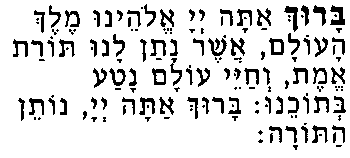
Ba-rookh ah-tah Adonai,
eh-lo-hay-noo meh-lech hah-ohlahm, ah-sher nah-tahn la-noo toe-raht eh-met, v’cha-yaye oh-lahm nah-tah b’toe-chay-noo. Ba-rookh ah-tah Adonai, no-tain ha-to-rah. Blessed are you, O Lord our God, King of the Universe, Who has given us a Torah of truth, and has planted eternal life in our midst. Blessed are You, O Lord, Giver of the Torah. |
|
Now that you’ve read
vaYak’hel
watch Rabbi Greg Hershberg’s teaching
Haftarah
The Blessing of the Haftarah
|
|
|
Ba-rookh, ah-tah Adonai, eh-lo-hay-noo, Ba-rookh ah-tah, Adonai, Blessed are you, O Lord our God, Blessed are You, O Lord, |

|
Haftarah vaYak’hel is M’lakhim Alef (1 Kings) 7:13–26 (S); 7:40–50 (A)
Listen to it read from the Complete Jewish Bible
13 King Shlomo sent and brought Hiram out of Tyre. 14 He was the son of a widow of the tribe of Naphtali, and his father was a man of Tyre, a worker in bronze; and he was filled with wisdom and understanding and skill to work all works in bronze. He came to king Shlomo and performed all his work. 15 For he fashioned the two posts of bronze, eighteen cubits high apiece; and a line of twelve cubits encircled either of them. 16 He made two capitals of molten bronze to set on the tops of the posts. The height of the one capital was five cubits, and the height of the other capital was five cubits. 17 There were nets of checker work and wreaths of chain work for the capitals which were on the top of the posts: seven for the one capital, and seven for the other capital. 18 So he made the posts; and there were two rows of pomegranates around the one network, to cover the capitals that were on the top of the posts; and he did so for the other capital. 19 The capitals that were on the top of the posts in the porch were of lily work, four cubits. 20 There were capitals above also on the two posts, close by the belly which was beside the network. There were two hundred pomegranates in rows around the other capital. 21 He set up the posts at the porch of the temple. He set up the right pillar and called its name Jachin; and he set up the left pillar and called its name Boaz. 22 On the tops of the posts was lily work. So the work of the posts was finished.
23 He made the molten sea ten cubits from brim to brim, round in shape. Its height was five cubits; and a line of thirty cubits encircled it. 24 Under its brim around there were buds which encircled it for ten cubits, encircling the sea. The buds were in two rows, cast when it was cast. 25 It stood on twelve oxen, three looking toward the north, and three looking toward the west, and three looking toward the south, and three looking toward the east; and the sea was set on them above, and all their hindquarters were inward. 26 It was a hand width thick. Its brim was worked like the brim of a cup, like the flower of a lily. It held two thousand baths.
(A) M’lakhim Alef (1 Kings) 7:40–50
40 Hiram made the pots, the shovels, and the basins. So Hiram finished doing all the work that he worked for king Shlomo in ADONAI’s house: 41 the two posts; the two bowls of the capitals that were on the top of the posts; the two networks to cover the two bowls of the capitals that were on the top of the posts; 42 the four hundred pomegranates for the two networks; two rows of pomegranates for each network, to cover the two bowls of the capitals that were on the posts; 43 the ten stands; the ten basins on the stands; 44 the one sea; the twelve oxen under the sea; 45 the pots; the shovels; and the basins. All of these utensils, which Hiram made for king Shlomo in ADONAI’s house, were of burnished bronze. 46 The king cast them in the plain of the Jordan, in the clay ground between Succoth and Zarethan. 47 Shlomo left all the utensils unweighed, because there were so many of them. The weight of the bronze could not be determined.
48 Shlomo made all the utensils that were in ADONAI’s house: the golden altar and the table that the Bread of the Presence was on, of gold; 49 and the menorahs, five on the right side and five on the left, in front of the inner Sanctuary, of pure gold; and the flowers, the lamps, and the tongs, of gold; 50 the cups, the snuffers, the basins, the spoons, and the fire pans, of pure gold; and the hinges, both for the doors of the inner house, the most holy place, and for the doors of the house, of the temple, of gold.
Ketuvei HaShalichim (Apostolic Writings)
The Blessing of the Ketuvei HaShalichimClick this to hear the blessing canted by Jeremiah Greenberg of Messianic Liturgical Resources. Page numbers refer to his Messianic Shabbat Siddur. |
|
|
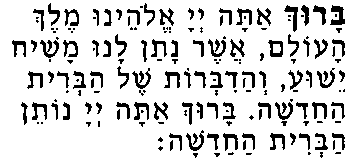
Bah-rookh ah-tah Adonai, Eh-lo-hay-noo meh-lekh hah-ohlahm, ah-shehr nah-tahn la-noo mah-she-ahch Yeshua, v’ha-deebrote shell Ha-breet Ha-kha-da-shah, ba-rookh ah-ta Adonai, notain Hah-breet Hah-kha-da-shah. Blessed are You, O Lord our God, |
 |
Basar
(Gospel)
Mattityahu (Matthew) 17:22-27
22While they were together in the Galil, Yeshua said to them, “The Son of Man is about to be betrayed to men 23who will kill Him, but on the third day He will be raised up.” They were extremely sad.
24When they had come to CapernaumK'far-Nachum, the didrachma[24] collectors came to Kefa and asked him, “Doesn’t your rabbi pay the didrachma?” 25He said, “Yes.”
When he came into the house, Yeshua anticipated him, saying, “What do you think, Shim`on? From whom do the kings of the earth receive toll or tribute? From their sons, or from strangers?”
26Kefa said to him, “From strangers.”
Yeshua said to him, “So then, the sons are exempt. 27But, just so we don’t cause offense, go down to the lake and cast a hook. Take the first fish that comes up. When you have opened its mouth, you’ll find a stater. Take that, and give it to them for you and Me.”[27b]
Kepherim (Letters, optional)
Korintim Bet (Second Corinthians) 9:1–15
1 It is indeed unnecessary for me to write to you concerning the service to the holy ones, 2 for I know your readiness, of which I boast on your behalf to those of Macedonia, that Achaia has been prepared for the past year. Your zeal has stirred up very many of them. 3 But I have sent the brothers so that our boasting on your behalf may not be in vain in this respect, that, just as I said, you may be prepared, 4 lest by any means, if anyone from Macedonia comes there with me and finds you unprepared, we (to say nothing of you) would be disappointed in this confident boasting. 5 I thought it necessary therefore to entreat the brothers that they would go before to you and arrange ahead of time the generous gift that you promised before, that the same might be ready as a matter of generosity, and not of greediness.
6 Remember this: he who sows sparingly will also reap sparingly. He who sows bountifully will also reap bountifully. 7 Let each man give according as he has determined in his heart, not grudgingly or under compulsion, for God loves a cheerful giver. 8 And God is able to make all grace abound to you, that you, always having all sufficiency in everything, may abound to every good work. 9 As it is written, “He has scattered abroad. He has given to the poor. His righteousness remains forever.” (Psalm 112:9)
10 Now
may he who supplies seed to the sower and bread for food, supply
and multiply your seed for sowing, and increase the fruits of your
righteousness,
11 you being enriched
in everything for all generosity, which produces thanksgiving to God
through us.
12 For this service
of giving that you perform not only makes up for lack among the
holy ones, but abounds also through much giving of thanks to God,
13 seeing that through
the proof given by this service, they glorify God for the obedience
of your confession to the Good News of Messiah and for the generosity
of your contribution to them and to all,
14 while they themselves
also, with supplication on your behalf, yearn for you by reason of the
exceeding grace of God in you.
15 Now thanks be to God
for his unspeakable gift!
Messianic Jews (Hebrews) 9:1–14
1 Now indeed even the first covenant [and tabernacle] had ordinances of divine service and an earthly Sanctuary. 2 For a tabernacle was prepared. In the first part were the menorah, the table, and the Bread of the Presence, which is called the Holy Place. 3 After the second veil was the tabernacle which is called the Holy of Holies, 4 having a golden altar of incense and the ark of the covenant overlaid on all sides with gold, in which was a golden pot holding the manna, Aharon’s rod that budded, and the tablets of the covenant; 5 and above it k’ruvim of glory overshadowing the mercy seat, of which things we can’t speak now in detail.
6 Now these things having been thus prepared, the cohenimpriests go in continually into the first tabernacle, accomplishing the services, 7 but into the second the Cohen GadolHigh Priest alone, once in the year, not without blood, which he offers for himself and for the errors of the people. 8 Ruach HaKodeshThe Holy Spirit is indicating this, that the way into the Holy Place wasn’t yet revealed while the first tabernacle was still standing. 9 This is a symbol of the present age, where gifts and sacrifices are offered that are incapable, concerning the conscience, of making the worshiper perfect, 10 being only (with foods and drinks and various washings) fleshly ordinances, imposed until a time of reformation.
11 But Messiah having come as a Cohen Gadol of the coming good things, through the greater and more perfect tabernacle, not made with hands, that is to say, not of this creation, 12 nor yet through the blood of goats and calves, but through his own blood, entered in once for all into the Holy Place, having obtained eternal redemption. 13 For if the blood of goats and bulls, and the ashes of a heifer sprinkling those who have been defiled, sanctify to the cleanness of the flesh, 14 how much more will the blood of Messiah, who through the eternal RuachSpirit offered Himself without defect to God, cleanse your conscience from dead works to serve the living God?
Hitgalut (Revelation) 11:1–13
1A reed like a rod was given to me.[1] Someone said, “Rise and measure God’s temple, and the altar, and those who worship in it. 2Leave out the court which is outside of the temple, and don’t measure it, for it has been given to the nations. They will tread the holy city under foot for forty-two months.[2] 3I will give power to my two witnesses,[3a] and they will prophesy one thousand two hundred sixty days,[3b] clothed in sackcloth.”[3c]
4These are the two olive trees and the two menorahs, standing before the Lord of the earth. 5If anyone desires to harm them, fire proceeds out of their mouth and devours their enemies. If anyone desires to harm them, he must be killed in this way. 6These have the power to shut up the sky, that it may not rain during the days of their prophecy. They have power over the waters, to turn them into blood, and to strike the earth with every plague, as often as they desire.
7When they have finished their testimony, the beast that comes up out of the abyss will make war with them, and overcome them, and kill them. 8Their dead bodies will be in the street of the great city, which spiritually is called Sodom and Egypt, where also their Lord was crucified.[8] 9From among the peoples, tribes, languages, and nations, people will look at their dead bodies[9a] for three and a half days, and will not allow their dead bodies to be laid in a tomb.[9b] 10Those who dwell on the earth will rejoice over them, and they will be glad. They will give gifts to one another, because these two prophets tormented those who dwell on the earth.
11After the three and a half days, the breath of life from God entered into them, and they stood on their feet. Great fear fell on those who saw them. 12I heard a loud voice from heaven saying to them, “Come up here!” They went up into heaven in a cloud, and their enemies saw them. 13In that day there was a great earthquake, and a tenth of the city fell. Seven thousand people were killed in the earthquake, and the rest were terrified and gave glory to the God of heaven.
The Blessing After the Ketuvei HaShalichimClick this to hear the blessing canted by Jeremiah Greenberg of Messianic Liturgical Resources. Page numbers refer to his Messianic Shabbat Siddur. |
|
|
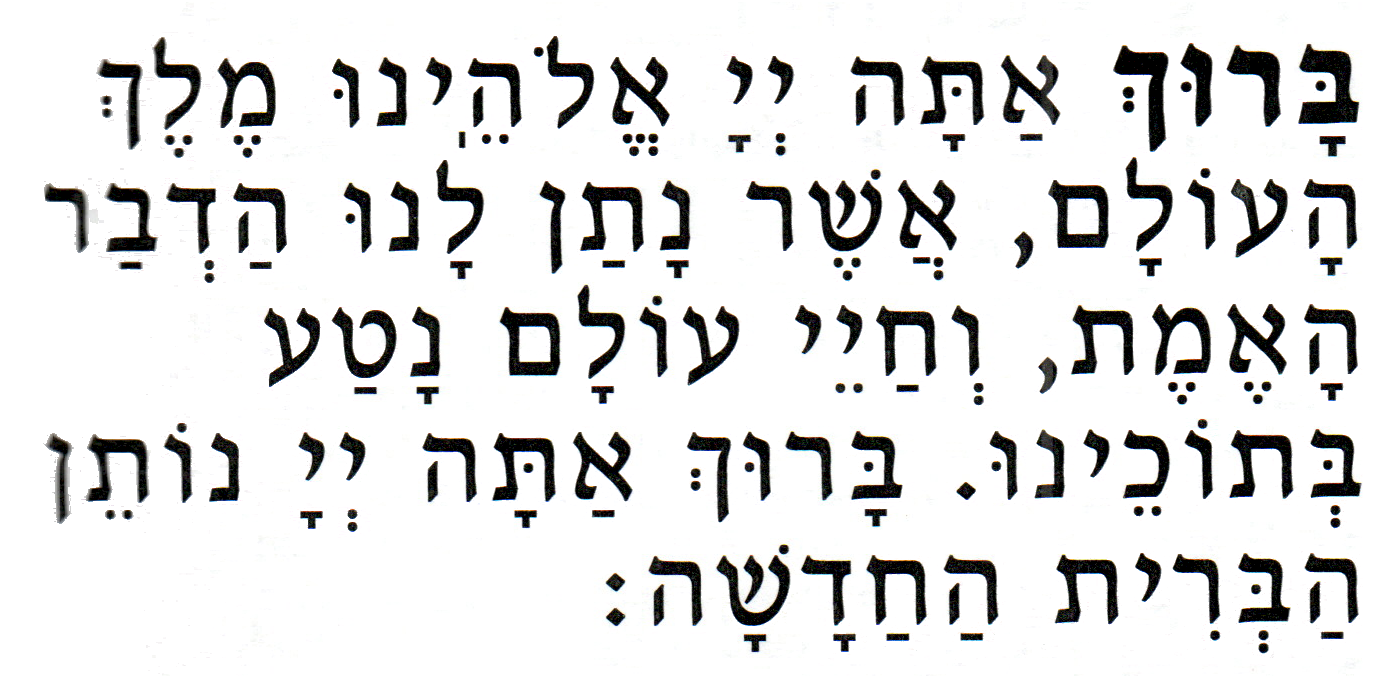
Ba-rookh ah-tah, Adonai Eh-lo-hay-noo, Blessed are You, O Lord our God, |
 |
The Blessing of the MessiahClick this to hear the blessing canted by Jeremiah Greenberg of Messianic Liturgical Resources. Page numbers refer to his Messianic Shabbat Siddur. |
|
|
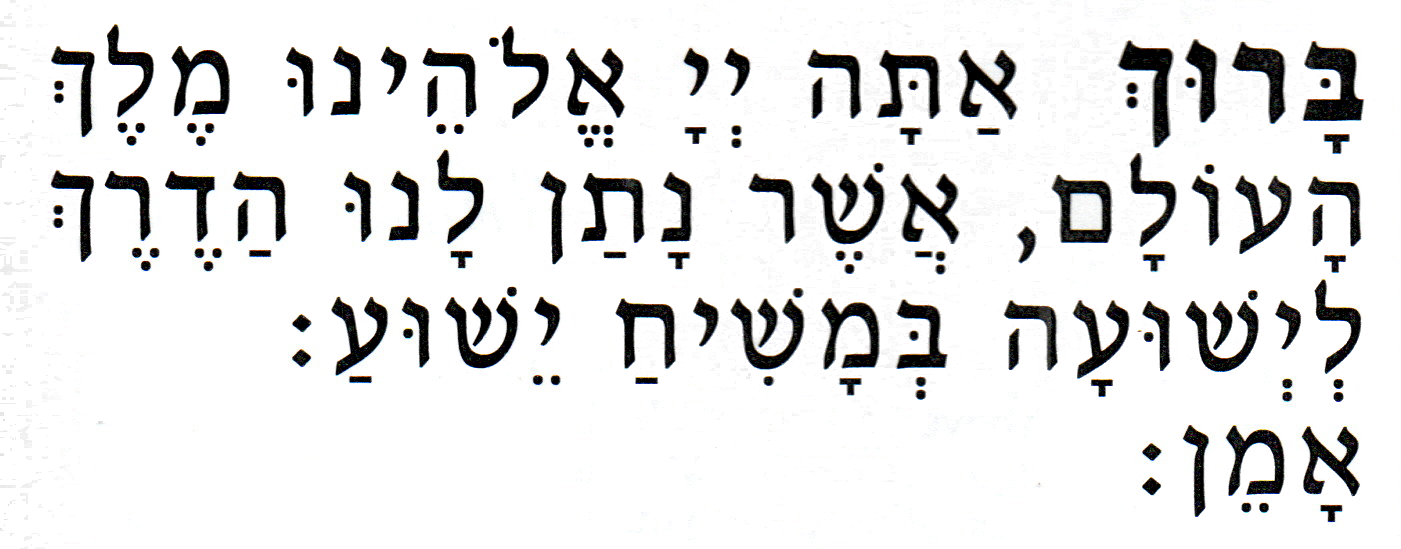
Ba-rookh ah-tah Adonai Eh-lo-hay-noo,
meh-lekh hah-oh-lahm, ah-sher na-tahn la-noo ha-deh-rech l'y'shoo-ah b'ma-she-ahch Yeshua. Ah-mein. Blessed are You, O Lord our God,
King of the Universe, |
 |
פָּרָשָׁה פְקוּדֵי
Parsha 23: P’kudei |
|
|
[In regular years read with Parsha Pekudei,
in leap years read separately] This week's commentary from First Fruits of Zion (Messianic) This week's commentary from Chabad.org (Rabbinical) This week’s commentary from Hebrew4Christians.com (Christian) |
|
| This Week’s Reading Schedule | |
|
Sunday Review and meditate on last week’s Parsha Monday Rishon [1st]: Sheni [2nd]: Tuesday Shlishi [3rd]: R'vi'i [4th]: Wednesday Chamishi [5th]: Shishi [6th]: |
Thursday Shvi'i [7th]: Maftir [Concluding]: Friday Haftarah: (Selections)[GN] M’lakhim Alef (1 Kings) 7:40–50 (S); 7:51–8:21 (A) Ketuvei HaShalichim (Apostolic Writings) Basar: The Gospel Luke 16:1-31 Kepherim: Letters (optional) Revelation 15:5–8 |



Listen to P'kudei read from the CJB
g. Inventory of Materials (38:21-31)
LY: Rishon [1st] 21 This is the inventory of materials used for the tabernacle, the Tabernacle of the Testimony, as they were counted according to Moshe’s command by the L’vi’imLevites under the supervision of Itamar, the son of Aharon the cohen. 22 B’tzal’el the son of Uri, the son of Hur, of the tribe of Y’hudah, made all that ADONAI commanded Moshe. 23 With him was Oholi’av, the son of Achisamakh, of the tribe of Dan, an engraver, a skiled designer, and an embroiderer in blue, purple, and scarlet yarn and in fine linen.
24 All the gold used for everything needed for the Sanctuary, the gold of the offering, weighed 29 talents, 730 shekels [1,930 pounds], according to the Sanctuary shekel.
25 The silver given by those who were counted from the congregation weighed 100 talents, 1,775 shekels [6,650 pounds] using the Sanctuary shekel: 26 a beka per person, that is, half a shekel, using the Sanctuary shekel, for everyone twenty years or older counted in the census, 603,550 men. 27 One hundred talents of silver were used to cast the bases for the Sanctuary and for the bases of the veil: one hundred bases made from one hundred talents, one talent [66 pounds] per base. 28 From the 1,775 shekels [50 pounds] he made hooks for the posts, overlaid their tops, and made fasteners for them.
29 The bronze of the offering was 70 talents, 2,400 shekels [4,680 pounds]. 30 With this he made the bases for the entrance to the Tent of Meeting, the bronze altar, the bronze grate for it, all the utensils of the altar, 31 the bases around the courtyard, the bases for the gateway to the courtyard, all the tent pegs of the tabernacle, and all the tent pegs around the courtyard.
Note on the Matthew passage
24. The half-shekel Temple tax, called simply the didrachma because of the coin usually to pay it. A didrachma, or double-drachma, is a Greek silver coin worth two drachmas, about as much as two Roman denarii, or about two days’ wages. It was commonly used to pay the half-shekel Temple tax, because two drachmas were worth one-half shekel of silver. [BACK]
27b. A stater is a silver coin equivalent to four Attic or two Alexandrian drachmas, or a Jewish shekel: just exactly enough to cover the half-shekel temple tax for two people. [BACK]
Notes on the Revelation Passage
1. A measuring device of some kind. [RETURN]
2. Three and one-half years. For the first half of the seven-year Tribulation period, Jerusalem will again be under the control of Gentiles. Given current events, one must wonder if this means Muslims. [RETURN]
3a. There has been much speculation, even argument, over the identity of the “two witnesses.” Some claim that they are only figurative, representing the “Law and the Prophets,” that is, the witness of Scripture. This is rediculous because the Torah and the Navi'im cannot be literally killed as the witnesses are. Many argue that the two witnesses are Moshe (Moses) and Eliyahu (Elijah), representing the “Law and the Prophets” and because of the nature of the miracles they perform. Still others argue Hanokh (Enoch) and Eliyahu (Elijah) because both of them were translated without tasting death and “it is appointed for men to die once” (Hebrews 9:7). The bottom line is this: all guesses are just guesses. Has HaShem felt it was important for us to know, wouldn’t He have told us? Will knowing the answer draw you closer to HaShem? Will knowing the answer assist you in righteous living? Then it doesn’t matter. [RETURN]
3b. 1,260 days is three and one-half prophetic years. A prophetic year is standd on the lunar calendar and is 360 days. [RETURN]
3c. The wearing of sackcloth is a sign of mourning. [RETURN]
8. Jerusalem. Back under Gentile control, it seems that Jerusalem will have become as wicked as Sodom and Egypt. [RETURN]
9a. With the advent of cable television and world-wide news broadcasting, it is now clear how their bodies will be able to be seen by the whole world. [RETURN]
9b. This will be especially apalling to Jews, who traditionally bury the dead on the same day as their death. [RETURN]
Other commentaries on Exodus 38
Ellicott's Commentary for English Readers
Pulpit Commentary
Matthew Henry's Concise Commentary
Gill's Exposition of the Entire Bible
|
 |
Subscribe to my Substack/newsletter |

ANXIOUSLY WATCHING FOR MASHIACH’S RETURN,
SPEEDILY AND IN OUR DAY. MARANA, TA!


