
NEW: Please subscribe to my Substack/newsletter at the bottom of the page. Thanks!
Parsha[GN] 18: Mishpatim (continued)
“Rulings” • Exod 21:1–24:18
5. The Covenant Sealed (24:1-18)
1Elohim[GN] said to Moshe, “Come up to ADONAI,[GN] you, and Aharon, Nadab, and Abihu, and seventy of the elders of Isra'el, and worship from a distance. 2Moshe alone is come near to ADONAI, but the others must not approach. And the people may not go up with him.”
3When Moshe came and told the people all the words and ordinances of ADONAI, all the people answered with one voice, “Every word that ADONAI has spoken we will do.”
4Moshe wrote down all of ADONAI’s words,[4] then rose up early in the morning and built an altar at the base of the mountain, with twelve pillars for the twelve tribes of Isra'el. 5Then he sent out some young men of Isra'el and they offered burnt offerings and sacrificed young bulls as peace offerings to ADONAI. 6Moshe took half of the blood and put it in basins, and the other half he sprinkled[6] on the altar. 7Then he took the Book of the Covenant[7a] and read it to the people, and they replied,“Every word that ADONAI has spoken we will do and obey.’”[7b]
8So Moshe took the blood, sprinkled it on the people, and said, “Look, this is the blood of the covenant[8] that ADONAI has made with you in accordance with all these words.”
9Then Moshe, Aharon, Nadab, Abihu, and seventy of the elders of Isra'el went up. 10They saw the God of Isra'el.[10] Under his feet was something like a pavement made of sapphireor lapis lazuli stone, as clear as sky. 11Yet Elohim did not harm the nobles of Isra'el. They saw Him, and they ate and drank.
12Then ADONAI said to Moshe, “Come up to Me on the mountain and stay here, so that I may give you the stone tablets with the Torah and the mitzvot I have written for their instruction.”[12]
13So Moshe set out with Y’hoshuaJoshua, his assistant, and went up onto the Mountain of Elohim. 14He said to the elders, “Wait here for us until we return. Hinneh,[GN] Aharon and Hur are with you. Whoever is involved in a dispute can go to them.”
(S: Maftir) 15When Moshe went up on the mountain the cloud covered it, (A: Maftir) 16and the Glory of ADONAI settled on Mount Sinai. For six days the cloud covered it, and on the seventh day ADONAI called to Moshe from within the cloud. 17The appearance of the Glory of ADONAI was like consuming fire on the mountaintop in the eyes of the Isra'elites. 18Moshe entered the middle of the cloud as he went up on the mountain, and he remained on the mountain for forty days and forty nights.[GN]
[CONTINUE READING AT CHAPTER 25]
The Blessing After TorahClick this to hear the blessing canted by Cantor Kenneth B. Cohen of Temple Sholom, Greenwich, CT |
|
|
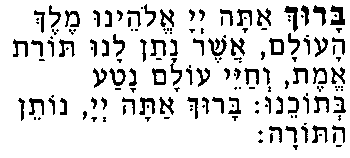
Ba-rookh ah-tah Adonai,
eh-lo-hay-noo meh-lech hah-ohlahm, ah-sher nah-tahn la-noo toe-raht eh-met, v’cha-yaye oh-lahm nah-tah b’toe-chay-noo. Ba-rookh ah-tah Adonai, no-tain ha-to-rah. Blessed are you, O Lord our God, King of the Universe, Who has given us a Torah of truth, and has planted eternal life in our midst. Blessed are You, O Lord, Giver of the Torah. |
|
Now that you’ve read
Mishpatim,
watch Rabbi Greg Hershberg’s teaching
Haftarah
The Blessing of the Haftarah
|
|
|
Ba-rookh, ah-tah Adonai, eh-lo-hay-noo, Ba-rookh ah-tah, Adonai, Blessed are you, O Lord our God, Blessed are You, O Lord, |

|
Haftarah Mishpatim is Yirmeyahu
(Jeremiah) 34:8-22; 33:25-26
Listen to it read from the Complete Jewish Bible
34 8 The word came to Yirmeyahu from ADONAI, after king Tzidkiyahu had made a covenant with all the people who were at Yerushalayim , to proclaim liberty to them, 9 that every man should let his male servant, and every man his female servant, who is a Hebrew or a Hebrewess, go free, that no one should make bondservants of them, of a Jew his brother. 10 All the officials and all the people obeyed who had entered into the covenant, that everyone should let his male servant and everyone his female servant go free, that no one should make bondservants of them any more. They obeyed and let them go, 11 but afterwards they turned, and caused the servants and the handmaids whom they had let go free to return, and brought them into subjection for servants and for handmaids.
12 Therefore The word of ADONAI came to Yirmeyahu from ADONAI, saying, 13 “ADONAI, the God of Isra'el, says: ‘I made a covenant with your fathers in the day that I brought them out of the land of Egypt, out of the house of bondage, saying: 14 At the end of seven years, every man of you shall release his brother who is a Hebrew, who has been sold to you, and has served you six years. You shall let him go free from you. But your fathers didn’t listen to me, and didn’t incline their ear. 15 You had now turned, and had done that which is right in my eyes, in every man proclaiming liberty to his neighbor. You had made a covenant before me in the house which is called by my name; 16 but you turned and profaned my name, and every man caused his servant and every man his handmaid, whom you had let go free at their pleasure, to return. You brought them into subjection, to be to you for servants and for handmaids.’”
17 Therefore ADONAI says: “You have not listened to me, to proclaim liberty, every man to his brother, and every man to his neighbor. Hinneh, I proclaim to you a liberty,” says ADONAI, “to the sword, to plague, and to the famine. I will make you be tossed back and forth among all the kingdoms of the earth. 18 I will give the men who have transgressed my covenant, who have not performed the words of the covenant which they made before me when they cut the calf in two and passed between its parts: 19 the officials of Y'hudah, the officials of Yerushalayim , the eunuchs, the cohenim, and all the people of the land, who passed between the parts of the calf. 20 I will even give them into the hand of their enemies and into the hand of those who seek their life. Their dead bodies will be food for the birds of the sky and for the animals of the earth.
21 “I will give Tzidkiyahu king of Y'hudah and his officials into the hands of their enemies, into the hands of those who seek their life and into the hands of the king of Bavel’s army, who has gone away from you. 22 Hinneh, I will command,” says ADONAI, “and cause them to return to this city. They will fight against it, take it, and burn it with fire. I will make the cities of Y'hudah a desolation, without inhabitant.”
33 25 ADONAI says: “If my covenant of day and night fails, if I have not appointed the ordinances of heaven and earth, 26 then I will also cast away the offspring of Ya'akov, and of David my servant, so that I will not take of his offspring to be rulers over the offspring of Abraham, Isaac, and Ya'akov; for I will cause their captivity to be reversed and will have mercy on them.”
Ketuvei HaShalichim (Apostolic Writings)
The Blessing of the Ketuvei HaShalichimClick this to hear the blessing canted by Jeremiah Greenberg of Messianic Liturgical Resources. Page numbers refer to his Messianic Shabbat Siddur. |
|
|
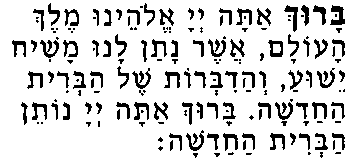
Bah-rookh ah-tah Adonai, Eh-lo-hay-noo meh-lekh hah-ohlahm, ah-shehr nah-tahn la-noo mah-she-ahch Yeshua, v’ha-deebrote shell Ha-breet Ha-kha-da-shah, ba-rookh ah-ta Adonai, notain Hah-breet Hah-kha-da-shah. Blessed are You, O Lord our God, |
 |
Basar
(Gospel)
Mattityahu (Matthew) 5:38-42; 15:1-20; Mordichai (Mark) 7:1-23
5 38“You have heard that our fathers were told, ‘Eye for eye and tooth for tooth.’[Exod. 21:24; Lev. 24:20; Deut. 19:21] 39But I tell you not to stand against one who does you wrong; if someone hits you on your right cheek, let him hit you on the left cheek, too. 40If someone sues you to take your shirt, let him have your jacket, too. 41If a soldier forces you to carry his pack for one mile, carry it for two miles! 42When someone asks you for something, give it to him; when someone wants to borrow something from you, lend it to them.
15 1Then some PhariseesP'rushim and Scribes, Torah teachersSofrim from Yerushalayim came to Yeshua and asked Him, 2“Why do your disciplestalmidim disobey the TakanotTradition of the Elders? For they don’t wash their hands [following the Pharisees’s ritual] before they eat.”
3Yeshua answered, “Really? Why do you disobey God’s commandment because of your TakanotTradition? 4For God commanded, ‘Honor your father and your mother,’[Exod. 20:12; Deut. 5:16.] and, ‘He who speaks evil of father or mother, let him be put to death.’[ Exod. 21:17; Lev. 20:9] 5But you say, ‘Anyone who tells his father or his mother, “Whatever help you might otherwise have gotten from me is a gift devoted to God,” 6he doesn’t need to honor his father or mother.’ You have nullified the word of God for the sake of your TakanotTradition. 7You hypocrites! IsaiahYesha'yahu was right about you when he prophesied,
8‘These people draw near to me with their mouth, and honor me with their lips; but their heart is far from me. 9And in vain do they worship me, teaching as doctrine rules made by men.’”[Isa. 29:13.]
10He called the crowd to Him and said, “Listen and understand this! 11It isn’t what goes into his mouth that makes a man unclean; what makes a man unclean is what what comes out of his mouth.”
12Then the talmidim came up and asked Him, “Do you know that the P'rushim were offended when they heard You say that?”
13But He answered, “Every plant that My heavenly Father didn’t plant will be uprooted. 14 Leave them alone. They are blind guides of the blind. And if the blind guide the blind, both will fall into a pit.”
15Kefa said to Him, “Explain the parable to us.”
16“Don’y you understand yet? Yeshua asked. 17Don’t you realize that everything that goes into the mouth passes into the stomach, and then into the toilet? 18But whatever comes out of the mouth comes from the heart, and this is what makes the man unclean. 19For out of the heart come evil thoughts, murder, adultery, sexual sin, theft, false testimony, and slander. 20These are the things that make a man unclean; but eating without first performing the hand-washing ceremony certainly doesn’t make a man unclean.”
1Then the P'rushimPharisees and some of the SofrimScribes, Torah Reachers who had come from YerushalayimJerusalem gathered around Him. 2They saw some of His talmidimdisciples eating bread with hands that were [ritually] “unclean” — that is, “unwashed.” 3(Following the Takanot[GN] of the elders, the P'rushim, in fact all the Y'hudimJudeans, Jewish leaders, don’t eat unless they ritually wash their hands and forearms. 4When they come home from the marketplace they don’t eat until they have immersed themselves. And there are many other customs which they have received and observe, like the ceremonial immersion of cups, pitchers, bronze vessels, and dining couches.) 5The P'rushim and the Sofrim asked Yeshua, “Why don’t your disciples walk according to the Takanot of the elders instead of eating their food with [ritually] unclean hands?”
6Yeshua answered, “Isaiah prophesied correctly about you hypocrites, as it is written,
8“For you disregard the commandments of God, and cling tightly to the Takanot of men.” 9He went on, “Full well do you reject the commandment of God, that you may keep your Takanot. 10For Moses said, ‘Honor your father and your mother;’[Exod. 20:12; Deut. 5:16] and, ‘He who speaks evil of father or mother, let him be put to death.’ [Exod. 21:17; Lev. 20:9.] 11But you say, ‘If a man tells his father or his mother, “Whatever benefit you might have received from me is Corban,”’” (that is to say, devoted to God) 12“then you no longer allow him to do anything for his father or his mother, 13nullifying the word of God by your Takanot which you have handed down. You do many things like this.”
14He called the crowd to Himself and said to them, “Hear me, all of you, and understand. 15Nothing that goes into a person from outside can defile him; but the things which come out of a person are the things that defile him. 16If anyone has ears to hear, let him hear!”
17When He had entered a house away from the crowd, his talmidim asked Him about the parable. 18He answered them, “Are you also without understanding? Don’t you realize that whatever goes into the man from outside can’t defile him? 19Because it doesn’t go into his heart, but into his stomach, then into the latrine?” (Thus He explained that all “food” is ritually clean.)
20Then He said, “Which comes out of a person — that defiles him. 21For from within, out of people’s hearts, come wicked thoughts, sexual immorality, theft, murder, adultery, 22greed, malice, deceit, indecency, envy, slander, arrogance, foolishness. 23All these evil things come from within and defile the person.”
Kepherim (Letters, optional)
Acts 23:1-11; Hebrews 9:15-22; 10:28-39
Acts 23 1Sha'ulPaul looked intently at the Sanhedrin and said, “Brothers, I have lived my life before God in all good conscience until this very day.”
2HananyahAnanias[2], the Cohen HaGadolHigh Priest, ordered those standing beside him to strike him on the mouth.
3Then Sha'ul said to him, “God will strike you, you whitewashed wall! You dare judge me by the Torah, and violate Torah by ordering me to be struck?”
4Those who stood nearby said, “You dare to insult God’s high priest?”
5Sha'ul said, “Brothers! I didn’t know that he was High Priest.[5a] The Torah says, ‘You shall not speak evil of a ruler of your people.’”[5b]
J. He Appeals to the Pharisees (23:6-10)
6Then Sha'ul, knowing that some of them were Tz'dukimSadducees and some were P'rushimPharisees, shouted out in the Sanhedrin, “Brothers, I am a ParushPharisee, and a son of P'rushim. I’m being judged over the hope and resurrection of the dead!”[6]
7As soon as Sha'ul had said this, an great argument arose between the P'rushim and Tz'dukim, and the Sanhedrin was divided. 8The Tz'dukim say there is no resurrection, no angels, and no spirit;[8] but the Pharisees affirm of these. 9A great clamor arose, and some of the SofrimScribes, Torah scholars who were P'rushim stood up, and argued, “We find nothing wrong with this man. If a spirit or angel has spoken to him, let’s not fight against God!”
10The dispute became so violent that the commander was afraid that Sha'ul would be torn apart by them, and ordered his soldiers to go down and remove him by force and bring him into the barracks.
9 15 For this reason He is the mediator of a new covenant, since a death has occurred for the redemption of the transgressions that were under the first covenant, that those who have been called may receive the promise of the eternal inheritance. 16 For where a last will and testament is, there must of necessity be the death of him who made it. 17 For a will is in force where there has been death, for it is never in force while he who made it lives. 18 Therefore even the first covenant has not been dedicated without blood. 19 For when every commandment had been spoken by Moses to all the people according to the Torah, he took the blood of the calves and the goats, with water and scarlet wool and hyssop, and sprinkled both the book itself and all the people, 20 saying, “This is the blood of the covenant which God has commanded you.” [Exodus 24:8]
21 He sprinkled the tabernacle and all the vessels of the ministry in the same way with the blood. 22 According to the Torah, nearly everything is cleansed with blood, and apart from shedding of blood there is no remission.
10 28 A man who disregards the Torah of Moses dies without compassion on the word of two or three witnesses. 29 How much worse punishment do you think he will be judged worthy of who has trodden under foot the Son of God, and has counted the blood of the covenant with which He was sanctified an unholy thing, and has insulted the Spirit of grace? 30 For we know him who said, “Vengeance belongs to Me. I will repay,” says the Lord. [Deut. 32:35] Again, “The Lord will judge his people.” [Deut. 32:36; Psalm 135:14] 31 It is a fearful thing to fall into the hands of the living God.
32 But remember the former days, in which, after you were enlightened, you endured a great struggle with sufferings: 33 partly, being exposed to both reproaches and oppressions, and partly, becoming partakers with those who were treated so. 34 For you both had compassion on me in my chains and joyfully accepted the plundering of your possessions, knowing that you have for yourselves a better possession and an enduring one in the heavens. 35 Therefore don’t throw away your boldness, which has a great reward. 36 For you need endurance so that, having done the will of God, you may receive the promise.
- 37 “In a very little while,
- he who comes will come and will not wait.
- 38 But the righteous one will live by faith.
- If he shrinks back, my soul has no pleasure in him.”[Habakkuk 2:3-4]
39 But we are not among those who shrink back to destruction, but of those who have faith to the saving of the soul.
The Blessing After the Ketuvei HaShalichimClick this to hear the blessing canted by Jeremiah Greenberg of Messianic Liturgical Resources. Page numbers refer to his Messianic Shabbat Siddur. |
|
|
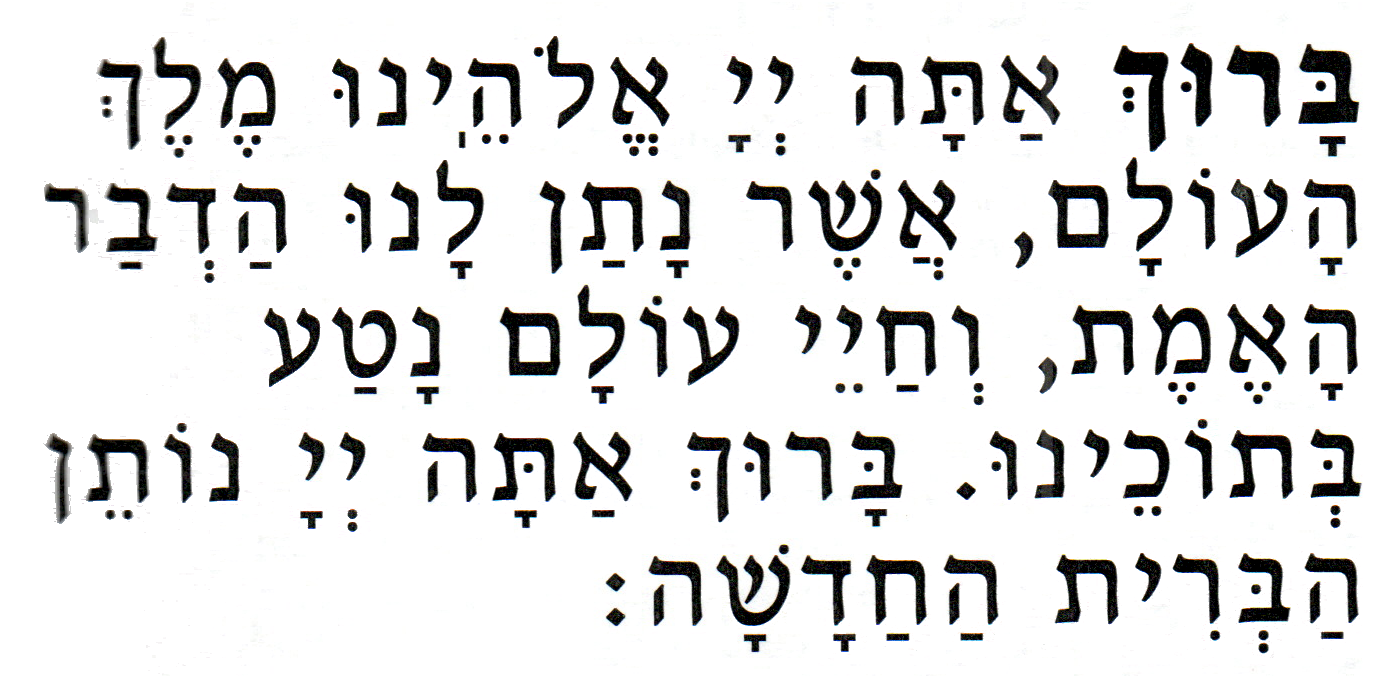
Ba-rookh ah-tah, Adonai Eh-lo-hay-noo, Blessed are You, O Lord our God, |
 |
The Blessing of the MessiahClick this to hear the blessing canted by Jeremiah Greenberg of Messianic Liturgical Resources. Page numbers refer to his Messianic Shabbat Siddur. |
|
|
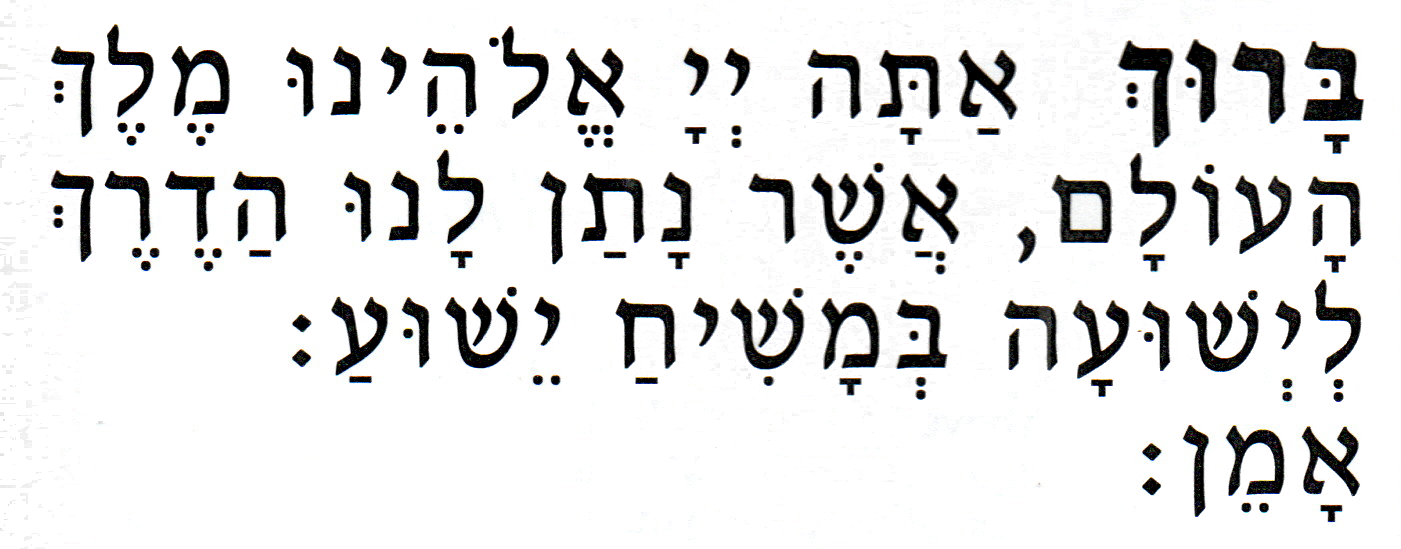
Ba-rookh ah-tah Adonai Eh-lo-hay-noo,
meh-lekh hah-oh-lahm, ah-sher na-tahn la-noo ha-deh-rech l'y'shoo-ah b'ma-she-ahch Yeshua. Ah-mein. Blessed are You, O Lord our God,
King of the Universe, |
 |
4. The Rabbis claim that Moshe did not, in fact, write down all of God’s instruction, but imstead handed down many additional commandments verbally. These are codified in the Talmud and consist of takanot and minhagim. However, the Scripture clearly says that “Moshe wrote down all the words of ADONAI.” Thus, the takanot and minhagim clearly are not “the words of ADONAI."
Most “scholars” (i.e., anti-Bible critics) claim that Moshe could not have penned the Torah because, in their view, there was no alphabet at the time of Moshe. Based on the excellent documentary “The Moshe Controversy” by Timothy P. Mahoney, I think that the Hebrew alphabet was very likely created out of Egyptian hieroglyphics by Joseph and was well established and in use by the Isra'elites by the time of Moshe who, as a highly-educated prince of Egypt, would have been well familiar with both forms of writing. [BACK]
6. “Sprinkle” is probably too “mild” a term to describe how He applied the blood to the altar. The Hebrew word is זָרַ֖ק (zā·raq), to scatter, sprinkle, toss, throw, scatter abundantly, strew. Would “splash” be a better interpretation? [BACK]
7a. Book of the Covenant (Heb. Sefer ha-B'rit) is “usually taken to refer to the legal, moral, and cultic corpus of literature found in Exodus 20:22-23:33.” (Jewish Virtual Library, accessed May 24, 2022.) [BACK]
7b. “‘Every word that has spoken we will do and obey.’ This is one of the most famous verses in Jewish theology, as it clearly. shows the people’s willingness to obey God in all matters. ‘We do and obey” in Hebrew is nah-ah-se v'nishma. Containing the word shema, the rabbis teach that a person is first to hear and then to do what is heard.” (CJSB, p. 104) [BACK]
8. Compare Mark 14:24. [BACK]
10. John 1:18. See “Theophany.” [BACK]
12. Artists and filmmakers nearly always depict the stone tablets as containing just the “Ten Commandments” on them, and Church tradition, whether actually spoken or not, is that only those ten (minus the fourth, obviously) are of importance. But that is clearly not what the Biblical text says. [BACK]
Other commentaries on Exodus 24
Ellicott's Commentary for English Readers
Pulpit Commentary
Matthew Henry's Concise Commentary
Gill's Exposition of the Entire Bible
|
 |
Subscribe to my Substack/newsletter |

ANXIOUSLY WATCHING FOR MASHIACH’S RETURN,
SPEEDILY AND IN OUR DAY. MARANA, TA!


