
NEW: Please subscribe to my Substack/newsletter at the bottom of the page. Thanks!
Parsha 20:
Tetzaveh (continued)
“You are to order,” Exod. 27:20-30:10
e. Other Elements in the Tabernacle (30:1-38)
(1) The Altar of Incense (30:1-10)
(vii) 1 “You are also to make an altar on which to burn incense; make it of acacia wood. 2 It is to be a cubit[2] square and two cubits high. Its horns are be of one piece with it. 3 Overlay it with pure gold: its top, all around its sides, and its horns; and put a gold molding around it. 4 Make two gold rings for it under its molding at the two corners on both sides; this is where the carrying-poles go. 5 Make the poles of acacia wood, overlayed with gold. 6 Place it in front of the curtain that is by the Ark of the Testimony, in front of the Mercy Seat that is over the Testimony, where I will meet with you. 7 Aharon is to burn fragrant incense on it every morning when he tends the lamps.
(Maftir)8 “When Aharon sets up the lamps at twilight, he must burn the incense perpetually before ADONAI ADONAI throughout your generations. 9 On this altar you must not burn any unapproved[9] incense, nor any burnt offering or grain offering, nor are you to pour any drink offering on it. 10 Once a year Aharon is to make atonement on its horns; once a year throughout your generations he is to make atonement for it with the blood of the sin offering of atonement. It is most holy to ADONAI.”
The Blessing After TorahClick this to hear the blessing canted by Cantor Kenneth B. Cohen of Temple Sholom, Greenwich, CT |
|
|
Ba-rookh ah-tah Adonai,
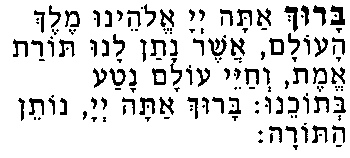
eh-lo-hay-noo meh-lech hah-ohlahm, ah-sher nah-tahn la-noo toe-raht eh-met, v’cha-yaye oh-lahm nah-tah b’toe-chay-noo. Ba-rookh ah-tah Adonai, no-tain ha-to-rah. Blessed are you, O Lord our God, King of the Universe, Who has given us a Torah of truth, and has planted eternal life in our midst. Blessed are You, O Lord, Giver of the Torah. |
|
Haftarah
The Blessing of the Haftarah
|
|
|
Ba-rookh, ah-tah Adonai, eh-lo-hay-noo, Ba-rookh ah-tah, Adonai, Blessed are you, O Lord our God, Blessed are You, O Lord, |

|
Haftarah Tetzaveh is M'lakhim Yechezk'el
(Ezekiel) 43:10-27
Listen to it read from the
Complete Jewish Bible
10 “You, son of man,[GN] show the house to the house of Isra'el, that they may be ashamed of their iniquities; and let them measure the pattern. 11 If they are ashamed of all that they have done, make known to them the form of the house, its fashion, its exits, its entrances, its structure, all its ordinances, all its forms, and all its laws; and write it in their sight, that they may keep the whole form of it, and all its ordinances, and do them.
12 “This is the law of the House. On the top of the mountain the whole limit around it is to be most holy. Behold, this is the law of the House.
13 “These are the measurements of the altar by cubits (the cubit[GN] is a cubit and a hand width): the bottom is to be a cubit, and the width a cubit, and its border around its edge a span;[GN] and this is to be the base of the altar. 14 From the bottom on the ground to the lower ledge is to be two cubits, and the width one cubit; and from the lesser ledge to the greater ledge is to be four cubits, and the width a cubit. 15 The upper altar is to be four cubits; and from the altar hearth and upward there are to be four horns. 16 The altar hearth is to be twelve cubits long by twelve wide, square in its four sides. 17 The ledge is to be fourteen cubits long by fourteen wide in its four sides; and the border about it is to be half a cubit; and its bottom is to be a cubit around; and its steps are to look toward the east.”
18 He said to me, “Son of man, Adonai ADONAI says: ‘These are the ordinances of the altar in the day when they make it, to offer burnt offerings on it, and to sprinkle blood on it. 19 You are to give to the Levitical priests who are of the offspring of Zadok, who are near to Me, to minister to Me,’ says Adonai ADONAI, ‘a young bull for a sin offering. 20 You are to take of its blood and put it on its four horns, and on the four corners of the ledge, and on the border all around. You are to cleanse it and make atonement for it that way. 21 You are to also take the bull of the sin offering, and it is to be burned in the appointed place of the house, outside of the sanctuary.
22 “On the second day you are to offer a male goat without defect for a sin offering; and they are to cleanse the altar, as they cleansed it with the bull. 23 When you have finished cleansing it, you are to offer a young bull without defect and a ram out of the flock without defect. 24 You are to bring them near to ADONAI, and the priests are to cast salt on them, and they are to offer them up for a burnt offering to ADONAI.
25 “Seven days you are to prepare every day a goat for a sin offering. They are to also prepare a young bull and a ram out of the flock, without defect. 26 Seven days shall they make atonement for the altar and purify it. So shall they consecrate it. 27 When they have accomplished the days, it is to be that on the eighth day and onward, the priests are to make your burnt offerings on the altar and your peace offerings. Then I will accept you,’ says Adonai ADONAI.”
Ketuvei HaShalichim (Apostolic Writings)
The Blessing of the Ketuvei HaShalichimClick this to hear the blessing canted by Jeremiah Greenberg of Messianic Liturgical Resources. Page numbers refer to his Messianic Shabbat Siddur. |
|
|
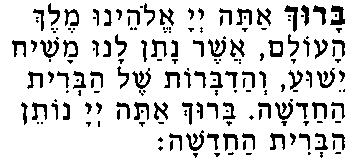
Bah-rookh ah-tah Adonai, Eh-lo-hay-noo meh-lekh hah-ohlahm, ah-shehr nah-tahn la-noo mah-she-ahch Yeshua, v’ha-deebrote shell Ha-breet Ha-kha-da-shah, ba-rookh ah-ta Adonai, notain Hah-breet Hah-kha-da-shah. Blessed are You, O Lord our God, |
 |
Basar
(Gospel)
The Gospel readiing for this portion is Mark 6:14-29
14King Herod heard of this, because Yeshua’s reputation had become well known. Some were saying, “YochananJohn the Immerser has risen from the dead, and that’s why these powers are at work in Him.” 15But others said, “He is EliyahuElijah.” Still others said, “He is a prophet, or like one of the prophets.” 16But when Herod heard about it, he said, “Yochanan, the man I beheaded, has been raised from the dead.”
17For Herod himself had sent and had Yochanan arrested and bound in prison on account of Herodias, his brother Philip’s wife, whom he had married. 18Yochanan had told Herod, “It is not lawful for you to have your brother’s wife.” 19So Herodias held a grudge against Yochanan and wanted to kill him, but she couldn’t, 20because Herod was in awe of Yochanan and was protecting him, knowing that he was a righteous and holy man. When Herod heard him, he was very perplexed, yet he enjoyed listening to him.
21Then an opportune time came on Herod’s birthday, when he hosted a banquet for his nobles, military commanders officers, and the leading men of the GalilGalilee. 22When Herodias’ daughter came in and danced, she pleased Herod and his guests. The king said to the girl, “Ask for whatever you want, and I will give it to you.” 23And He swore an oath her, “Whatever you ask of me, I will give you, up to half of my kingdom.”
24She went out and asked her mother, “What should I ask for?”
She said, “The head of Yochanan the Immerser.”
25She immediately hurried back in to the king and asked, “I want you to give me the head of Yochanan the Immerser on a platter right now .”
26The king was extremely sorry, but for the sake of his oaths and of his dinner guests, he didn’t wish to refuse her. 27Immediately the king sent an executioner and ordered him to bring Yochanan’s head. So he went to the prison and beheaded Yochanan, 28 brought his head on a platter, and gave it to the girl, and the girl gave it to her mother.
29When Yochanan’s talmidim heard about this, they came and took his body and laid it in a tomb.
Kepherim (Letters, optional)
The reading from the Kepharim for this portion is Philippians 4:10-20
10 But I rejoice in the Lord greatly that now at length you have revived your thought for me; in which you did indeed take thought, but you lacked opportunity. 11 Not that I speak because of lack, for I have learned in whatever state I am, to be content in it. 12 I know how to be humbled, and I also know how to abound. In any and all circumstances I have learned the secret both to be filled and to be hungry, both to abound and to be in need. 13 I can do all things through Messiah who strengthens me. 14 However you did well that you shared in my affliction. 15 You yourselves also know, you Philippians, that in the beginning of the Good News, when I departed from Macedonia, no assembly shared with me in the matter of giving and receiving but you only. 16 For even in Thessalonica you sent once and again to my need. 17 Not that I seek for the gift, but I seek for the fruit that increases to your account. 18 But I have all things and abound. I am filled, having received from Epaphroditus the things that came from you, a sweet-smelling fragrance, an acceptable and well-pleasing sacrifice to God. 19 My God will supply every need of yours according to his riches in glory in Messiah Yeshua. 20 Now to our God and Father be the glory forever and ever! Amen.
The Blessing After the Ketuvei HaShalichimClick this to hear the blessing canted by Jeremiah Greenberg of Messianic Liturgical Resources. Page numbers refer to his Messianic Shabbat Siddur. |
|
|
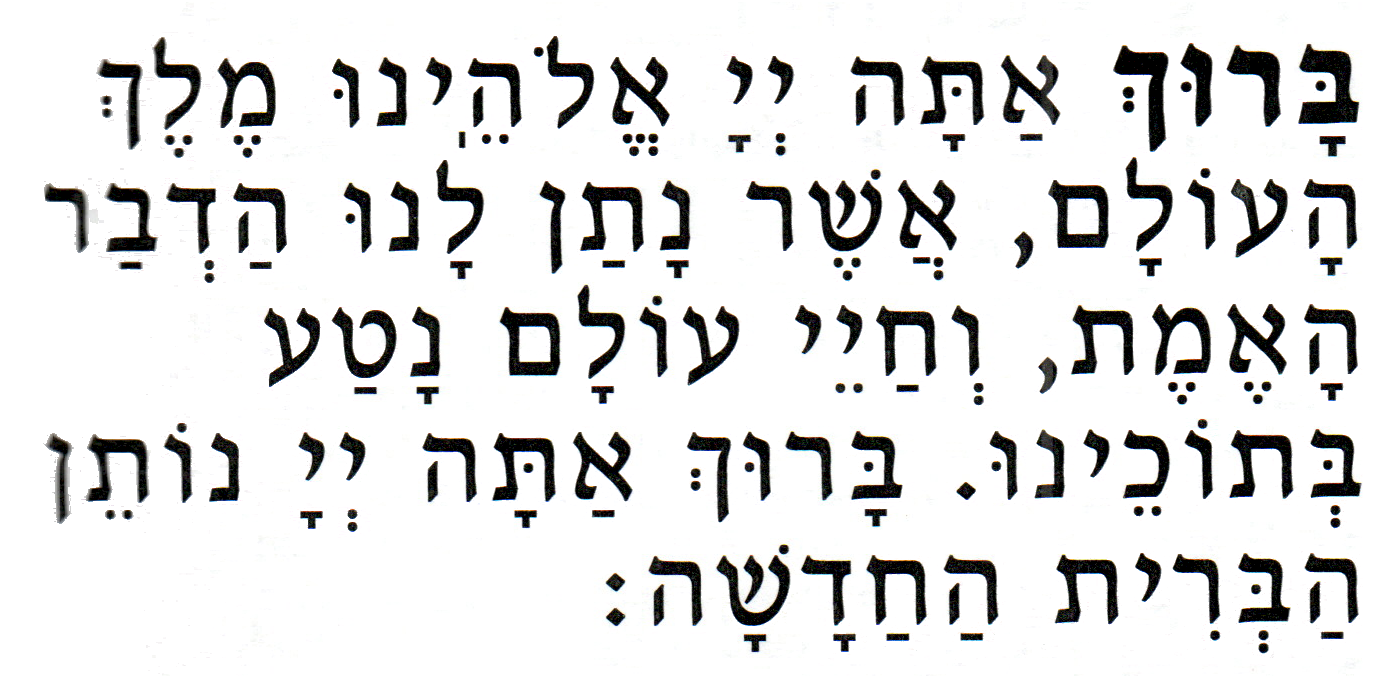
Ba-rookh ah-tah, Adonai Eh-lo-hay-noo, Blessed are You, O Lord our God, |
 |
The Blessing of the MessiahClick this to hear the blessing canted by Jeremiah Greenberg of Messianic Liturgical Resources. Page numbers refer to his Messianic Shabbat Siddur. |
|
|
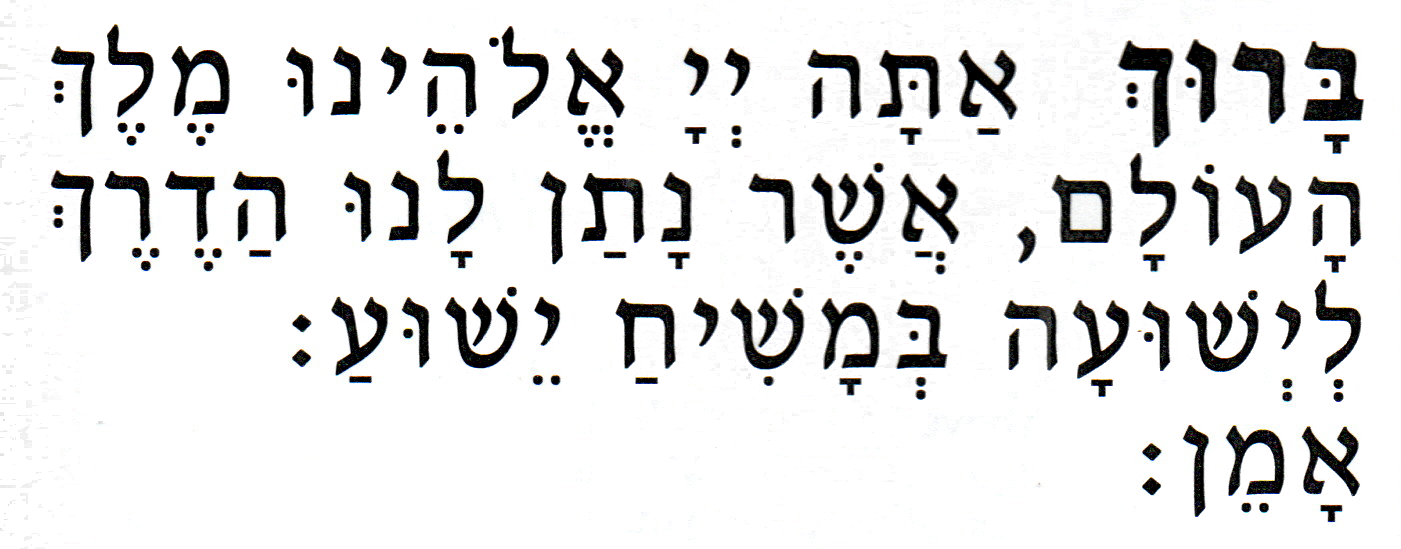
Ba-rookh ah-tah Adonai Eh-lo-hay-noo,
meh-lekh hah-oh-lahm, ah-sher na-tahn la-noo ha-deh-rech l'y'shoo-ah b'ma-she-ahch Yeshua. Ah-mein. Blessed are You, O Lord our God,
King of the Universe, |
 |
פָּרָשָׁה כִּי תִשָּׂא
Parsha 21. KiTisa |
|
|
This week’s commentary from First Fruits of Zion (Messianic) |
|
| This Week’s Reading Schedule | |
|
Sunday Review and meditate on last week’s Parsha Monday Rishon [1st]: 30:11-31:17 Sheni [2nd]: 31:18-33:11 Tuesday Shlishi [3rd]: 33:12-16 R'vi'i [4th]: 33:17-23 Wednesday Chamishi [5th]: 34:1-9 Shishi [6th]: 34:10-26 |
Thursday Shvi'i [7th]: 34:27-32 Maftir [Concluding]: 34:33-35 Friday Haftarah: (Selections)[GN] Yechezk’el (Ezekiel) 36:16–38 Ketuvei HaShalichim (Apostolic Writings) Basar: The Gospel Yochanan (John) 11:47-56 Kepherim: Letters (optional) Lukos (Luke) 11:14–20 P’yilut (Acts) 7:35–8:1 Korintim Alef (1Cor.) 10:1–13 Korintim Bet (2Cor. 3:1–18 |



Listen to
Parsha Ki Tisa read from the CJB
(2) The Census (30:11-16)
(i) 11 ADONAI said to Moshe, 12 “When you take a census of the people of Isra'el to number them, each man must pay ADONAI a ransom for his life when he is counted. Then there will be no plague among you when they are numbered. 13 Everyone who crosses over to those who are counted must pay half a shekel, according to the sanctuary shekel which weighs twenty gerahs.[13] This half a shekel is an offering to ADONAI.
14 “Everyone twenty years old and older who crosses over to those who are counted[14] must give this offering to ADONAI.
15 “When making the contribution to ADONAI to atone for your lives, the rich are not to give more and the poor are not to give less than the half shekel.[15] 16 Take the atonement money from the people of Isra'el and use it for the service of the Tent of Meeting. It will serve as a memorial for the people of Isra'el before ADONAI to atone[16] for your lives.”
(3) The Bronze Basin (30:17-21)
17 ADONAI said to Moshe, 18 “Make a bronze with a bronze stand for washing. Place it between the Tent of Meeting and the altar, and put water in it. 19 Aharon and his sons are to wash their hands and their feet in it. 20 Whenever they enter the Tent of Meeting or approach the altar to minister by presenting an offering made by fire to ADONAI they must wash with water so they don’t die. 21 They must wash their hands and their feet so that they not die. This shall be a permanent statute for them, for Aharon and his descendants throughout their generations.”
(4) The Anointing Oil (30:22-33)
22 Again ADONAI said to Moshe, 23 “Take the finest spices: five hundred shekels[23] of liquid myrrh, half that much fragrant cinnamon, that is, two hundred and fifty shekels, two hundred and fifty shekels of fragrant cane, 24 five hundred shekels of cassia (all according to the sanctuary shekel), and a hin[24] of olive oil. 25 Prepare from these a holy anointing oil, a fragrant mixturemthe work of a perfumer; it will be a holy anointing oil. 26 Use it to anoint the Tent of Meeting, the Ark of the Testimony, 27 the table and all its implements, the lampstand and its accessories, the altar of incense, 28 the altar of burnt offering with all its utensils, and the basin with its stand. 29 You are to consecrate them so that they will be most holy. Whatever touches them will be holy. 30 Anoint Aharon and his sons, and copnsecrate them to serve Me as cohenim. 31 You are to tell the people of Isra'el, ‘This will be My holy anointing oil throughout your generations. 32 It must not used for ordinary anointing oil and a person’s body, and you must not make any like it using its formula. It is holy, and it must be holy to you. 33 Anyone who compounds something like it or puts any of it on a layman[33] must be cut off from his people.’”
(5) The Incense (30:34-38)
34 Then ADONAI told Moshe, “Take fragrant spices — gum resin, onycha, albanum, these sweet spices along with pure frankincense — all in equal measure. 35 Make a fragrant blend of incense from it, the work of the perfumer, seasoned with salt, pure and holy. 36 Grind some of it very finely and place some of it in front of the Testimony in the Tent of Meeting, where I will meet with you. It shall be to you most holy to you. 37 You must not make any incense for yourselves using this formula; it is to be regarded by you as sacred for ADONAI. 38 Anyone who makes any like it to enjoy its fragrance is to be cut off from his people.”
2. A cubit is the length from the tip of the middle finger to the elbow on a man’s arm, or about 18 inches or 46 centimeters. [BACK]
9. Unapproved: Hebrew זָרָ֖ה (zā·rāh), strange, to be a stranger or to become estranged or alienated; a foreigner or an enemy; loathsome; a prostitute. [BACK]
13. Units of weight in ancient times were based on the known weight of things around them. A shekel (שקל, weight) is the basic ancient Hebrew unit of measure for weight, not currency (the earliest known coins were used in Anatolia, Asia Minor or modern Turkey, in the seventh century BCE). It weighs 20 gerah (גרה, grain), about 0.39 ounces or 11 grams. A gerah (גרה, grain) is 1/20 of a shekel, equal to the weight of 16 barley grains or 4 to 5 carob beans. Weights and measures in ancient times varied widely from place to place; therefore, Moshe established the standard sanctuary shekel, or sacred shekel. [BACK]
14. “… who crosses over to those who are counted …” It would seem that they divided the camp then called people one at a time to cross over past a certain point as they were counted. [BACK]
15. See Matthew 17:24-27. [BACK]
16. Atone: Hebrew כָּפַר (kawfar), to cover. The sacrificial system did not provide forgiveness of sin. It merely covered them (so God would not see them) until the sacrifice of Messiah provided for ultimate forgiveness and sanctification. (Hebrews 10:3-10, cf Hebrews 10:18-20) [BACK]
23. 500 shekels is about 12½ pounds. [BACK]
24. A hin is about a gallon. [BACK]
33. Layman: Hebrew זָ֑ר (zār), stranger, foreigner; the clear implication is that it refers to any person not ordained to the priesthood, anyone other than Aharon and his sons. [BACK]
Other commentaries on Exodus 30
Ellicott's Commentary for English Readers
Pulpit Commentary
Matthew Henry's Concise Commentary
Gill's Exposition of the Entire Bible
|
 |
Subscribe to my Substack/newsletter |

ANXIOUSLY WATCHING FOR MASHIACH’S RETURN,
SPEEDILY AND IN OUR DAY. MARANA, TA!


