
NEW: Please subscribe to my Substack/newsletter at the bottom of the page. Thanks!
Parsha[GN] 19:
T'rumah (continued)
“Contribution,” Exod.
25:1-27:19
(2) The Bronze Altar (27:1-8)
(vi) 1 “You are to construct the altar of acacia wood. It is to be square, five cubits [7½ feet] long, five cubits wide, and three cubits [4½ feet] high. 2 You are to make its horns of one piece with it, one horn on each of its four corners, and overlay it with bronze. 3 Make all its vessels of bronze — its pots for removing ashes, its shovels, basins, meat forks, and fire pans. 4 Make a grate for it of bronze mesh, with four bronze rings on its corners. 5 Put it under the rim of the altar, so that the netting reaches halfway up the altar. 6 Make acacia wood poles for the altar and overlay them with bronze. 7 Its poles are be inserted into the rings on both sides of the altar when carrying it. 8 Make it with planks so that it is hollow. It is to be made just as you were shown on the mountain.
(3) Curtains and Posts for the Courtyard (27:9-19)[GN]
(vii) 9 “Make a courtyard for the tabernacle: on the south side facing southward there are to be curtains[9] of finely woven linen, one hundred cubits [150 feet] long for one side, 10 supported on twenty posts with bronze bases. The hooks on the posts and their attaached rings are to be of silver. 11 Likewise, along the north side, there are to be curtains one hundred cubits long, with twenty posts with bronze bases; the hooks on the posts and their attaached rings are to be of silver. 12 Across the width of the courtyard on the west side are to be curtains fifty cubits [75 feet] long, with ten posts on ten bases. 13 The width of the courtyard on the east side shall also be fifty cubits. 14 The curtains for one side of the gateway are to be fifteen cubits [22½ feet] long, with three posts on three bases. 15 For the other side there are also to be curtains fifteen cubits long, with three posts on three bases.
16 “The gateway to the courtyard is to be a curtain twenty cubits [30 feet] wide, of finely woven linen with blue, purple, and scarlet embroidery, on four posts with four bases.
The Blessing After TorahClick this to hear the blessing canted by Cantor Kenneth B. Cohen of Temple Sholom, Greenwich, CT |
|
|
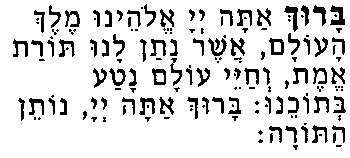
Ba-rookh ah-tah Adonai,
eh-lo-hay-noo meh-lech hah-ohlahm, ah-sher nah-tahn la-noo toe-raht eh-met, v’cha-yaye oh-lahm nah-tah b’toe-chay-noo. Ba-rookh ah-tah Adonai, no-tain ha-to-rah. Blessed are you, O Lord our God, King of the Universe, Who has given us a Torah of truth, and has planted eternal life in our midst. Blessed are You, O Lord, Giver of the Torah. |
|
Now that you’ve read
T’rumah,
watch Rabbi Greg Hershberg’s teaching
Haftarah
The Blessing of the Haftarah
|
|
|
Ba-rookh, ah-tah Adonai, eh-lo-hay-noo, Ba-rookh ah-tah, Adonai, Blessed are you, O Lord our God, Blessed are You, O Lord, |

|
Haftarah T'rumah is M'lakhim Alef
(1 Kings) 5:12-6:13
Listen to it read from the
Complete Jewish Bible
12 (4:32) He spoke three thousand proverbs, and his songs numbered one thousand five. 13 (4:33) He spoke of trees, from the cedar that is in Lebanon even to the hyssop that grows out of the wall; he also spoke of animals, of birds, of creeping things, and of fish. 14 (4:34) People of all nations came to hear the wisdom of Solomon, sent by all kings of the earth who had heard of his wisdom.
15 (5:1) Hiram king of Tyre sent his servants to Solomon, for he had heard that they had anointed him king in the place of his father, and Hiram had always loved David. 16 (5:2) Solomon sent to Hiram, saying, 17 (5:3) “You know that David my father could not build a house for the name of ADONAI his God because of the wars which were around him on every side, until ADONAI put his enemies under the soles of his feet. 18 (5:4) But now ADONAI my God has given me rest on every side. There is no enemy and no evil occurrence. 19 (5:5) Behold, I intend to build a house for the name of ADONAI my God, as ADONAI spoke to David my father, saying, ‘Your son, whom I will set on your throne in your place shall build the house for my name.’ 20 (5:6) Now therefore command that cedar trees be cut for me out of Lebanon. My servants will be with your servants; and I will give you wages for your servants according to all that you say. For you know that there is nobody among us who knows how to cut timber like the Sidonians.”
21 (5:7) When Hiram heard the words of Solomon, he rejoiced greatly, and said, “Blessed is ADONAI today, who has given to David a wise son to rule over this great people.” 22 (5:8) Hiram sent to Solomon, saying, “I have heard the message which you have sent to me. I will do all your desire concerning timber of cedar, and concerning cypress timber. 23 (5:9) My servants will bring them down from Lebanon to the sea. I will make them into rafts to go by sea to the place that you specify to me, and will cause them to be broken up there, and you will receive them. You will accomplish my desire, in giving food for my household.”
24 (5:10) So Hiram gave Solomon cedar timber and cypress timber according to all his desire. 25 (5:11) Solomon gave Hiram twenty thousand cors* 20,000 cors would be about 120,000 bushels or about 4.2 megaliters of wheat, which would weigh about 3,270 metric tons. of wheat for food to his household, and twenty cors† 20 cors is about 1,100 gallons or about 4220 liters. of pure oil. Solomon gave this to Hiram year by year.
26 (5:12) ADONAI gave Solomon wisdom, as he promised him. There was peace between Hiram and Solomon, and the two of them made a treaty together.
27 (5:13) King Solomon raised a levy out of all Isra'el; and the levy was thirty thousand men. 28 (5:14) He sent them to Lebanon, ten thousand a month by courses: for a month they were in Lebanon, and two months at home; and Adoniram was over the men subject to forced labor. 29 (5:15) Solomon had seventy thousand who bore burdens, and eighty thousand who were stone cutters in the mountains, 30 (5:16) besides Solomon’s chief officers who were over the work: three thousand three hundred who ruled over the people who labored in the work. 31 (5:17) The king commanded, and they cut out large stones, costly stones, to lay the foundation of the house with worked stone. 32 (5:18) Solomon’s builders and Hiram’s builders and the Gebalites cut them, and prepared the timber and the stones to build the house.
6 1 In the four hundred and eightieth year after the children of Isra'el had come out of the land of Egypt, in the fourth year of Solomon’s reign over Isra'el, in the month Ziv, which is the second month, he began to build ADONAI’s House. 2 The house which king Solomon built for ADONAI had a length of sixty cubits,* A cubit is the length from the tip of the middle finger to the elbow on a man’s arm, or about 18 inches or 46 centimeters. and its width twenty, and its height thirty cubits. 3 The porch in front of the temple of the house had a length of twenty cubits, which was along the width of the house. Ten cubits was its width in front of the house. 4 He made windows of fixed lattice work for the house. 5 Against the wall of the house, he built floors all around, against the walls of the house all around, both of the temple and of the inner sanctuary; and he made side rooms all around. 6 The lowest floor was five cubits wide, and the middle was six cubits wide, and the third was seven cubits wide; for on the outside he made offsets in the wall of the house all around, that the beams should not be inserted into the walls of the house. 7 The house, when it was under construction, was built of stone prepared at the quarry; and no hammer or ax or any tool of iron was heard in the house while it was under construction. 8 The door for the middle side rooms was in the right side of the house. They went up by winding stairs into the middle floor, and out of the middle into the third. 9 So he built the house and finished it; and he covered the house with beams and planks of cedar. 10 He built the floors all along the house, each five cubits high; and they rested on the house with timbers of cedar.
11 ADONAI’s word came to Solomon, saying, 12 “Concerning this house which you are building, if you will walk in my statutes, and execute my ordinances, and keep all my commandments to walk in them, then I will establish my word with you, which I spoke to David your father. 13 I will dwell among the children of Isra'el, and will not forsake my people Isra'el.”
Ketuvei HaShalichim (Apostolic Writings)
The Blessing of the Ketuvei HaShalichimClick this to hear the blessing canted by Jeremiah Greenberg of Messianic Liturgical Resources. Page numbers refer to his Messianic Shabbat Siddur. |
|
|
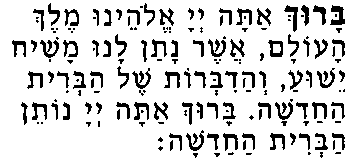
Bah-rookh ah-tah Adonai, Eh-lo-hay-noo meh-lekh hah-ohlahm, ah-shehr nah-tahn la-noo mah-she-ahch Yeshua, v’ha-deebrote shell Ha-breet Ha-kha-da-shah, ba-rookh ah-ta Adonai, notain Hah-breet Hah-kha-da-shah. Blessed are You, O Lord our God, |
 |
Basar
(Gospel)
Mattityahu (Matthew) 17:22-27
22While they were together in the Galil, Yeshua said to them, “The Son of Man is about to be betrayed to men 23who will kill Him, but on the third day He will be raised up.” They were extremely sad.
17. The Miracle of the Temple Tax (17:24-27; Mark 12:13-17)
24When they had come to CapernaumK'far-Nachum, the didrachma24] collectors came to Kefa and asked him, “Doesn’t your rabbi pay the didrachma?” 25He said, “Yes.”
When he came into the house, Yeshua anticipated him, saying, “What do you think, Shim`on? From whom do the kings of the earth receive toll or tribute? From their sons, or from strangers?”
26Kefa said to him, “From strangers.”
Yeshua said to him, “So then, the sons are exempt. 27But, just so we don’t cause offense,[27a] go down to the lake and cast a hook. Take the first fish that comes up. When you have opened its mouth, you’ll find a stater.[27b] Take that, and give it to them for you and Me.”
Kepherim (Letters, optional)
Messianic Jews (Hebrews) 8:1–6; 9:23–24; 10:1
8 1 Now in the things which we are saying, the main point is this: we have such a High Priest, Who sat down on the right hand of the throne of the Majesty in the heavens, 2 a Servant of the sanctuary and of the true tabernacle which the Lord pitched, not man. 3 For every high priest is appointed to offer both gifts and sacrifices. Therefore it is necessary that this High Priest also have something to offer. 4 For if He were on earth, He would not be a priest at all, seeing there are priests who offer the gifts according to the Torah, 5 who serve a copy and shadow of the heavenly things, even as Moshe was warned by God when he was about to make the tabernacle, for He said, “See, you shall make everything according to the pattern that was shown to you on the mountain.” [Exodus 25:40] 6 But now He has obtained a more excellent ministry, by as much as He is also the Mediator of a better covenant, which on better promises has been given as Torah.
9 23 It was necessary therefore that the copies of the things in the heavens should be cleansed with these, but the heavenly things themselves with better sacrifices than these. 24 For Mashiach hasn’t entered into holy places made with hands, which are representations of the true, but into heaven itself, now to appear in the presence of God for us;
10 1 For the Torah, having a shadow of the good to come, not the very image of the things, can never with the same sacrifices year by year, which they offer continually, make perfect those who draw near.
The Blessing After the Ketuvei HaShalichimClick this to hear the blessing canted by Jeremiah Greenberg of Messianic Liturgical Resources. Page numbers refer to his Messianic Shabbat Siddur. |
|
|
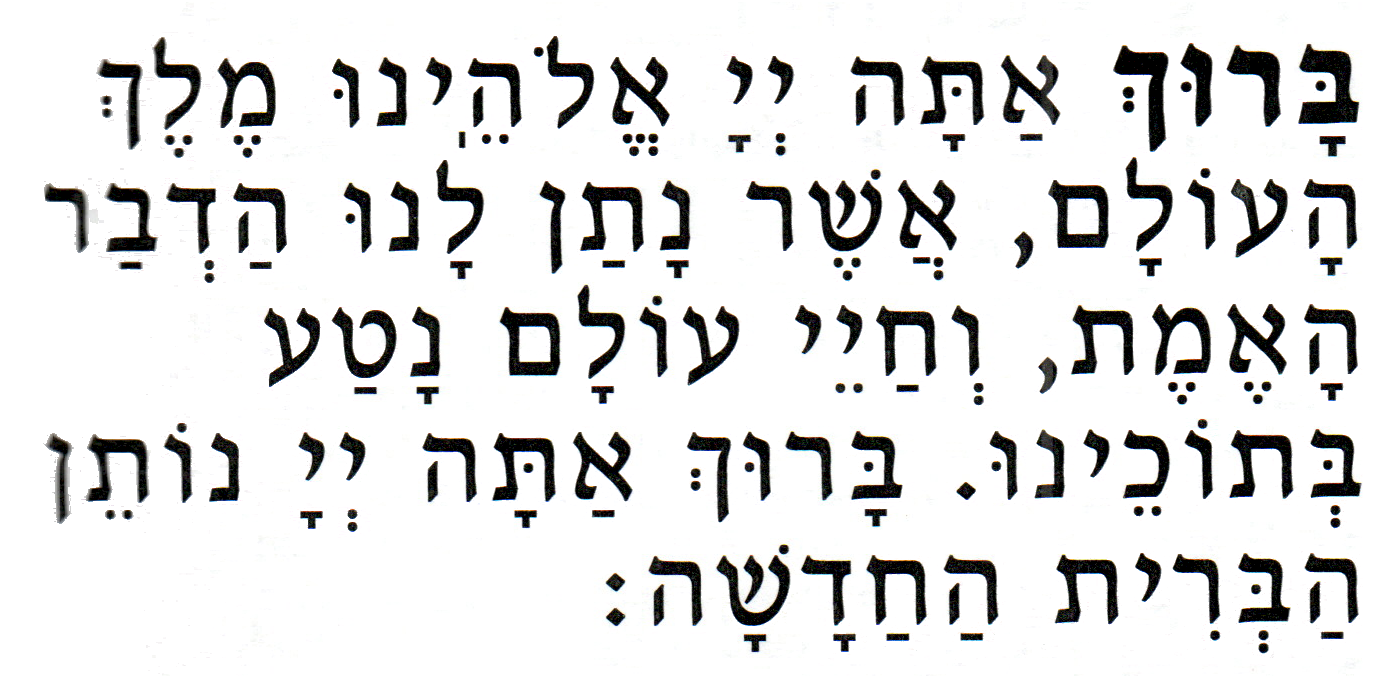
Ba-rookh ah-tah, Adonai Eh-lo-hay-noo, Blessed are You, O Lord our God, |
 |
The Blessing of the MessiahClick this to hear the blessing canted by Jeremiah Greenberg of Messianic Liturgical Resources. Page numbers refer to his Messianic Shabbat Siddur. |
|
|
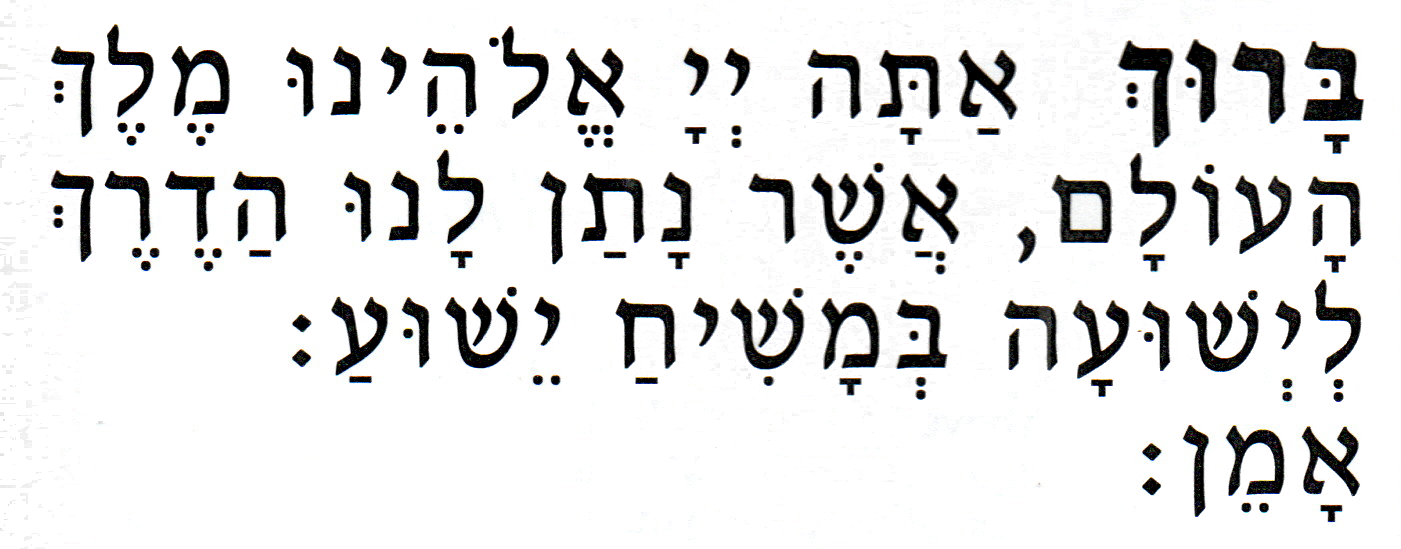
Ba-rookh ah-tah Adonai Eh-lo-hay-noo,
meh-lekh hah-oh-lahm, ah-sher na-tahn la-noo ha-deh-rech l'y'shoo-ah b'ma-she-ahch Yeshua. Ah-mein. Blessed are You, O Lord our God,
King of the Universe, |
 |
פָּרָשָׁה תְּצַוֶּה
Parsha 20.
Tetzaveh |
|
|
This week’s commentary from First Fruits of Zion (Messianic) |
|
| This Week’s Reading Schedule | ||
|
Sunday Review and meditate on last week’s Parsha Monday Rishon [1st]: 27:20-28:12 Sheni [2nd]: 28:13-30 Tuesday Shlishi [3rd]: 28:31-43 R'vi'i [4th]: 29:1-18 Wednesday Chamishi [5th]: 29:19-37 Shishi [6th]: 29:38-45 |
Thursday Shvi'i [7th]: 30:1-7 Maftir [Concluding]: 30:8-10 Friday Haftarah: (Selections)[GN] 1Sam. 15:2–34 Ketuvei HaShalichim (Apostolic Writings) Basar: The Gospel Mark 6:14-29 Kepherim: Letters (optional) Philippians 4:10–20 |
|



Listen to
Parsha Tetzaveh read from the CJB
(4) Oil for the Lamps (27:20-21)
(i) 20 “You are to order the people of Isra'el to bring you pure oil of beaten olives for the light, to keep a lamp burning continually.[20] 21 Aharon and his sons are to shall keep it in the Tent of Meeting, outside the curtain which is in front of the Testimony, and keep it burning from evening to morning before ADONAI. This is to be a permanent regulation throughout all the generations of the people of Isra'el.
9. Hebrew קְלָעִ֨ים (qə·lā·‘îm), curtains, drapes, hangings. The CJB translates the word as “tapestries.” I like that. [BACK]
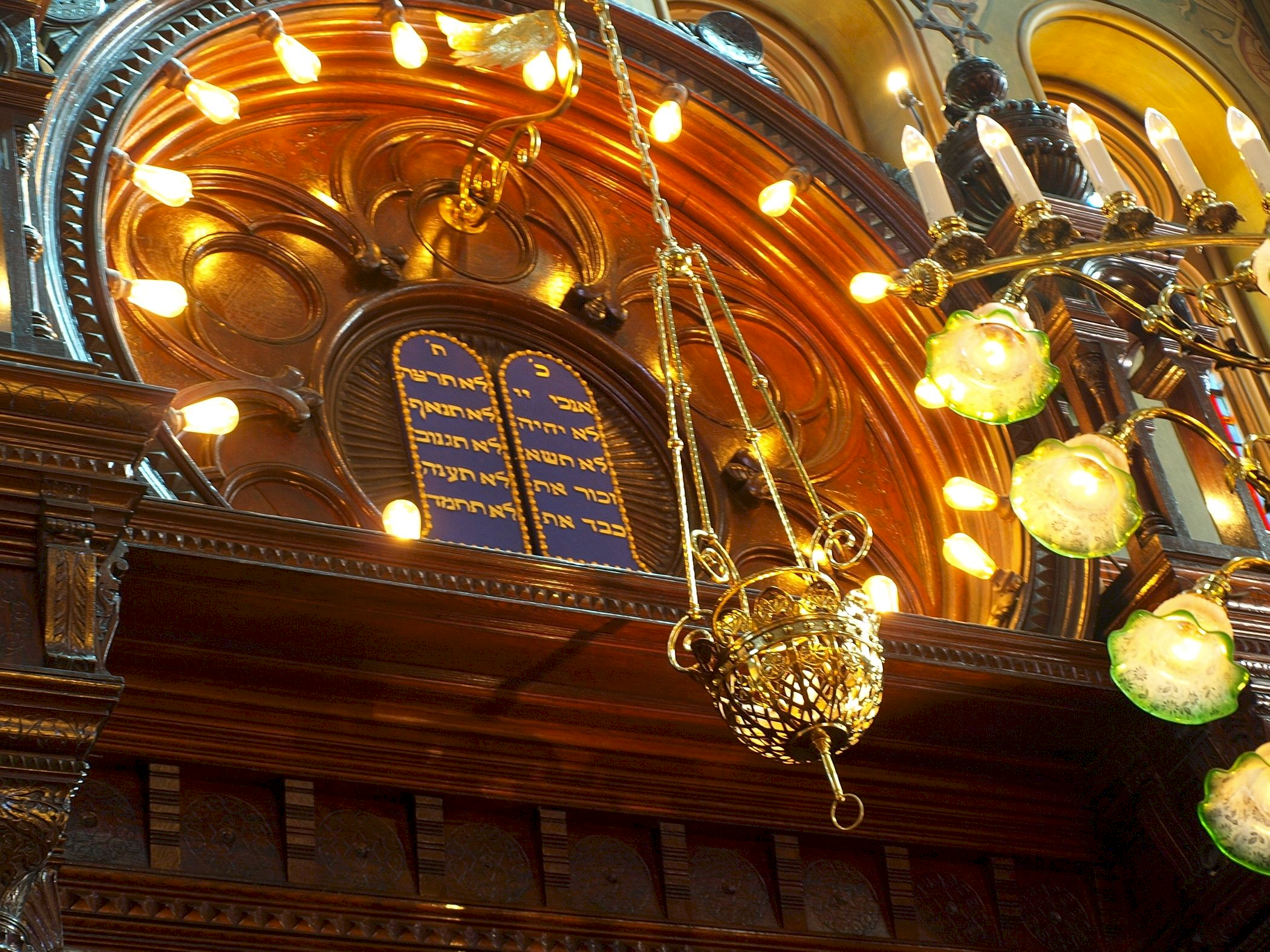 Ner Tamid before the Ark (Click for a larger image) |
20. “In the synagogue, right above the Holy Ark, stands the ner tamid, the “eternal flame.” Its name is derived from [this] verse in Exodus, where we read that an eternal flame was to burn on the golden menorah in the Holy Temple at all times. … In days gone by, the ner tamid was an actual flame. In the modern era, however, using light bulbs or LED lighting has become ubiquitous and perfectly acceptable.” (“Ner Tamid: The Eternal Light,” chabad.org, accessed 31 May 2022.) [BACK]
Notes on the Matthew Passage
24. The half-shekel Temple tax, called simply the didrachma because of the coin usually to pay it. A didrachma, or double-drachma, is a Greek silver coin worth two drachmas, about as much as two Roman denarii, or about two days’ wages. It was commonly used to pay the half-shekel Temple tax, because two drachmas were worth one-half shekel of silver. [BACK]
27a. Sometimes is it appropriate to set aside our personal liberties for the sake of avoiding offense. [BACK]
27b. A stater is a silver coin equivalent to four Attic or two Alexandrian drachmas, or a Jewish shekel: just exactly enough to cover the half-shekel temple tax for two people. [BACK]
Other commentaries on Exodus 27
Ellicott's Commentary for English Readers
Pulpit Commentary
Matthew Henry's Concise Commentary
Gill's Exposition of the Entire Bible
|
 |
Subscribe to my Substack/newsletter |

ANXIOUSLY WATCHING FOR MASHIACH’S RETURN,
SPEEDILY AND IN OUR DAY. MARANA, TA!


