
NEW: Please subscribe to my Substack/newsletter at the bottom of the page. Thanks!
Anthropology
or
What Torah Says About Humanity
Torah, Genesis, and Eternal Life
Click the picture to view in full screen

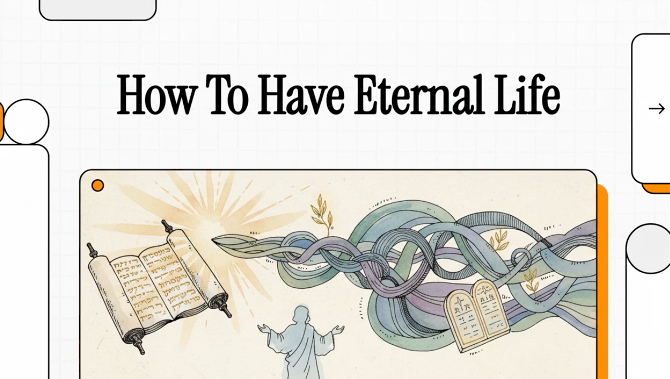 Watch the “Explainer” (5 minutes) |
|||
 |
Take “Deep Dive 1” into this section (36 minutes) Take Deep Dive 2 into this section (30 minutes)[1] |
Approx. reading time: 3 min. | |
The provided documents [in this section] outline the Messianic Systematic Theology of Dr. Rickard L. Sawyer and the Center for Messianic Learning,[2] emphasizing a literal interpretation[3] of the Hebrew Scriptures and the Jewish identity of Jesus. The author defines sin as the violation of Torah,[4] arguing that [Torah] remains in effect to set the standard for human conduct. Key theological stances include a Young Earth Creationist view, the sanctity of life from conception, and the belief that gender is biologically determined by God. Regarding salvation, the text asserts that eternal security is absolute, suggesting that true believers are chosen by God before creation and cannot lose their redeemed status.[5] Furthermore, the sources argue that genuine faith must be evidenced by obedience to biblical commandments[6] rather than mere intellectual or religious ritual. Ultimately, this framework seeks to reconnect modern believers with the first-century Jewish roots of their faith.
Man was originally created in the image of HaShem, by HaShem’s own hand and not by any process of evolution or natural selection, and was given the authority and ability to exercise dominion over the created world.
Adam wlfully chose to disobey HaShem, and because of his disobedience Adam, all of his descendants, and all of his entire dominion fell under HaShem’s curse. Sin, sickness, and death entered the world; man became alienated from HaShem and inherited a sin nature, is totally depraved, possesses no spark of divine life, and, of himself, is utterly helpless to remedy his lost condition apart from the grace of HaShem.
Full Disclosure: The Center for Messianic Learning is not affiliated with Beth Yeshua International, and the presence of Beth Yeshua content on this website does not imply an endorsement by Beth Yehua or by Rabbi Greg Hershberg. I consider Rabbi Greg “my rabbi” and I attend their worship services remotely at 10:10 a.m. Eastern Time every Shabbat and Holy Day either on Vimeo.com or on their YouTube channel. If you do not have a Messianic synagogue near you, may I suggest you do as I do. It is doubtful you will find a better Torah teacher — or a man who is more sold out for ADONAI and His Messiah — anywhere.
May 14, 2022 Life, Death, and the Afterlife (Part 1)
May 21, 2022 Life, Death, and the Afterlife (Part 2)
1. Unfortunately, I cannot correct the mispronunciation of Hebrew terms or inability to correctly parse chapter and verse references in these recordings. [BACK]
2. This summary is the unedited result of loading all of (and only) the pages in this section into NotebookLM and asking for a summary. As AIs are wont to do, NotebookLM misinterpreted the Calvinist position of some of the included or quoted content as my position and I have corrected the information in these footnotes. I considered simply not including this paragraph, but upon further consideration I decided to leave it in and use it to demonstrate the danger of simply accepting what the AI tells you as “truth” without verifying the source. [BACK]
3. I do not hold to a woodenly literal interpretation. Rather I believe that one can only understand the Scriptures when they are diligently studied (2Tim 2:15), which requires one to take a holistic (or better, wholistic) approach to the text including grammatical, literal, historical, dispensational, ethnical, and societal consideratons. See “Principles of Biblical Interpretation.” [BACK]
4. Most English translations say something equivalent to “Everyone who practices sin also practices lawlessness; and sin is lawlessness” (1John 3:4). “Lawlessness” represents Hebrew concept of being with or outside of Torah as witnessed by the Complete Jewish Bible rendering this sentence as “Everyone who keeps sinning is violating Torah — indeed, sin is violation of Torah.” So it is the Scripture, not "the author" who defines sin. [BACK]
5. This is covered more fully in the “Deep Dive 2” discussion. [BACK]
6. The actual idea presented in the source pages is that true redemption will produce the will and ability to live in pursuance of a Torah-centric lifestyle rather than one of habitual sin. [BACK]
|
 |
Subscribe to my Substack/newsletter |

ANXIOUSLY WATCHING FOR MASHIACH’S RETURN,
SPEEDILY AND IN OUR DAY. MARANA, TA!


