
NEW: Please subscribe to my Substack/newsletter at the bottom of the page. Thanks!
The summary of the entire Torah is as simple as this:
Love what HaShem loves; hate what HaShem hates.
All else is commentary.
בּמִדְבּר • B'midbar
(“In the Wilderness”)
The Fourth Book of Moses,
Commonly Called
Numbers

iv. Laws about Vows (30:1-16)
1 (29:40) Moshe told the people of Isra'el everything, just as ADONAI had commanded Moshe.
פָּרָשָׁה מַּטּוֹת
Parsha 42. Mattot |
|
|
[In regular years read with Parsha 43,
in leap years read separately] This week’s commentary from First Fruits of Zion (Messianic) This week's commentary from Chabad.org (Rabbinical) This week’s commentary from Hebrew4Christians.com (Christian) |
|
| [Go to Leap Year Reading Schedule] Regular Year Reading Schedule |
||
|
Sunday Review and meditate on last week’s Parsha Monday Rishon [1st]: 30:2(1)-31:12 Sheni [2nd]: 31:13-54 Tuesday Shlishi [3rd]: 32:1-19 R'vi'i [4th]: 32:20-33:49 Wednesday Chamishi [5th]: 33:50-34:15 Shishi [6th]: 34:16-35:8 |
Thursday Shvi'i [7th]: 35:9-36:9 Maftir [Concluding]: 36:10-13 Friday Haftarah: (Selections) Yirmeyahu (Jeremiah) 2:4–28; 3:4 (A) Yirmeyahu (Jeremiah) 2:4–28; 4:1–2 (S) Ketuvei HaShalichim (Apostolic Writings) Basar: The Gospel Mark 11:12-25 Kepherim: Letters (optional) Ya‘akov (James) 4:1–12 |
|
| Leap Year Reading Schedule | ||
|
Sunday Review and meditate on last week’s Parsha Monday Rishon [1st]: 30:2(1)-17(16) Sheni [2nd]: 31:1-12 Tuesday Shlishi [3rd]: 31:13-24 R'vi'i [4th]: 31:25-41 Wednesday Chamishi [5th]: 31:42-54 Shishi [6th]: 32:1-19 |
Thursday Shvi'i [7th]: 32:20-38 Maftir [Concluding]: 32:38-42 Friday Haftarah: (Selections) Yirmeyahu (Jeremiah) 1:1–2:3 Ketuvei HaShalichim (Apostolic Writings) Basar: The Gospel Mattityahu (Matthew) 5:33–37 |
|
TorahThe Blessing of the TorahClick here to listen to this canted byCantor Kenneth B. Cohen of Temple Sholom, Greenwich, CT. |
|
| Aliya: (the one who “goes up” to read) | |
|
Bar-khu et Adonai
ham-vor-ack. (Praise ADONAI Who is worthy to be praised.) |

|
| Congregation: | |
|
Ba-rookh Adonai ham-vor-ack
ley-oh-lam vah-ed. (Praise ADONAI Who is worthy to be praised for all eternity.) |

|
| All: | |
|
Ba-rookh Adonai ham-vor-ack
ley-oh-lam vah-ed. (Praise ADONAI Who is worthy to be praised for all eternity.) |
|
|
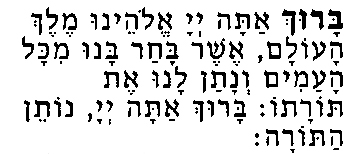
Ba-rookh ah-tah
Adonai, Eh-lo-hay-noo meh-lekh hah oh-lahm, ah-sher ba-char ba-noo me-kol ha-ahmeem, v’na-tahn lah-noo et torah-toe, ba-rookh ah-tah Adonai, no-tane hah-torah. Blessed are You, O Lord our God, King of the Universe, Who has chosen us from all peoples and given us His Torah. Blessed are You, O Lord, Giver of the Torah. |
 |
Listen to Parashah Mattot read from the Complete Jewish Bible
(i) 2 (1) Moshe tolf the heads of the clans of the people of Isra'el, “This is the thing which ADONAI has commanded: 3 (2) “When a man vows a vow to ADONAI, or swears an oath to bind his soul with a bond, he shall not break his word. He shall do according to all that proceeds out of his mouth.
4 (3) “When a woman vows a vow to ADONAI and binds herself by a pledge, being in her father’s house, in her youth, 5 (4) and her father hears her vow and her pledge with which she has bound her soul, and her father says nothing to her, then all her vows shall stand, and every pledge with which she has bound her soul shall stand. 6 (5) But if her father forbids her in the day that he hears, none of her vows or of her pledges with which she has bound her soul, shall stand. ADONAI will forgive her, because her father has forbidden her.
7 (6) “If she has a husband, while her vows are on her, or the rash utterance of her lips with which she has bound her soul, 8 (7) and her husband hears it, and says nothing to her in the day that he hears it; then her vows shall stand, and her pledges with which she has bound her soul shall stand. 9 (8) But if her husband forbids her in the day that he hears it, then he makes void her vow which is on her and the rash utterance of her lips, with which she has bound her soul, ADONAI will forgive her.
10 (9) “But the vow of a widow, or of her who is divorced, everything with which she has bound her soul shall stand against her.
11 (10) “If she vowed in her husband’s house or bound her soul by a bond with an oath, 12 (11) and her husband heard it, and held his peace at her and didn’t disallow her, then all her vows shall stand, and every pledge with which she bound her soul shall stand. 13 (12) But if her husband made them null and void in the day that he heard them, then whatever proceeded out of her lips concerning her vows, or concerning the bond of her soul, shall not stand. Her husband has made them void, ADONAI will forgive her. 14 (13) Every vow, and every binding oath to afflict the soul, her husband may establish it, or her husband may make it void. 15 (14) But if her husband says nothing to her from day to day, then he establishes all her vows or all her pledges which are on her. He has established them, because he said nothing to her in the day that he heard them. 16 (15) But if he makes them null and void after he has heard them, then he shall bear her iniquity.”
17 (16) These are the statutes which ADONAI commanded Moshe, between a man and his wife, between a father and his daughter, being in her youth, in her father’s house.
|
 |
Subscribe to my Substack/newsletter |

ANXIOUSLY WATCHING FOR MASHIACH’S RETURN,
SPEEDILY AND IN OUR DAY. MARANA, TA!


