
NEW: Please subscribe to my Substack/newsletter at the bottom of the page. Thanks!
Parsha 34. B’midbar
(continued)

5. The Duties of the Clans of Levi (4:1-33)
a. The Kohathites (4:1-20)
(vii) 1 Then ADONAI told Moshe and Aharon, 2 “Count the descendants of K’hat from among the descendants of Levi, by their clans and families, 3 men from thirty years old and up to fifty years old, everyone who is qualified to serve in the work of the Tent of Meeting.
4 “This is the service of the descendants of K’hat in the Tent of Meeting concerning the most holy things. 5 Whenever the camp is ready to set out, Aharon and his sons are to go in and take down the veil of the curtain and cover the Ark of the Testimony with it. 6 Then they are to put a fine leather cover over it, spread a solid blue cloth over that, then insert its carrying-poles.
7 “On the table of showbread they are to spread a blue cloth and put on it the dishes, the incense pans, the offering bowls, and the pitchers; but the perpetual bread is to be left on the table. 8 They are to cover all that with a scarlet cloth, then cover it all with a covering of fine leather and insert its carrying-poles.
9 “They are to take a blue cloth and cover the menorah of the light, its lamps, its snuffers, its snuff dishes, and the jars that are used to add oil to it. 10 They are to wrap it and all its accessories within a covering of fine leather, and put it on a carrying-frame.
11 “On the gold altar they are to spread a blue cloth, cover it with a covering of fine leather, and insert its carrying-poles.
12 “Then they are to take all the utensils for serving in the sanctuary and place them in a blue cloth, then cover them with a covering of fine leather and put them on a carrying-frame.
13 “They are to remove the greasy ashes from the altar, and spread a purple cloth over it 14 and put on it all its vessels used to serve there: the firepans, meat forks, shovels, and basins — all the equipment of the altar. They are to spread over it a covering of fine leather, and insert its carrying-poles.
15 “When Aharon and his sons have finished covering the holy objects and all their equipment, as soon as the camp is ready to move forward, the descendants of K’hat are to come and carry them. But they must not touch the holy objects, or they will die. These are the transportation duties of the descendants of K’hat, to carry these things belonging to the Tent of Meeting.
16 “El‘azar ben Aharon the cohen is to oversee the oil for the light, the fragrant incense, the daily grain offering, and the anointing oil. He has oversight of the entire tabernacle and everything that is in it, including the holy objects and their implements.”
(Maftir) 17 Then ADONAI told Moshe and Aharon, 18 “Don’t allow the clan of the families of the K’hatites to be cut off from among the L’vi’im. 19 Do this for them so that they may live and not die when they approach the most holy things: Aharon and his sons are go in and assign everyone his task and what he is to carry; 20 but they must not go in and look at the holy objects, not even for a moment, or they will die.”
The Blessing After TorahClick here to listen to this canted byCantor Kenneth B. Cohen of Temple Sholom, Greenwich, CT |
|
|
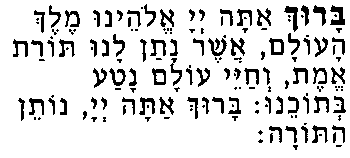
Ba-rookh ah-tah Adonai,
eh-lo-hay-noo meh-lech hah-ohlahm, ah-sher nah-tahn la-noo toe-raht eh-met, v’cha-yaye oh-lahm nah-tah b’toe-chay-noo. Ba-rookh ah-tah Adonai, no-tain ha-to-rah. Blessed are you, O Lord our God, King of the Universe, Who has given us a Torah of truth, and has planted eternal life in our midst. Blessed are You, O Lord, Giver of the Torah. |
|
Now that you've read Parsha B'midbar listen to
Rabbi Greg Hershberg teach from the text
Haftarah
The Blessing of the Haftarah
Click here
to listen to this canted |
|
|
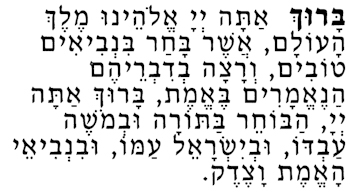
Ba-rookh, ah-tah Adonai, eh-lo-hay-noo, Ba-rookh ah-tah, Adonai, Blessed are you, O Lord our God, Blessed are You, O Lord, |
|
Haftarah B’midbar is Hoshea (Hosea) 2:1(1:10)–2:22(20)[GN]
Listen to it read from the Complete Jewish Bible
1 (1:10) Yet the number of the people of Isra'el will be as the sand of the sea, which can’t be measured or counted; and it will come to pass that, in the place where it was said to them, ‘You are not My people,’ they will be called ‘sons of the living God.’ 2 (1:11) The children of Y’hudah and the people of Isra'el will be gathered together, and they will appoint themselves one head, and will go up from the land; for great will be the day of Yizre‘el.
3 (1) “Say to your brothers, ‘Ammi“My people”’
and to your sisters, ‘Ruhamah“pitied” or “My loved one”’
4 (2) Contend with your mother!
Contend, for she is not my wife,
neither am I her husband;
and let her put away her prostitution from her face,
and her adulteries from between her breasts;
and make her bare as in the day that she was born,
and make her like a wilderness,
and set her like a dry land,
and kill her with thirst.
6 (4) Indeed, on her children I will have no mercy,
for they are children of unfaithfulness.
7 (5) For their mother has played the prostitute.
She who conceived them has done shamefully;
for she said, ‘I will go after my lovers,
who give me my bread and my water,
my wool and my flax,
my oil and my drink.’
8 (6) Therefore hinneh,[GN] I will hedge up your way with thorns,
and I will build a wall against her,
that she can’t find her way.
9 (7) She will follow after her lovers,
but she won’t overtake them;
and she will seek them,
but won’t find them.
Then she will say, ‘I will go and return to my first husband,
for then it was better with me than now.’
10 (8) For she didn’t know that I gave her the grain, the new wine, and the oil,
and multiplied to her silver and gold, which they used for Baal.
11 (9) Therefore I will take back my grain in its time,
and my new wine in its season,
and will pluck away my wool and my flax which should have covered her nakedness.
12 (10) Now I will uncover her lewdness in the sight of her lovers,
and no one will deliver her out of my hand.
13 (11) I will also cause all her celebrations to cease:
her feasts, her new moons, her Sabbaths, and all her solemn assemblies.
14 (12) I will lay waste her vines and her fig trees,
about which she has said, ‘These are my wages that my lovers have given me,’
and I will make them a forest,
and the animals of the field shall eat them.
15 (13) I will visit on her the days of the Baals,
to which she burned incense
when she decked herself with her earrings and her jewels,
and went after her lovers
and forgot me,” says ADONAI.
16 (14) “Therefore Hinneh, I will allure her,
and bring her into the wilderness,
and speak tenderly to her.
17 (15) I will give her vineyards from there,
and the valley of Achor for a door of hope;
and she will respond there
as in the days of her youth,
and as in the day when she came up out of the land of Egypt.
16 (16) It will be in that day,” says ADONAI,
“that you will call Me Ishi“My husband”,’
and no longer call Me Ba'alli“my master”.’
19 (17) For I will take away the names of the ba'alim[GN] out of her mouth,
and they will no longer be mentioned by name.
20 (18) In that day I will make a covenant for them with the animals of the field,
and with the birds of the sky,
and with the creeping things of the ground.
I will break the bow, the sword, and the battle out of the land,
and will make them lie down safely.
21 (19) I will betroth you to me forever.
Yes, I will betroth you to me in righteousness, in justice, in loving kindness, and in compassion.
22 (20) I will even betroth you to me in faithfulness;
and you shall know ADONAI.
Ketuvei HaShalichim (Apostolic Writings)
The Blessing of the Ketuvei HaShalichimClick here to listen to this canted byJeremiah Greenberg of Messianic Liturgical Resources. Page numbers refer to his Messianic Shabbat Siddur. |
|
|
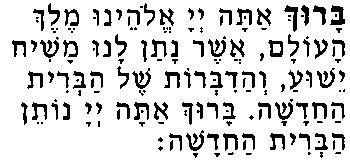
Bah-rookh ah-tah Adonai, Eh-lo-hay-noo meh-lekh hah-ohlahm, ah-shehr nah-tahn la-noo mah-she-ahch Yeshua, v’ha-deebrote shell Ha-breet Ha-kha-da-shah, ba-rookh ah-ta Adonai, notain Hah-breet Hah-kha-da-shah. Blessed are You, O Lord our God, |
 |
Basar
(Gospel)
Luke 2:1–7
1It was at that time [the 25th year of the reign of Caesar Agustus] that Caesar Augustus ordered a census to be taken of all his Empire. 2This was the first census of its kind, taken when Quirinius was governor of Syria [3-2 BCE]. 3Everyone went to his home town to be registered. 4Because he was a descendant of David, YosefJoseph went up from NatzeretNazareth in the GalilGalilee to the city of David, Beit-LechemBethlehem, House of Bread, in Y'hudahJudea, 5to register himself and MyriamMary, to whom he was engaged and who was pregnant.
6While they were there, the time came for her to give birth, 7and she delivered her first child, a Son. She wrapped Him in bands of cloth, and laid Him on the food tray of the sukkahtemporary dwelling erected especnaily for the festival they were staying in, because there was no space for them in the living quarters.
Kepherim (Letters, optional)
1 Corinthians 12:12–31
12 For as the body is one and has many members, and all the members of the body, being many, are one body; so also is Messiah. 13 For in one Spirit we were all immersed into one body, whether Jews or Greeks, whether bond or free; and were all given to drink into one Spirit.
14 For the body is not one member, but many. 15 If the foot would say, “Because I’m not the hand, I’m not part of the body,” it is not therefore not part of the body. 16 If the ear would say, “Because I’m not the eye, I’m not part of the body,” it’s not therefore not part of the body. 17 If the whole body were an eye, where would the hearing be? If the whole were hearing, where would the smelling be? 18 But now God has set the members, each one of them, in the body, just as he desired. 19 If they were all one member, where would the body be? 20 But now they are many members, but one body. 21 The eye can’t tell the hand, “I have no need for you,” or again the head to the feet, “I have no need for you.” 22 No, much rather, those members of the body which seem to be weaker are necessary. 23 Those parts of the body which we think to be less honorable, on those we bestow more abundant honor; and our unpresentable parts have more abundant modesty, 24 while our presentable parts have no such need. But God composed the body together, giving more abundant honor to the inferior part, 25 that there should be no division in the body, but that the members should have the same care for one another. 26 When one member suffers, all the members suffer with it. When one member is honored, all the members rejoice with it.
27 Now you are the body of Messiah, and members individually. 28 God has set some in the assembly: first emissaries, second prophets, third teachers, then miracle workers, then gifts of healings, helps, governments, and various kinds of languages. 29 Are all emissaries? Are all prophets? Are all teachers? Are all miracle workers? 30 Do all have gifts of healings? Do all speak with various languages? Do all interpret? 31 But earnestly desire the best gifts. Moreover, I show a most excellent way to you.
The Blessing After the Ketuvei HaShalichimClick here to listen to this canted byJeremiah Greenberg of Messianic Liturgical Resources. Page numbers refer to his Messianic Shabbat Siddur. |
|
|
Ba-rookh ah-tah, Adonai Eh-lo-hay-noo, Blessed are You, O Lord our God, |
 |
The Blessing of the MessiahClick here to listen to this canted byJeremiah Greenberg of Messianic Liturgical Resources. Page numbers refer to his Messianic Shabbat Siddur. |
|
|
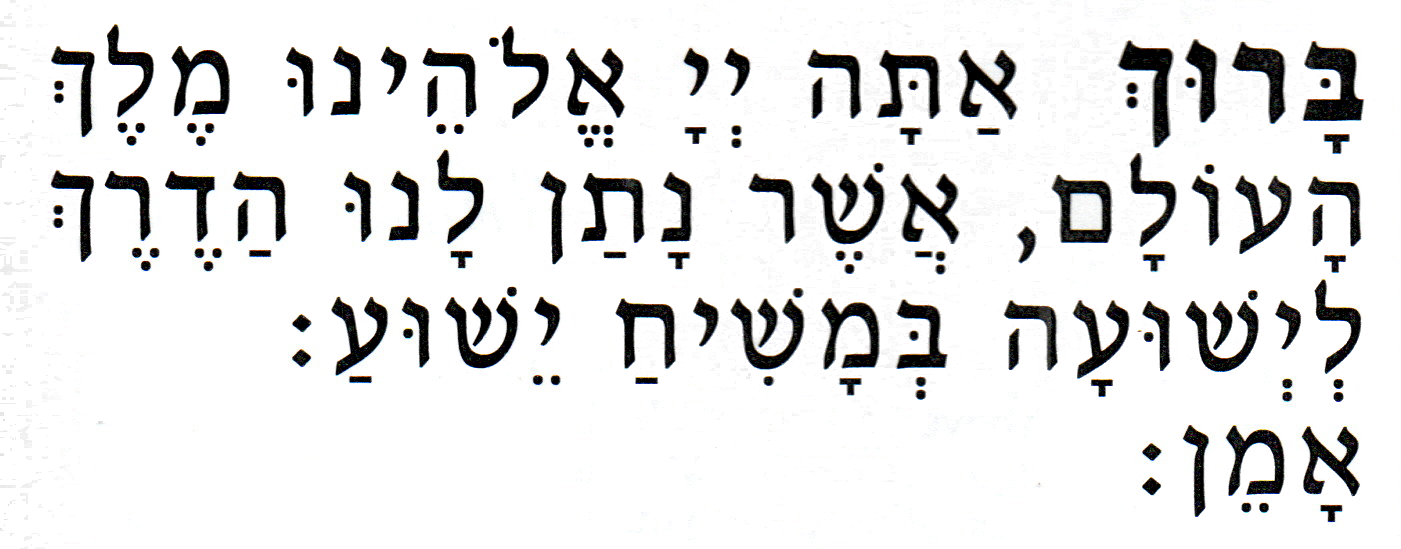
Ba-rookh ah-tah Adonai Eh-lo-hay-noo,
meh-lekh hah-oh-lahm, ah-sher na-tahn la-noo ha-deh-rech l'y'shoo-ah b'ma-she-ahch Yeshua. Ah-mein. Blessed are You, O Lord our God,
King of the Universe, |
 |

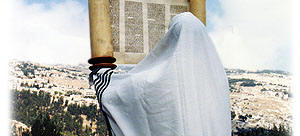
פָּרָשָׁה נָשֹׂא
Parsha 35: Naso |
|
|
This week’s commentary from First Fruits of Zion (Messianic) |
|
| This Week’s Reading Schedule | ||
|
Sunday Review and meditate on last week’s Parsha Monday Rishon [1st]: (S) 4:21-33 (A) 4:21-37 Sheni [2nd]: (S) 4:32-49 (A) 4:38-49 Tuesday Shlishi [3rd]: (S) 5:1-6:27 (A) 5:1-10 R'vi'i [4th]: (S) 7:1-11 (A) 5:11-6:27 |
Wednesday Chamishi [5th]: (S) 7:12-42 (A) 7:1-42 Shishi [6th]: 7:42-71 Thursday Shvi'i [7th]: 7:7-86 Maftir [Concluding]: 7:87-89 Friday Haftarah: (Selections) Shof’tim (Judges) 13:2–25 Ketuvei HaShalichim (Apostolic Writings) Basar: The Gospel Yochanan (John) 7:53–8:11 Kepherim: Letters (optional) Acts 21:17–32 |
|
TorahThe Blessing of the TorahClick here to listen to this canted byCantor Kenneth B. Cohen of Temple Sholom, Greenwich, CT. |
|
| Aliya: (the one who “goes up” to read) | |
|
Bar-khu et Adonai
ham-vor-ack. (Praise ADONAI Who is worthy to be praised.) |

|
| Congregation: | |
|
Ba-rookh Adonai ham-vor-ack
ley-oh-lam vah-ed. (Praise ADONAI Who is worthy to be praised for all eternity.) |

|
| All: | |
|
Ba-rookh Adonai ham-vor-ack
ley-oh-lam vah-ed. (Praise ADONAI Who is worthy to be praised for all eternity.) |
|
|
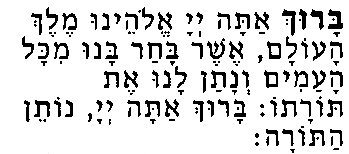
Ba-rookh ah-tah
Adonai, Eh-lo-hay-noo meh-lekh hah oh-lahm, ah-sher ba-char ba-noo me-kol ha-ahmeem, v’na-tahn lah-noo et torah-toe, ba-rookh ah-tah Adonai, no-tane hah-torah. Blessed are You, O Lord our God, King of the Universe, Who has chosen us from all peoples and given us His Torah. Blessed are You, O Lord, Giver of the Torah. |
 |
Listen to Parsha Naso read from the Complete Jewish Bible
b. The Gershonites (4:21-28)
(i) 21 And ADONAI told Moshe, 22 “Count[22] the descendants of Gershon as well, by their clans and families; 23 you are to count everyone who is qualified to perform the service in the Tent of Meeting, from thirty years old to fifty years old.
24 “This is the service of the families of the Gershonites regarding their serving and transport: 25 they are carry the curtains of the tabernacle, the Tent of Meeting with its covering of fine leather that is over it, the curtains for the entrance to the Tent of Meeting, 26 the cortains of the courtyard, and the curtain for the entrance to the gate of the courtyard which surrounds the tabernacle and the altar, along with their ropes and all the equipment for their service. They are to do everything that needs to be done with these items. 27 All the service of the Gershon clan, all their transportation duties and other work is to be done under the direction of Aharon and his sons; you are to assign to them all they are responsible to carry. 28 This is the service of the Gershon families at the Tent of Meeting, and all their duties is to be under the supervision of Itamar ben Aharon the cohen.
c. The Merarites (4:29-33)
29 “As for the descendants of M’rari, you are to count them by their clans and families, 30 all the men from thirty to fifty years old — everyone who enters on the service in the work of the Tent of Meeting. 31 This is their transportation duty associated with the Tent of Meeting: they are to carry the tabernacle’s frames, crossbars, posts and bases, 32 the posts of the surrounding courtyard, their bases, tent pegs, and ropes, including all their equipment, everything related to their use. You are to assign by name the items they are responsible to carry. 33 This is the service of the families of the descendants of M’rari, according to all their work at the Tent of Meeting, under the supervision of Itamar ben Aharon the cohen.”
6. The Numbering of the Levites from Thirty to Fifty (4:34-49)
(S: ii) 34 So Moshe and Aharon and the leaders of the community counted the descendants of K’hat by their families, and by their clans, 35 everyone from thirty to fifty years old who came to serve in the work at the Tent of Meeting. 36 Those who were counted by their clans totaled 2,750. 37 These were counted of the K’hat clans, everyone who could serve in the Tent of Meeting. Moshe and Aharon numbered them as ADONAI had commanded Moshe.
(A: ii) 38 Those who were counted of the descendants of Gershon, by their clans and families, 39 every man from thirty to fifty years old who came to serve in the work at the Tent of Meeting, 40 all those who were counted by their clans and families numbered 2,650. 41 These were counted of the families of the descendants of Gershon, everyone who served in the Tent of Meeting, whom Moshe and Aharon counted as ADONAI had commanded.
42 And the descendants of M’rari were counted by their clans and families, 43 every man from thirty to fifty years old, everyone who came to serve in the work at the Tent of Meeting. 44 All the men who were counted by their clans and families numbered 3,200. 45 These were numbered of the families of the descendants of M’rari, whom Moshe and Aharon counted as ADONAI had commanded Moshe.
46 The total of those L’vi’im whom Moshe and Aharon and the leaders of Isra'el counted by their clans and families, 47 from thirty to fifty years old, everyone who came to do the work of service and duties of transporting the Tent of Meeting, 48 all of those who were counted numbered 8,580. 49 At ADONAI’s command they were counted through Moshe, and each one was assigned his work burden, as ADONAI had commanded Moshe.
22. “Count” can also be translated as “Take a census of.” Hence the two possible names for this Parsha. Also in verse 2. [BACK]
|
 |
Subscribe to my Substack/newsletter |

ANXIOUSLY WATCHING FOR MASHIACH’S RETURN,
SPEEDILY AND IN OUR DAY. MARANA, TA!


